Jiaying Zhu , Yingying Zhu , Hui Li , Caili Fu , Weimin Yin , Chunbao Li
{"title":"解冻方式影响冷冻牛肉的品质和蛋白质变性","authors":"Jiaying Zhu , Yingying Zhu , Hui Li , Caili Fu , Weimin Yin , Chunbao Li","doi":"10.1016/j.foodchem.2025.143484","DOIUrl":null,"url":null,"abstract":"<div><div>Balancing efficiency and meat quality during thawing remains a big challenge for meat industry. In this study, the effects of three thawing methods, including ultrasound-assisted thawing (UT), solid-state microwave thawing (SMT) and traditional air thawing (CT) on the thawing features, quality attributes and protein physicochemical properties of beef in a pilot scale, were investigated. COMSOL Multiphysics simulation was employed to optimize the thawing process, identifying an optimal endpoint of no more than −2 °C. Results showed that optimized SMT helpfully avoided overheating, improved thawing efficiency and kept better water-holding capacity, microstructure and lower oxidation. In contrast, UT maintained better protein conformation and color, especially in a* value, but serious mechanical damage caused worse texture and aggravated protein oxidation, which limited its application. Thus, SMT could be a promising solution for industrial meat thawing applications.</div></div>","PeriodicalId":318,"journal":{"name":"Food Chemistry","volume":"476 ","pages":"Article 143484"},"PeriodicalIF":9.8000,"publicationDate":"2025-06-01","publicationTypes":"Journal Article","fieldsOfStudy":null,"isOpenAccess":false,"openAccessPdf":"","citationCount":"0","resultStr":"{\"title\":\"Thawing methods affect quality properties and protein denaturation of frozen beef\",\"authors\":\"Jiaying Zhu , Yingying Zhu , Hui Li , Caili Fu , Weimin Yin , Chunbao Li\",\"doi\":\"10.1016/j.foodchem.2025.143484\",\"DOIUrl\":null,\"url\":null,\"abstract\":\"<div><div>Balancing efficiency and meat quality during thawing remains a big challenge for meat industry. In this study, the effects of three thawing methods, including ultrasound-assisted thawing (UT), solid-state microwave thawing (SMT) and traditional air thawing (CT) on the thawing features, quality attributes and protein physicochemical properties of beef in a pilot scale, were investigated. COMSOL Multiphysics simulation was employed to optimize the thawing process, identifying an optimal endpoint of no more than −2 °C. Results showed that optimized SMT helpfully avoided overheating, improved thawing efficiency and kept better water-holding capacity, microstructure and lower oxidation. In contrast, UT maintained better protein conformation and color, especially in a* value, but serious mechanical damage caused worse texture and aggravated protein oxidation, which limited its application. Thus, SMT could be a promising solution for industrial meat thawing applications.</div></div>\",\"PeriodicalId\":318,\"journal\":{\"name\":\"Food Chemistry\",\"volume\":\"476 \",\"pages\":\"Article 143484\"},\"PeriodicalIF\":9.8000,\"publicationDate\":\"2025-06-01\",\"publicationTypes\":\"Journal Article\",\"fieldsOfStudy\":null,\"isOpenAccess\":false,\"openAccessPdf\":\"\",\"citationCount\":\"0\",\"resultStr\":null,\"platform\":\"Semanticscholar\",\"paperid\":null,\"PeriodicalName\":\"Food Chemistry\",\"FirstCategoryId\":\"97\",\"ListUrlMain\":\"https://www.sciencedirect.com/science/article/pii/S0308814625007356\",\"RegionNum\":1,\"RegionCategory\":\"农林科学\",\"ArticlePicture\":[],\"TitleCN\":null,\"AbstractTextCN\":null,\"PMCID\":null,\"EPubDate\":\"2025/2/18 0:00:00\",\"PubModel\":\"Epub\",\"JCR\":\"Q1\",\"JCRName\":\"CHEMISTRY, APPLIED\",\"Score\":null,\"Total\":0}","platform":"Semanticscholar","paperid":null,"PeriodicalName":"Food Chemistry","FirstCategoryId":"97","ListUrlMain":"https://www.sciencedirect.com/science/article/pii/S0308814625007356","RegionNum":1,"RegionCategory":"农林科学","ArticlePicture":[],"TitleCN":null,"AbstractTextCN":null,"PMCID":null,"EPubDate":"2025/2/18 0:00:00","PubModel":"Epub","JCR":"Q1","JCRName":"CHEMISTRY, APPLIED","Score":null,"Total":0}
Thawing methods affect quality properties and protein denaturation of frozen beef
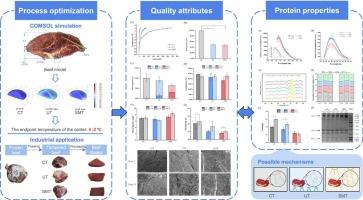
Balancing efficiency and meat quality during thawing remains a big challenge for meat industry. In this study, the effects of three thawing methods, including ultrasound-assisted thawing (UT), solid-state microwave thawing (SMT) and traditional air thawing (CT) on the thawing features, quality attributes and protein physicochemical properties of beef in a pilot scale, were investigated. COMSOL Multiphysics simulation was employed to optimize the thawing process, identifying an optimal endpoint of no more than −2 °C. Results showed that optimized SMT helpfully avoided overheating, improved thawing efficiency and kept better water-holding capacity, microstructure and lower oxidation. In contrast, UT maintained better protein conformation and color, especially in a* value, but serious mechanical damage caused worse texture and aggravated protein oxidation, which limited its application. Thus, SMT could be a promising solution for industrial meat thawing applications.
期刊介绍:
Food Chemistry publishes original research papers dealing with the advancement of the chemistry and biochemistry of foods or the analytical methods/ approach used. All papers should focus on the novelty of the research carried out.





 京公网安备 11010802042870号
京ICP备2023020795号-1
京公网安备 11010802042870号
京ICP备2023020795号-1

 分享
分享
 求助内容:
求助内容: 应助结果提醒方式:
 扫码关注我们
