Myung Hwan Bae , Seung Han Kim , Hong Min Seung , Joo Hwan Oh
{"title":"非线性单原子-双原子可转换超材料的开带隙","authors":"Myung Hwan Bae , Seung Han Kim , Hong Min Seung , Joo Hwan Oh","doi":"10.1016/j.ijmecsci.2025.110067","DOIUrl":null,"url":null,"abstract":"<div><div>Elastic metamaterials with nonlinearity have been actively studied recently due to their capability of bandgap tuning via wave amplitude. Nevertheless, previous approaches generally focused on tuning bandgap which was already formed without nonlinearities, so that they shared same limitations as in the linear bandgap cases. In this work, we propose a new nonlinear metamaterial that can open a non-existing bandgap or close the existing bandgap with nonlinear effect. The main idea is to utilize the transition between monoatomic and diatomic chains. To achieve the transition, we introduced alternating nonlinearity by using different bounding springs for even and odd masses. To theoretically describe the bandgap opening phenomena, we found that the general <em>Lindstedt-Poincaré</em> perturbation cannot be applied in the proposed metamaterial, so we applied <em>Brillouin-Wigner</em> perturbation. The proposed idea is validated with numerical simulation results. We expect our idea may extend the practical usability of nonlinear bandgap tunings and offer abundant new approaches to facilitate various advanced functionalities.</div></div>","PeriodicalId":56287,"journal":{"name":"International Journal of Mechanical Sciences","volume":"289 ","pages":"Article 110067"},"PeriodicalIF":9.4000,"publicationDate":"2025-03-01","publicationTypes":"Journal Article","fieldsOfStudy":null,"isOpenAccess":false,"openAccessPdf":"","citationCount":"0","resultStr":"{\"title\":\"Opening Bandgap in monoatomic-diatomic convertible metamaterial with nonlinearity\",\"authors\":\"Myung Hwan Bae , Seung Han Kim , Hong Min Seung , Joo Hwan Oh\",\"doi\":\"10.1016/j.ijmecsci.2025.110067\",\"DOIUrl\":null,\"url\":null,\"abstract\":\"<div><div>Elastic metamaterials with nonlinearity have been actively studied recently due to their capability of bandgap tuning via wave amplitude. Nevertheless, previous approaches generally focused on tuning bandgap which was already formed without nonlinearities, so that they shared same limitations as in the linear bandgap cases. In this work, we propose a new nonlinear metamaterial that can open a non-existing bandgap or close the existing bandgap with nonlinear effect. The main idea is to utilize the transition between monoatomic and diatomic chains. To achieve the transition, we introduced alternating nonlinearity by using different bounding springs for even and odd masses. To theoretically describe the bandgap opening phenomena, we found that the general <em>Lindstedt-Poincaré</em> perturbation cannot be applied in the proposed metamaterial, so we applied <em>Brillouin-Wigner</em> perturbation. The proposed idea is validated with numerical simulation results. We expect our idea may extend the practical usability of nonlinear bandgap tunings and offer abundant new approaches to facilitate various advanced functionalities.</div></div>\",\"PeriodicalId\":56287,\"journal\":{\"name\":\"International Journal of Mechanical Sciences\",\"volume\":\"289 \",\"pages\":\"Article 110067\"},\"PeriodicalIF\":9.4000,\"publicationDate\":\"2025-03-01\",\"publicationTypes\":\"Journal Article\",\"fieldsOfStudy\":null,\"isOpenAccess\":false,\"openAccessPdf\":\"\",\"citationCount\":\"0\",\"resultStr\":null,\"platform\":\"Semanticscholar\",\"paperid\":null,\"PeriodicalName\":\"International Journal of Mechanical Sciences\",\"FirstCategoryId\":\"5\",\"ListUrlMain\":\"https://www.sciencedirect.com/science/article/pii/S0020740325001535\",\"RegionNum\":1,\"RegionCategory\":\"工程技术\",\"ArticlePicture\":[],\"TitleCN\":null,\"AbstractTextCN\":null,\"PMCID\":null,\"EPubDate\":\"2025/2/15 0:00:00\",\"PubModel\":\"Epub\",\"JCR\":\"Q1\",\"JCRName\":\"ENGINEERING, MECHANICAL\",\"Score\":null,\"Total\":0}","platform":"Semanticscholar","paperid":null,"PeriodicalName":"International Journal of Mechanical Sciences","FirstCategoryId":"5","ListUrlMain":"https://www.sciencedirect.com/science/article/pii/S0020740325001535","RegionNum":1,"RegionCategory":"工程技术","ArticlePicture":[],"TitleCN":null,"AbstractTextCN":null,"PMCID":null,"EPubDate":"2025/2/15 0:00:00","PubModel":"Epub","JCR":"Q1","JCRName":"ENGINEERING, MECHANICAL","Score":null,"Total":0}
Opening Bandgap in monoatomic-diatomic convertible metamaterial with nonlinearity
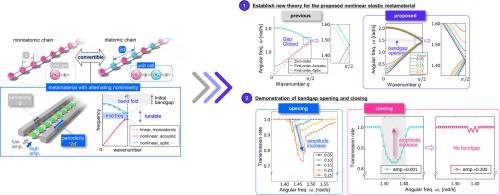
Elastic metamaterials with nonlinearity have been actively studied recently due to their capability of bandgap tuning via wave amplitude. Nevertheless, previous approaches generally focused on tuning bandgap which was already formed without nonlinearities, so that they shared same limitations as in the linear bandgap cases. In this work, we propose a new nonlinear metamaterial that can open a non-existing bandgap or close the existing bandgap with nonlinear effect. The main idea is to utilize the transition between monoatomic and diatomic chains. To achieve the transition, we introduced alternating nonlinearity by using different bounding springs for even and odd masses. To theoretically describe the bandgap opening phenomena, we found that the general Lindstedt-Poincaré perturbation cannot be applied in the proposed metamaterial, so we applied Brillouin-Wigner perturbation. The proposed idea is validated with numerical simulation results. We expect our idea may extend the practical usability of nonlinear bandgap tunings and offer abundant new approaches to facilitate various advanced functionalities.
期刊介绍:
The International Journal of Mechanical Sciences (IJMS) serves as a global platform for the publication and dissemination of original research that contributes to a deeper scientific understanding of the fundamental disciplines within mechanical, civil, and material engineering.
The primary focus of IJMS is to showcase innovative and ground-breaking work that utilizes analytical and computational modeling techniques, such as Finite Element Method (FEM), Boundary Element Method (BEM), and mesh-free methods, among others. These modeling methods are applied to diverse fields including rigid-body mechanics (e.g., dynamics, vibration, stability), structural mechanics, metal forming, advanced materials (e.g., metals, composites, cellular, smart) behavior and applications, impact mechanics, strain localization, and other nonlinear effects (e.g., large deflections, plasticity, fracture).
Additionally, IJMS covers the realms of fluid mechanics (both external and internal flows), tribology, thermodynamics, and materials processing. These subjects collectively form the core of the journal's content.
In summary, IJMS provides a prestigious platform for researchers to present their original contributions, shedding light on analytical and computational modeling methods in various areas of mechanical engineering, as well as exploring the behavior and application of advanced materials, fluid mechanics, thermodynamics, and materials processing.




 京公网安备 11010802042870号
京ICP备2023020795号-1
京公网安备 11010802042870号
京ICP备2023020795号-1

 分享
分享
 求助内容:
求助内容: 应助结果提醒方式:
 扫码关注我们
