{"title":"下肢肌肉力量与晚期或复发肺癌患者的预后相关:一项回顾性观察性研究","authors":"Takuya Fukushima, Utae Katsushima, Naoya Ogushi, Kimitaka Hase, Jiro Nakano","doi":"10.1186/s12885-025-13728-6","DOIUrl":null,"url":null,"abstract":"<p><strong>Background: </strong>We aimed to examine associations between various sarcopenia indices-including skeletal muscle index (SMI), handgrip strength, lower-extremity muscle strength, a combined measure of handgrip and lower-extremity muscle strength, sarcopenia (defined as a combination of SMI and muscle strength), and the SARC-F questionnaire-and all-cause mortality in patients with advanced or recurrent lung cancer. Moreover, we aimed to identify factors influencing sarcopenia indices that demonstrate strong correlations with prognosis, aiming to inform the development of targeted interventional strategies.</p><p><strong>Methods: </strong>This retrospective observational study enrolled outpatients with lung cancer who underwent chemotherapy. Patients were evaluated for sarcopenia indices, including SMI, handgrip strength, five-repetition sit-to-stand test (5STS), and SARC-F. Physical activity was assessed using the International Physical Activity Questionnaire-Short Form (IPAQ-SF). The log-rank test and Cox proportional hazards model, adjusted for confounders, were used to examine the association between the sarcopenia index and prognosis. Harrell's concordance index (C-index) was used to quantify the predictive power of the resultant model. To examine the significant factors associated with sarcopenia indices, which are associated with prognosis, multivariate logistic regression analysis was performed.</p><p><strong>Results: </strong>There was a significant association between low handgrip strength (hazard ratio [HR], 2.73; 95% confidence interval [CI], 1.20-6.25; P = 0.017), 5STS ≥ 12 s (low lower-extremity muscle strength) (HR, 2.32; 95% CI, 1.23-4.36; P < 0.01), the combination of low handgrip strength and 5STS ≥ 12 s (HR, 2.37; 95% CI, 1.23-4.57; P = 0.010), and sarcopenia (defined as a combination of SMI and muscle strength) (HR, 2.07; 95% CI, 1.02-4.21; P = 0.044) and survival, whereas there was no significant association between SMI (HR, 1.62; 95% CI, 0.74-3.53; P = 0.20) and SARC-F (HR, 2.07; 95% CI, 0.97-4.43; P = 0.061) and survival. The C-index for handgrip strength and 5STS was 0.625 (95% CI: 0.624-0.627) and 0.635 (95% CI: 0.634-0.636), respectively. Multivariate logistic analysis adjusted for age, sex, clinical stage, and treatment line showed that IPAQ-SF was an independent significant factor associated with 5STS ≥ 12 s (odds ratio [OR], 9.31; 95% CI, 2.93-29.58; P < 0.001), the combination of low handgrip strength and 5STS ≥ 12 s (OR, 6.45; 95% CI, 2.10-19.81; P = 0.001), and sarcopenia (OR, 4.90; 95% CI, 1.52-15.84; P = 0.008).</p><p><strong>Conclusions: </strong>Handgrip strength and lower-extremity muscle strength were stronger predictors of prognosis compared to the SMI. Furthermore, physical inactivity was significantly associated with lower-extremity muscle strength. From a clinical perspective, evaluating lower-extremity strength and physical activity is essential, and implementing exercise interventions, including strategies to enhance physical activity levels, should be considered.</p>","PeriodicalId":9131,"journal":{"name":"BMC Cancer","volume":"25 1","pages":"282"},"PeriodicalIF":4.1000,"publicationDate":"2025-02-18","publicationTypes":"Journal Article","fieldsOfStudy":null,"isOpenAccess":false,"openAccessPdf":"https://www.ncbi.nlm.nih.gov/pmc/articles/PMC11834189/pdf/","citationCount":"0","resultStr":"{\"title\":\"Lower-extremity muscle strength is associated with prognosis in patients with advanced or recurrent lung cancer: a retrospective, observational study.\",\"authors\":\"Takuya Fukushima, Utae Katsushima, Naoya Ogushi, Kimitaka Hase, Jiro Nakano\",\"doi\":\"10.1186/s12885-025-13728-6\",\"DOIUrl\":null,\"url\":null,\"abstract\":\"<p><strong>Background: </strong>We aimed to examine associations between various sarcopenia indices-including skeletal muscle index (SMI), handgrip strength, lower-extremity muscle strength, a combined measure of handgrip and lower-extremity muscle strength, sarcopenia (defined as a combination of SMI and muscle strength), and the SARC-F questionnaire-and all-cause mortality in patients with advanced or recurrent lung cancer. Moreover, we aimed to identify factors influencing sarcopenia indices that demonstrate strong correlations with prognosis, aiming to inform the development of targeted interventional strategies.</p><p><strong>Methods: </strong>This retrospective observational study enrolled outpatients with lung cancer who underwent chemotherapy. Patients were evaluated for sarcopenia indices, including SMI, handgrip strength, five-repetition sit-to-stand test (5STS), and SARC-F. Physical activity was assessed using the International Physical Activity Questionnaire-Short Form (IPAQ-SF). The log-rank test and Cox proportional hazards model, adjusted for confounders, were used to examine the association between the sarcopenia index and prognosis. Harrell's concordance index (C-index) was used to quantify the predictive power of the resultant model. To examine the significant factors associated with sarcopenia indices, which are associated with prognosis, multivariate logistic regression analysis was performed.</p><p><strong>Results: </strong>There was a significant association between low handgrip strength (hazard ratio [HR], 2.73; 95% confidence interval [CI], 1.20-6.25; P = 0.017), 5STS ≥ 12 s (low lower-extremity muscle strength) (HR, 2.32; 95% CI, 1.23-4.36; P < 0.01), the combination of low handgrip strength and 5STS ≥ 12 s (HR, 2.37; 95% CI, 1.23-4.57; P = 0.010), and sarcopenia (defined as a combination of SMI and muscle strength) (HR, 2.07; 95% CI, 1.02-4.21; P = 0.044) and survival, whereas there was no significant association between SMI (HR, 1.62; 95% CI, 0.74-3.53; P = 0.20) and SARC-F (HR, 2.07; 95% CI, 0.97-4.43; P = 0.061) and survival. The C-index for handgrip strength and 5STS was 0.625 (95% CI: 0.624-0.627) and 0.635 (95% CI: 0.634-0.636), respectively. Multivariate logistic analysis adjusted for age, sex, clinical stage, and treatment line showed that IPAQ-SF was an independent significant factor associated with 5STS ≥ 12 s (odds ratio [OR], 9.31; 95% CI, 2.93-29.58; P < 0.001), the combination of low handgrip strength and 5STS ≥ 12 s (OR, 6.45; 95% CI, 2.10-19.81; P = 0.001), and sarcopenia (OR, 4.90; 95% CI, 1.52-15.84; P = 0.008).</p><p><strong>Conclusions: </strong>Handgrip strength and lower-extremity muscle strength were stronger predictors of prognosis compared to the SMI. Furthermore, physical inactivity was significantly associated with lower-extremity muscle strength. From a clinical perspective, evaluating lower-extremity strength and physical activity is essential, and implementing exercise interventions, including strategies to enhance physical activity levels, should be considered.</p>\",\"PeriodicalId\":9131,\"journal\":{\"name\":\"BMC Cancer\",\"volume\":\"25 1\",\"pages\":\"282\"},\"PeriodicalIF\":4.1000,\"publicationDate\":\"2025-02-18\",\"publicationTypes\":\"Journal Article\",\"fieldsOfStudy\":null,\"isOpenAccess\":false,\"openAccessPdf\":\"https://www.ncbi.nlm.nih.gov/pmc/articles/PMC11834189/pdf/\",\"citationCount\":\"0\",\"resultStr\":null,\"platform\":\"Semanticscholar\",\"paperid\":null,\"PeriodicalName\":\"BMC Cancer\",\"FirstCategoryId\":\"3\",\"ListUrlMain\":\"https://doi.org/10.1186/s12885-025-13728-6\",\"RegionNum\":2,\"RegionCategory\":\"医学\",\"ArticlePicture\":[],\"TitleCN\":null,\"AbstractTextCN\":null,\"PMCID\":null,\"EPubDate\":\"\",\"PubModel\":\"\",\"JCR\":\"Q2\",\"JCRName\":\"ONCOLOGY\",\"Score\":null,\"Total\":0}","platform":"Semanticscholar","paperid":null,"PeriodicalName":"BMC Cancer","FirstCategoryId":"3","ListUrlMain":"https://doi.org/10.1186/s12885-025-13728-6","RegionNum":2,"RegionCategory":"医学","ArticlePicture":[],"TitleCN":null,"AbstractTextCN":null,"PMCID":null,"EPubDate":"","PubModel":"","JCR":"Q2","JCRName":"ONCOLOGY","Score":null,"Total":0}
Lower-extremity muscle strength is associated with prognosis in patients with advanced or recurrent lung cancer: a retrospective, observational study.
Background: We aimed to examine associations between various sarcopenia indices-including skeletal muscle index (SMI), handgrip strength, lower-extremity muscle strength, a combined measure of handgrip and lower-extremity muscle strength, sarcopenia (defined as a combination of SMI and muscle strength), and the SARC-F questionnaire-and all-cause mortality in patients with advanced or recurrent lung cancer. Moreover, we aimed to identify factors influencing sarcopenia indices that demonstrate strong correlations with prognosis, aiming to inform the development of targeted interventional strategies.
Methods: This retrospective observational study enrolled outpatients with lung cancer who underwent chemotherapy. Patients were evaluated for sarcopenia indices, including SMI, handgrip strength, five-repetition sit-to-stand test (5STS), and SARC-F. Physical activity was assessed using the International Physical Activity Questionnaire-Short Form (IPAQ-SF). The log-rank test and Cox proportional hazards model, adjusted for confounders, were used to examine the association between the sarcopenia index and prognosis. Harrell's concordance index (C-index) was used to quantify the predictive power of the resultant model. To examine the significant factors associated with sarcopenia indices, which are associated with prognosis, multivariate logistic regression analysis was performed.
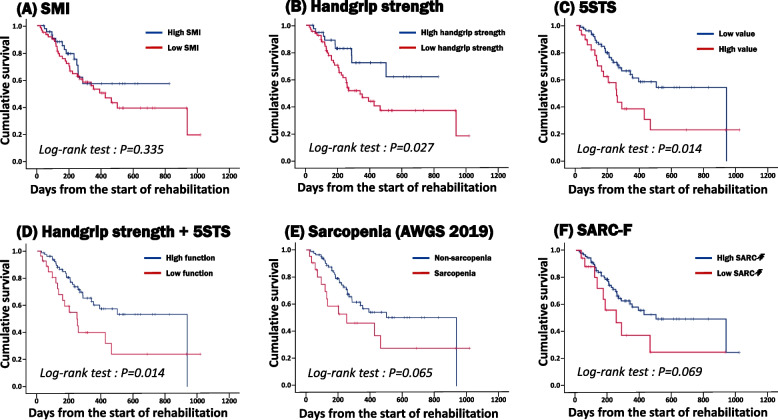
Results: There was a significant association between low handgrip strength (hazard ratio [HR], 2.73; 95% confidence interval [CI], 1.20-6.25; P = 0.017), 5STS ≥ 12 s (low lower-extremity muscle strength) (HR, 2.32; 95% CI, 1.23-4.36; P < 0.01), the combination of low handgrip strength and 5STS ≥ 12 s (HR, 2.37; 95% CI, 1.23-4.57; P = 0.010), and sarcopenia (defined as a combination of SMI and muscle strength) (HR, 2.07; 95% CI, 1.02-4.21; P = 0.044) and survival, whereas there was no significant association between SMI (HR, 1.62; 95% CI, 0.74-3.53; P = 0.20) and SARC-F (HR, 2.07; 95% CI, 0.97-4.43; P = 0.061) and survival. The C-index for handgrip strength and 5STS was 0.625 (95% CI: 0.624-0.627) and 0.635 (95% CI: 0.634-0.636), respectively. Multivariate logistic analysis adjusted for age, sex, clinical stage, and treatment line showed that IPAQ-SF was an independent significant factor associated with 5STS ≥ 12 s (odds ratio [OR], 9.31; 95% CI, 2.93-29.58; P < 0.001), the combination of low handgrip strength and 5STS ≥ 12 s (OR, 6.45; 95% CI, 2.10-19.81; P = 0.001), and sarcopenia (OR, 4.90; 95% CI, 1.52-15.84; P = 0.008).
Conclusions: Handgrip strength and lower-extremity muscle strength were stronger predictors of prognosis compared to the SMI. Furthermore, physical inactivity was significantly associated with lower-extremity muscle strength. From a clinical perspective, evaluating lower-extremity strength and physical activity is essential, and implementing exercise interventions, including strategies to enhance physical activity levels, should be considered.
期刊介绍:
BMC Cancer is an open access, peer-reviewed journal that considers articles on all aspects of cancer research, including the pathophysiology, prevention, diagnosis and treatment of cancers. The journal welcomes submissions concerning molecular and cellular biology, genetics, epidemiology, and clinical trials.






 京公网安备 11010802042870号
京ICP备2023020795号-1
京公网安备 11010802042870号
京ICP备2023020795号-1

 分享
分享
 求助内容:
求助内容: 应助结果提醒方式:
 扫码关注我们
