Grace Hanly, Elizabeth Campbell, Kate Bartlem, Julia Dray, Caitlin Fehily, Kim Colyvas, Tahlia Reynolds, Sandy Davidson, Sarah Yeun-Sim Jeong, John Wiggers, Luke Wolfenden, Jenny Bowman
{"title":"转介至人群水平电话指导服务以改善精神疾病患者健康风险行为的有效性:一项随机对照试验。","authors":"Grace Hanly, Elizabeth Campbell, Kate Bartlem, Julia Dray, Caitlin Fehily, Kim Colyvas, Tahlia Reynolds, Sandy Davidson, Sarah Yeun-Sim Jeong, John Wiggers, Luke Wolfenden, Jenny Bowman","doi":"10.1186/s12889-025-21614-w","DOIUrl":null,"url":null,"abstract":"<p><strong>Background: </strong>Telephone support services are a viable means of providing population-level support to reduce health risk behaviours. While research exists on the effectiveness of Quitlines to reduce smoking, there is limited other research investigating whether telephone services can provide effective behaviour change support for people with a mental health condition for behaviours including physical activity, healthy eating, and weight management. The aims of this trial were to evaluate the effectiveness of referral of people with a mental health condition to a population-level telephone coaching service to improve health risk behaviours and increase attempts to do so.</p><p><strong>Methods: </strong>A parallel-group randomised controlled trial was conducted. Participants with a mental health condition (N = 681) were assigned to a control (health information pack) or intervention group (information pack and referral by the research team to a coaching program). Data were collected via telephone surveys at baseline and six months post-recruitment. Primary outcomes were: (1) weekly minutes of moderate-to-vigorous physical activity, (2) daily fruit serves, (3) daily vegetable serves, and (4) attempted behaviour change/weight loss (yes/no; composite measure). Secondary outcomes included weight, Body Mass Index (BMI), and attempts to change each health behaviour individually.</p><p><strong>Results: </strong>Intention-to-treat analyses found no significant differential change between groups from baseline to six months for primary or secondary outcomes. By follow-up, 242/549 (44%) of intervention participants had enrolled in coaching and completed at least one call, with 16/242 having completed the program, 79 ongoing, and 147 withdrawn. Per-protocol analyses found attempting to improve at least one health behaviour/lose weight was significantly greater in enrolees (OR = 3.7, 95% CI 1.03-13.23) than the control group.</p><p><strong>Conclusions: </strong>Referral to the program did not improve risk behaviours or weight/BMI but did support behaviour change attempts. Contributing factors may include low program completion by follow-up and impact of COVID-19. Further research is required to better understand participation in and benefits of telephone coaching services for people with a mental health condition.</p><p><strong>Trial registration: </strong>Registered retrospectively with the Australian New Zealand Clinical Trials Registry (ACTRN12620000351910).</p>","PeriodicalId":9039,"journal":{"name":"BMC Public Health","volume":"25 1","pages":"677"},"PeriodicalIF":3.6000,"publicationDate":"2025-02-19","publicationTypes":"Journal Article","fieldsOfStudy":null,"isOpenAccess":false,"openAccessPdf":"https://www.ncbi.nlm.nih.gov/pmc/articles/PMC11837387/pdf/","citationCount":"0","resultStr":"{\"title\":\"Effectiveness of referral to a population-level telephone coaching service for improving health risk behaviours in people with a mental health condition: a randomised controlled trial.\",\"authors\":\"Grace Hanly, Elizabeth Campbell, Kate Bartlem, Julia Dray, Caitlin Fehily, Kim Colyvas, Tahlia Reynolds, Sandy Davidson, Sarah Yeun-Sim Jeong, John Wiggers, Luke Wolfenden, Jenny Bowman\",\"doi\":\"10.1186/s12889-025-21614-w\",\"DOIUrl\":null,\"url\":null,\"abstract\":\"<p><strong>Background: </strong>Telephone support services are a viable means of providing population-level support to reduce health risk behaviours. While research exists on the effectiveness of Quitlines to reduce smoking, there is limited other research investigating whether telephone services can provide effective behaviour change support for people with a mental health condition for behaviours including physical activity, healthy eating, and weight management. The aims of this trial were to evaluate the effectiveness of referral of people with a mental health condition to a population-level telephone coaching service to improve health risk behaviours and increase attempts to do so.</p><p><strong>Methods: </strong>A parallel-group randomised controlled trial was conducted. Participants with a mental health condition (N = 681) were assigned to a control (health information pack) or intervention group (information pack and referral by the research team to a coaching program). Data were collected via telephone surveys at baseline and six months post-recruitment. Primary outcomes were: (1) weekly minutes of moderate-to-vigorous physical activity, (2) daily fruit serves, (3) daily vegetable serves, and (4) attempted behaviour change/weight loss (yes/no; composite measure). Secondary outcomes included weight, Body Mass Index (BMI), and attempts to change each health behaviour individually.</p><p><strong>Results: </strong>Intention-to-treat analyses found no significant differential change between groups from baseline to six months for primary or secondary outcomes. By follow-up, 242/549 (44%) of intervention participants had enrolled in coaching and completed at least one call, with 16/242 having completed the program, 79 ongoing, and 147 withdrawn. Per-protocol analyses found attempting to improve at least one health behaviour/lose weight was significantly greater in enrolees (OR = 3.7, 95% CI 1.03-13.23) than the control group.</p><p><strong>Conclusions: </strong>Referral to the program did not improve risk behaviours or weight/BMI but did support behaviour change attempts. Contributing factors may include low program completion by follow-up and impact of COVID-19. Further research is required to better understand participation in and benefits of telephone coaching services for people with a mental health condition.</p><p><strong>Trial registration: </strong>Registered retrospectively with the Australian New Zealand Clinical Trials Registry (ACTRN12620000351910).</p>\",\"PeriodicalId\":9039,\"journal\":{\"name\":\"BMC Public Health\",\"volume\":\"25 1\",\"pages\":\"677\"},\"PeriodicalIF\":3.6000,\"publicationDate\":\"2025-02-19\",\"publicationTypes\":\"Journal Article\",\"fieldsOfStudy\":null,\"isOpenAccess\":false,\"openAccessPdf\":\"https://www.ncbi.nlm.nih.gov/pmc/articles/PMC11837387/pdf/\",\"citationCount\":\"0\",\"resultStr\":null,\"platform\":\"Semanticscholar\",\"paperid\":null,\"PeriodicalName\":\"BMC Public Health\",\"FirstCategoryId\":\"3\",\"ListUrlMain\":\"https://doi.org/10.1186/s12889-025-21614-w\",\"RegionNum\":2,\"RegionCategory\":\"医学\",\"ArticlePicture\":[],\"TitleCN\":null,\"AbstractTextCN\":null,\"PMCID\":null,\"EPubDate\":\"\",\"PubModel\":\"\",\"JCR\":\"Q1\",\"JCRName\":\"PUBLIC, ENVIRONMENTAL & OCCUPATIONAL HEALTH\",\"Score\":null,\"Total\":0}","platform":"Semanticscholar","paperid":null,"PeriodicalName":"BMC Public Health","FirstCategoryId":"3","ListUrlMain":"https://doi.org/10.1186/s12889-025-21614-w","RegionNum":2,"RegionCategory":"医学","ArticlePicture":[],"TitleCN":null,"AbstractTextCN":null,"PMCID":null,"EPubDate":"","PubModel":"","JCR":"Q1","JCRName":"PUBLIC, ENVIRONMENTAL & OCCUPATIONAL HEALTH","Score":null,"Total":0}
引用次数: 0
摘要
背景:电话支助服务是提供人口一级支助以减少健康危险行为的可行手段。虽然有关于戒烟热线减少吸烟的有效性的研究,但关于电话服务是否可以为有精神健康状况的人提供有效的行为改变支持的其他研究有限,包括身体活动、健康饮食和体重管理。本试验的目的是评估将有精神健康问题的人转介到人口水平的电话指导服务,以改善健康风险行为并增加这样做的尝试的有效性。方法:采用平行组随机对照试验。有心理健康问题的参与者(N = 681)被分配到对照组(健康信息包)或干预组(信息包和由研究小组转介到指导计划)。数据收集通过电话调查在基线和六个月后的招聘。主要结果是:(1)每周进行中等到高强度体力活动的分钟数,(2)每天吃水果,(3)每天吃蔬菜,(4)尝试改变行为/减肥(是/否;复合测量)。次要结果包括体重、身体质量指数(BMI)和单独改变每种健康行为的尝试。结果:意向治疗分析发现,从基线到6个月,两组之间的主要或次要结局没有显著差异变化。通过随访,242/549(44%)的干预参与者参加了辅导并完成了至少一个电话,其中16/242已经完成了该计划,79人正在进行中,147人退出。按方案分析发现,与对照组相比,参与者试图改善至少一种健康行为/减肥的比例显著更高(OR = 3.7, 95% CI 1.03-13.23)。结论:转介到该计划并没有改善危险行为或体重/BMI,但确实支持改变行为的尝试。影响因素可能包括随访项目完成率低和COVID-19的影响。需要进一步的研究,以更好地了解电话辅导服务对有精神健康问题的人的参与和好处。试验注册:在澳大利亚新西兰临床试验注册中心回顾性注册(ACTRN12620000351910)。
Effectiveness of referral to a population-level telephone coaching service for improving health risk behaviours in people with a mental health condition: a randomised controlled trial.
Background: Telephone support services are a viable means of providing population-level support to reduce health risk behaviours. While research exists on the effectiveness of Quitlines to reduce smoking, there is limited other research investigating whether telephone services can provide effective behaviour change support for people with a mental health condition for behaviours including physical activity, healthy eating, and weight management. The aims of this trial were to evaluate the effectiveness of referral of people with a mental health condition to a population-level telephone coaching service to improve health risk behaviours and increase attempts to do so.
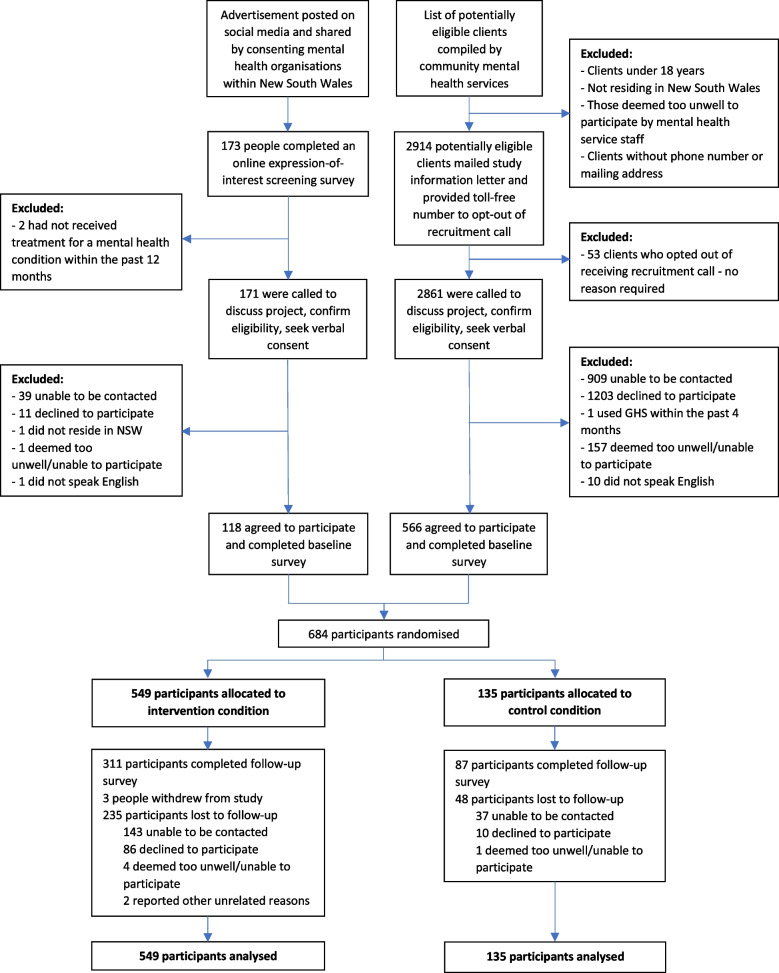
Methods: A parallel-group randomised controlled trial was conducted. Participants with a mental health condition (N = 681) were assigned to a control (health information pack) or intervention group (information pack and referral by the research team to a coaching program). Data were collected via telephone surveys at baseline and six months post-recruitment. Primary outcomes were: (1) weekly minutes of moderate-to-vigorous physical activity, (2) daily fruit serves, (3) daily vegetable serves, and (4) attempted behaviour change/weight loss (yes/no; composite measure). Secondary outcomes included weight, Body Mass Index (BMI), and attempts to change each health behaviour individually.
Results: Intention-to-treat analyses found no significant differential change between groups from baseline to six months for primary or secondary outcomes. By follow-up, 242/549 (44%) of intervention participants had enrolled in coaching and completed at least one call, with 16/242 having completed the program, 79 ongoing, and 147 withdrawn. Per-protocol analyses found attempting to improve at least one health behaviour/lose weight was significantly greater in enrolees (OR = 3.7, 95% CI 1.03-13.23) than the control group.
Conclusions: Referral to the program did not improve risk behaviours or weight/BMI but did support behaviour change attempts. Contributing factors may include low program completion by follow-up and impact of COVID-19. Further research is required to better understand participation in and benefits of telephone coaching services for people with a mental health condition.
Trial registration: Registered retrospectively with the Australian New Zealand Clinical Trials Registry (ACTRN12620000351910).
期刊介绍:
BMC Public Health is an open access, peer-reviewed journal that considers articles on the epidemiology of disease and the understanding of all aspects of public health. The journal has a special focus on the social determinants of health, the environmental, behavioral, and occupational correlates of health and disease, and the impact of health policies, practices and interventions on the community.





 京公网安备 11010802042870号
京ICP备2023020795号-1
京公网安备 11010802042870号
京ICP备2023020795号-1

 分享
分享
 求助内容:
求助内容: 应助结果提醒方式:
 扫码关注我们
