Tor-Björn Claesson, Stefan Mutter, Jukka Putaala, Eero Salli, Daniel Gordin, Per-Henrik Groop, Juha Martola, Lena M Thorn
{"title":"1型糖尿病发病年龄不影响获得的脑容量。","authors":"Tor-Björn Claesson, Stefan Mutter, Jukka Putaala, Eero Salli, Daniel Gordin, Per-Henrik Groop, Juha Martola, Lena M Thorn","doi":"10.1186/s12902-025-01868-6","DOIUrl":null,"url":null,"abstract":"<p><strong>Introduction: </strong>Type 1 diabetes is suspected to hamper brain growth, implying that people with earlier diabetes onset would, on average, achieve lower maximal brain volume. We set out to test this hypothesis.</p><p><strong>Methods: </strong>Examining brain MRI scans of middle-aged people with type 1 diabetes, we related age at diabetes onset to intracranial volume in 180 participants, as well as to cerebral gray and white matter volumes in a subset of 113 (63%) participants, using fractional polynomial regression models. Of the participants, 118 (67%) had been diagnosed with diabetes before 18 years of age.</p><p><strong>Results: </strong>Of our participants, 54% were women, the median age 40.0 (IQR 33.2-45.0) years and the range of age at diabetes onset was 1.2-39.0 years. We found no association between age at diabetes onset and intracranial volume (p = 0.85), cerebral white (p = 0.10), or gray matter volumes (p = 0.12). Further, correlations between age at diabetes onset and the measured brain volumes were poor in analyses stratified for sex (all correlation coefficients ρ ≤ 0.16).</p><p><strong>Conclusions: </strong>We found no association between age at diabetes onset and attained intracranial volume or gray or white matter volumes, indicating that type 1 diabetes may not have a clinically significant influence on brain growth.</p>","PeriodicalId":9152,"journal":{"name":"BMC Endocrine Disorders","volume":"25 1","pages":"43"},"PeriodicalIF":3.7000,"publicationDate":"2025-02-18","publicationTypes":"Journal Article","fieldsOfStudy":null,"isOpenAccess":false,"openAccessPdf":"https://www.ncbi.nlm.nih.gov/pmc/articles/PMC11834590/pdf/","citationCount":"0","resultStr":"{\"title\":\"Age at type 1 diabetes onset does not influence attained brain volume.\",\"authors\":\"Tor-Björn Claesson, Stefan Mutter, Jukka Putaala, Eero Salli, Daniel Gordin, Per-Henrik Groop, Juha Martola, Lena M Thorn\",\"doi\":\"10.1186/s12902-025-01868-6\",\"DOIUrl\":null,\"url\":null,\"abstract\":\"<p><strong>Introduction: </strong>Type 1 diabetes is suspected to hamper brain growth, implying that people with earlier diabetes onset would, on average, achieve lower maximal brain volume. We set out to test this hypothesis.</p><p><strong>Methods: </strong>Examining brain MRI scans of middle-aged people with type 1 diabetes, we related age at diabetes onset to intracranial volume in 180 participants, as well as to cerebral gray and white matter volumes in a subset of 113 (63%) participants, using fractional polynomial regression models. Of the participants, 118 (67%) had been diagnosed with diabetes before 18 years of age.</p><p><strong>Results: </strong>Of our participants, 54% were women, the median age 40.0 (IQR 33.2-45.0) years and the range of age at diabetes onset was 1.2-39.0 years. We found no association between age at diabetes onset and intracranial volume (p = 0.85), cerebral white (p = 0.10), or gray matter volumes (p = 0.12). Further, correlations between age at diabetes onset and the measured brain volumes were poor in analyses stratified for sex (all correlation coefficients ρ ≤ 0.16).</p><p><strong>Conclusions: </strong>We found no association between age at diabetes onset and attained intracranial volume or gray or white matter volumes, indicating that type 1 diabetes may not have a clinically significant influence on brain growth.</p>\",\"PeriodicalId\":9152,\"journal\":{\"name\":\"BMC Endocrine Disorders\",\"volume\":\"25 1\",\"pages\":\"43\"},\"PeriodicalIF\":3.7000,\"publicationDate\":\"2025-02-18\",\"publicationTypes\":\"Journal Article\",\"fieldsOfStudy\":null,\"isOpenAccess\":false,\"openAccessPdf\":\"https://www.ncbi.nlm.nih.gov/pmc/articles/PMC11834590/pdf/\",\"citationCount\":\"0\",\"resultStr\":null,\"platform\":\"Semanticscholar\",\"paperid\":null,\"PeriodicalName\":\"BMC Endocrine Disorders\",\"FirstCategoryId\":\"3\",\"ListUrlMain\":\"https://doi.org/10.1186/s12902-025-01868-6\",\"RegionNum\":3,\"RegionCategory\":\"医学\",\"ArticlePicture\":[],\"TitleCN\":null,\"AbstractTextCN\":null,\"PMCID\":null,\"EPubDate\":\"\",\"PubModel\":\"\",\"JCR\":\"Q3\",\"JCRName\":\"ENDOCRINOLOGY & METABOLISM\",\"Score\":null,\"Total\":0}","platform":"Semanticscholar","paperid":null,"PeriodicalName":"BMC Endocrine Disorders","FirstCategoryId":"3","ListUrlMain":"https://doi.org/10.1186/s12902-025-01868-6","RegionNum":3,"RegionCategory":"医学","ArticlePicture":[],"TitleCN":null,"AbstractTextCN":null,"PMCID":null,"EPubDate":"","PubModel":"","JCR":"Q3","JCRName":"ENDOCRINOLOGY & METABOLISM","Score":null,"Total":0}
Age at type 1 diabetes onset does not influence attained brain volume.
Introduction: Type 1 diabetes is suspected to hamper brain growth, implying that people with earlier diabetes onset would, on average, achieve lower maximal brain volume. We set out to test this hypothesis.
Methods: Examining brain MRI scans of middle-aged people with type 1 diabetes, we related age at diabetes onset to intracranial volume in 180 participants, as well as to cerebral gray and white matter volumes in a subset of 113 (63%) participants, using fractional polynomial regression models. Of the participants, 118 (67%) had been diagnosed with diabetes before 18 years of age.
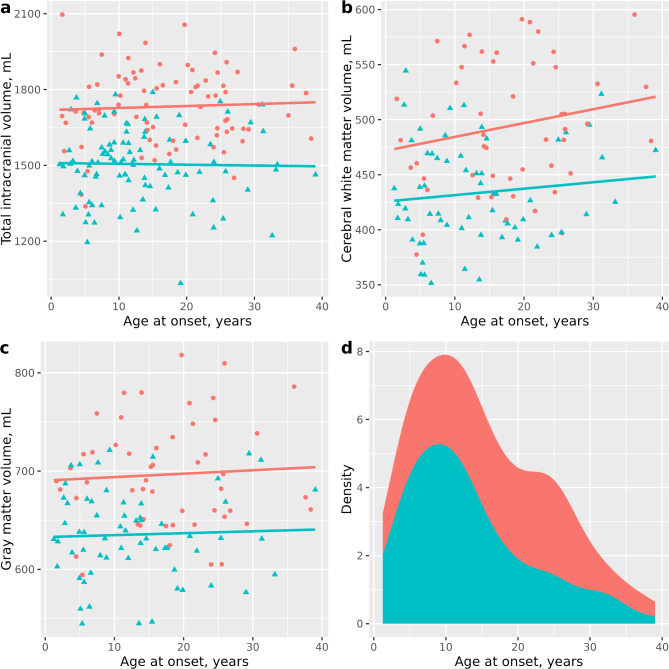
Results: Of our participants, 54% were women, the median age 40.0 (IQR 33.2-45.0) years and the range of age at diabetes onset was 1.2-39.0 years. We found no association between age at diabetes onset and intracranial volume (p = 0.85), cerebral white (p = 0.10), or gray matter volumes (p = 0.12). Further, correlations between age at diabetes onset and the measured brain volumes were poor in analyses stratified for sex (all correlation coefficients ρ ≤ 0.16).
Conclusions: We found no association between age at diabetes onset and attained intracranial volume or gray or white matter volumes, indicating that type 1 diabetes may not have a clinically significant influence on brain growth.
期刊介绍:
BMC Endocrine Disorders is an open access, peer-reviewed journal that considers articles on all aspects of the prevention, diagnosis and management of endocrine disorders, as well as related molecular genetics, pathophysiology, and epidemiology.




 京公网安备 11010802042870号
京ICP备2023020795号-1
京公网安备 11010802042870号
京ICP备2023020795号-1

 分享
分享
 求助内容:
求助内容: 应助结果提醒方式:
 扫码关注我们
