{"title":"中国被忽视的热带病负担估算的差异:现实世界数据与全球疾病负担2021数据(2004-2020)的比较研究","authors":"Guo-Jing Yang, Han-Qi Ouyang, Zi-Yu Zhao, Wei-Hao Li, Ibrahima Socé Fall, Amadou Garba Djirmay, Xiao-Nong Zhou","doi":"10.1136/bmj-2024-080969","DOIUrl":null,"url":null,"abstract":"<p><strong>Objectives: </strong>To assess the discrepancies between real-world data and the Global Burden of Disease (GBD) 2021 estimates for six neglected tropical diseases in China. Additionally, to evaluate the applicability of the GBD model within the Chinese context and to assess the effectiveness of China's historical prevention and control policies for neglected tropical diseases.</p><p><strong>Design: </strong>Comparative study of real-world data and GBD 2021 (2004-2020).</p><p><strong>Main outcome measures: </strong>Disability adjusted life years (DALYs).</p><p><strong>Methods: </strong>DALYs based on reported data for leprosy, echinococcosis, schistosomiasis, visceral leishmaniasis, dengue, and rabies from 2004 to 2020 were compared with the estimated DALYs from the GBD 2021 database. Additionally, we combined and analysed China's historical policies on prevention and control of neglected tropical diseases with real-world DALYs.</p><p><strong>Data sources: </strong>Reported data were sourced from the Chinese Center for Disease Control and Prevention's China Public Health Science data centre and related reports. Data for GBD 2021 and GBD 2019 were obtained from GBD databases. These data included all of China's 31 provinces (including autonomous regions and municipalities) and the Xinjiang Production and Construction Corps.</p><p><strong>Results: </strong>The total real-world DALYs based on reported data of six neglected tropical diseases decreased from 260 000 person years in 2004 to 19 000 person years in 2020, with a 93% (241 000/260 000 person years) reduction. The 17 year average real-world DALYs from 2004 to 2020 versus the GBD 2021 estimates for the same period were 42 <i>v</i> 500 for leprosy, 960 <i>v</i> 11 000 for echinococcosis, 64 000 <i>v</i> 98 000 for schistosomiasis, 56 <i>v</i> 16 000 for visceral leishmaniasis, 190 <i>v</i> 780 for dengue, and 47 000 <i>v</i> 67 000 for rabies. The ratios of the GBD estimates to the real-world DALYs for the six neglected tropical diseases were 17 for leprosy, 11 for echinococcosis, 1.5 for schistosomiasis, 280 for visceral leishmaniasis, 4.2 for dengue, and 1.4 for rabies.</p><p><strong>Conclusions: </strong>The findings indicate that reliance solely on global estimates, such as those of the GBD, may not sufficiently capture the dynamics of neglected tropical diseases in China. Integrating local epidemiological data into global health assessments is crucial to develop accurate and effective public health policies. This study highlights the importance of continuously updating and improving data collection and surveillance methods to adapt public health strategies to evolving disease patterns.</p>","PeriodicalId":9201,"journal":{"name":"BMJ : British Medical Journal","volume":"388 ","pages":"e080969"},"PeriodicalIF":55.1000,"publicationDate":"2025-02-18","publicationTypes":"Journal Article","fieldsOfStudy":null,"isOpenAccess":false,"openAccessPdf":"https://www.ncbi.nlm.nih.gov/pmc/articles/PMC11833545/pdf/","citationCount":"0","resultStr":"{\"title\":\"Discrepancies in neglected tropical diseases burden estimates in China: comparative study of real-world data and Global Burden of Disease 2021 data (2004-2020).\",\"authors\":\"Guo-Jing Yang, Han-Qi Ouyang, Zi-Yu Zhao, Wei-Hao Li, Ibrahima Socé Fall, Amadou Garba Djirmay, Xiao-Nong Zhou\",\"doi\":\"10.1136/bmj-2024-080969\",\"DOIUrl\":null,\"url\":null,\"abstract\":\"<p><strong>Objectives: </strong>To assess the discrepancies between real-world data and the Global Burden of Disease (GBD) 2021 estimates for six neglected tropical diseases in China. Additionally, to evaluate the applicability of the GBD model within the Chinese context and to assess the effectiveness of China's historical prevention and control policies for neglected tropical diseases.</p><p><strong>Design: </strong>Comparative study of real-world data and GBD 2021 (2004-2020).</p><p><strong>Main outcome measures: </strong>Disability adjusted life years (DALYs).</p><p><strong>Methods: </strong>DALYs based on reported data for leprosy, echinococcosis, schistosomiasis, visceral leishmaniasis, dengue, and rabies from 2004 to 2020 were compared with the estimated DALYs from the GBD 2021 database. Additionally, we combined and analysed China's historical policies on prevention and control of neglected tropical diseases with real-world DALYs.</p><p><strong>Data sources: </strong>Reported data were sourced from the Chinese Center for Disease Control and Prevention's China Public Health Science data centre and related reports. Data for GBD 2021 and GBD 2019 were obtained from GBD databases. These data included all of China's 31 provinces (including autonomous regions and municipalities) and the Xinjiang Production and Construction Corps.</p><p><strong>Results: </strong>The total real-world DALYs based on reported data of six neglected tropical diseases decreased from 260 000 person years in 2004 to 19 000 person years in 2020, with a 93% (241 000/260 000 person years) reduction. The 17 year average real-world DALYs from 2004 to 2020 versus the GBD 2021 estimates for the same period were 42 <i>v</i> 500 for leprosy, 960 <i>v</i> 11 000 for echinococcosis, 64 000 <i>v</i> 98 000 for schistosomiasis, 56 <i>v</i> 16 000 for visceral leishmaniasis, 190 <i>v</i> 780 for dengue, and 47 000 <i>v</i> 67 000 for rabies. The ratios of the GBD estimates to the real-world DALYs for the six neglected tropical diseases were 17 for leprosy, 11 for echinococcosis, 1.5 for schistosomiasis, 280 for visceral leishmaniasis, 4.2 for dengue, and 1.4 for rabies.</p><p><strong>Conclusions: </strong>The findings indicate that reliance solely on global estimates, such as those of the GBD, may not sufficiently capture the dynamics of neglected tropical diseases in China. Integrating local epidemiological data into global health assessments is crucial to develop accurate and effective public health policies. This study highlights the importance of continuously updating and improving data collection and surveillance methods to adapt public health strategies to evolving disease patterns.</p>\",\"PeriodicalId\":9201,\"journal\":{\"name\":\"BMJ : British Medical Journal\",\"volume\":\"388 \",\"pages\":\"e080969\"},\"PeriodicalIF\":55.1000,\"publicationDate\":\"2025-02-18\",\"publicationTypes\":\"Journal Article\",\"fieldsOfStudy\":null,\"isOpenAccess\":false,\"openAccessPdf\":\"https://www.ncbi.nlm.nih.gov/pmc/articles/PMC11833545/pdf/\",\"citationCount\":\"0\",\"resultStr\":null,\"platform\":\"Semanticscholar\",\"paperid\":null,\"PeriodicalName\":\"BMJ : British Medical Journal\",\"FirstCategoryId\":\"3\",\"ListUrlMain\":\"https://doi.org/10.1136/bmj-2024-080969\",\"RegionNum\":1,\"RegionCategory\":\"医学\",\"ArticlePicture\":[],\"TitleCN\":null,\"AbstractTextCN\":null,\"PMCID\":null,\"EPubDate\":\"\",\"PubModel\":\"\",\"JCR\":\"Q1\",\"JCRName\":\"Medicine\",\"Score\":null,\"Total\":0}","platform":"Semanticscholar","paperid":null,"PeriodicalName":"BMJ : British Medical Journal","FirstCategoryId":"3","ListUrlMain":"https://doi.org/10.1136/bmj-2024-080969","RegionNum":1,"RegionCategory":"医学","ArticlePicture":[],"TitleCN":null,"AbstractTextCN":null,"PMCID":null,"EPubDate":"","PubModel":"","JCR":"Q1","JCRName":"Medicine","Score":null,"Total":0}
Discrepancies in neglected tropical diseases burden estimates in China: comparative study of real-world data and Global Burden of Disease 2021 data (2004-2020).
Objectives: To assess the discrepancies between real-world data and the Global Burden of Disease (GBD) 2021 estimates for six neglected tropical diseases in China. Additionally, to evaluate the applicability of the GBD model within the Chinese context and to assess the effectiveness of China's historical prevention and control policies for neglected tropical diseases.
Design: Comparative study of real-world data and GBD 2021 (2004-2020).
Main outcome measures: Disability adjusted life years (DALYs).
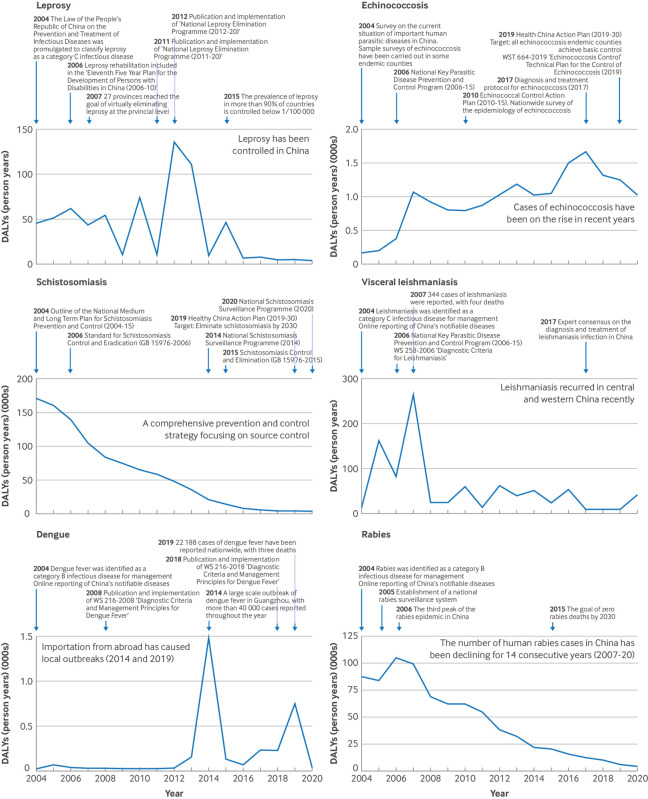
Methods: DALYs based on reported data for leprosy, echinococcosis, schistosomiasis, visceral leishmaniasis, dengue, and rabies from 2004 to 2020 were compared with the estimated DALYs from the GBD 2021 database. Additionally, we combined and analysed China's historical policies on prevention and control of neglected tropical diseases with real-world DALYs.
Data sources: Reported data were sourced from the Chinese Center for Disease Control and Prevention's China Public Health Science data centre and related reports. Data for GBD 2021 and GBD 2019 were obtained from GBD databases. These data included all of China's 31 provinces (including autonomous regions and municipalities) and the Xinjiang Production and Construction Corps.
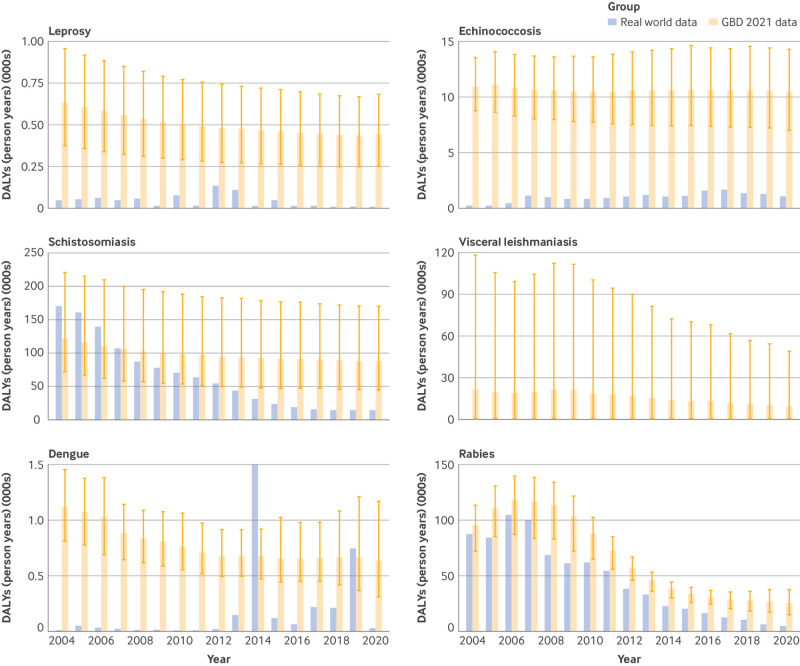
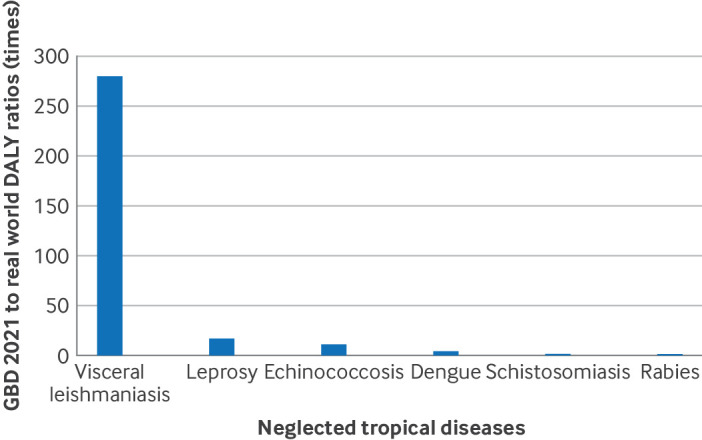
Results: The total real-world DALYs based on reported data of six neglected tropical diseases decreased from 260 000 person years in 2004 to 19 000 person years in 2020, with a 93% (241 000/260 000 person years) reduction. The 17 year average real-world DALYs from 2004 to 2020 versus the GBD 2021 estimates for the same period were 42 v 500 for leprosy, 960 v 11 000 for echinococcosis, 64 000 v 98 000 for schistosomiasis, 56 v 16 000 for visceral leishmaniasis, 190 v 780 for dengue, and 47 000 v 67 000 for rabies. The ratios of the GBD estimates to the real-world DALYs for the six neglected tropical diseases were 17 for leprosy, 11 for echinococcosis, 1.5 for schistosomiasis, 280 for visceral leishmaniasis, 4.2 for dengue, and 1.4 for rabies.
Conclusions: The findings indicate that reliance solely on global estimates, such as those of the GBD, may not sufficiently capture the dynamics of neglected tropical diseases in China. Integrating local epidemiological data into global health assessments is crucial to develop accurate and effective public health policies. This study highlights the importance of continuously updating and improving data collection and surveillance methods to adapt public health strategies to evolving disease patterns.
期刊介绍:
The BMJ (British Medical Journal) is an international peer-reviewed medical journal with a "continuous publication" model, where articles are published on bmj.com before appearing in the print journal. The website is updated daily with the latest original research, education, news, and comment articles, along with podcasts, videos, and blogs. The BMJ's editorial team is primarily located in London, with additional editors in Europe, the US, and India.




 京公网安备 11010802042870号
京ICP备2023020795号-1
京公网安备 11010802042870号
京ICP备2023020795号-1

 分享
分享
 求助内容:
求助内容: 应助结果提醒方式:
 扫码关注我们
