Patrizia Porazzi, Siena Nason, Ziqi Yang, Alberto Carturan, Guido Ghilardi, Puneeth Guruprasad, Ruchi P. Patel, Melody Tan, Anushka Anant Padmanabhan, Jean Lemoine, Eugenio Fardella, Yunlin Zhang, Raymone Pajarillo, Linhui Chen, Ositadimma Ugwuanyi, Kelly Markowitz, Devora Delman, Mathew G. Angelos, Olga Shestova, Yusuke Isshiki, Marco Ruella
{"title":"EZH1/EZH2抑制增强对多种癌症模型的过继性T细胞免疫治疗","authors":"Patrizia Porazzi, Siena Nason, Ziqi Yang, Alberto Carturan, Guido Ghilardi, Puneeth Guruprasad, Ruchi P. Patel, Melody Tan, Anushka Anant Padmanabhan, Jean Lemoine, Eugenio Fardella, Yunlin Zhang, Raymone Pajarillo, Linhui Chen, Ositadimma Ugwuanyi, Kelly Markowitz, Devora Delman, Mathew G. Angelos, Olga Shestova, Yusuke Isshiki, Marco Ruella","doi":"10.1016/j.ccell.2025.01.013","DOIUrl":null,"url":null,"abstract":"Tumor resistance to chimeric antigen receptor T cell (CAR-T) and, in general, to adoptive cell immunotherapies (ACTs) is a major challenge in the clinic. We hypothesized that inhibiting the tumor drivers’ methyltransferases EZH2 and EZH1 could enhance ACT by rewiring cancer cells to a more immunogenic state. In human B cell lymphoma, EZH2 inhibition (tazemetostat) improved the efficacy of anti-CD19 CAR-T by enhancing activation, expansion, and tumor infiltration. Mechanistically, tazemetostat-treated tumors showed upregulation of genes related to adhesion, B cell activation, and inflammatory responses, and increased avidity to CAR-T. Furthermore, tazemetostat improved CAR- and TCR-engineered T cell efficacy in multiple liquid (myeloma and acute myeloid leukemia) and solid (sarcoma, ovarian, and prostate) cancers. Lastly, combined EZH1/EZH2 inhibition (valemetostat) further boosted CAR-T efficacy and expansion in multiple cancers. This study shows that EZH1/2 inhibition reprograms tumors to a more immunogenic state and potentiates ACT in preclinical models of both liquid and solid cancers.","PeriodicalId":9670,"journal":{"name":"Cancer Cell","volume":"17 1","pages":""},"PeriodicalIF":44.5000,"publicationDate":"2025-02-20","publicationTypes":"Journal Article","fieldsOfStudy":null,"isOpenAccess":false,"openAccessPdf":"","citationCount":"0","resultStr":"{\"title\":\"EZH1/EZH2 inhibition enhances adoptive T cell immunotherapy against multiple cancer models\",\"authors\":\"Patrizia Porazzi, Siena Nason, Ziqi Yang, Alberto Carturan, Guido Ghilardi, Puneeth Guruprasad, Ruchi P. Patel, Melody Tan, Anushka Anant Padmanabhan, Jean Lemoine, Eugenio Fardella, Yunlin Zhang, Raymone Pajarillo, Linhui Chen, Ositadimma Ugwuanyi, Kelly Markowitz, Devora Delman, Mathew G. Angelos, Olga Shestova, Yusuke Isshiki, Marco Ruella\",\"doi\":\"10.1016/j.ccell.2025.01.013\",\"DOIUrl\":null,\"url\":null,\"abstract\":\"Tumor resistance to chimeric antigen receptor T cell (CAR-T) and, in general, to adoptive cell immunotherapies (ACTs) is a major challenge in the clinic. We hypothesized that inhibiting the tumor drivers’ methyltransferases EZH2 and EZH1 could enhance ACT by rewiring cancer cells to a more immunogenic state. In human B cell lymphoma, EZH2 inhibition (tazemetostat) improved the efficacy of anti-CD19 CAR-T by enhancing activation, expansion, and tumor infiltration. Mechanistically, tazemetostat-treated tumors showed upregulation of genes related to adhesion, B cell activation, and inflammatory responses, and increased avidity to CAR-T. Furthermore, tazemetostat improved CAR- and TCR-engineered T cell efficacy in multiple liquid (myeloma and acute myeloid leukemia) and solid (sarcoma, ovarian, and prostate) cancers. Lastly, combined EZH1/EZH2 inhibition (valemetostat) further boosted CAR-T efficacy and expansion in multiple cancers. This study shows that EZH1/2 inhibition reprograms tumors to a more immunogenic state and potentiates ACT in preclinical models of both liquid and solid cancers.\",\"PeriodicalId\":9670,\"journal\":{\"name\":\"Cancer Cell\",\"volume\":\"17 1\",\"pages\":\"\"},\"PeriodicalIF\":44.5000,\"publicationDate\":\"2025-02-20\",\"publicationTypes\":\"Journal Article\",\"fieldsOfStudy\":null,\"isOpenAccess\":false,\"openAccessPdf\":\"\",\"citationCount\":\"0\",\"resultStr\":null,\"platform\":\"Semanticscholar\",\"paperid\":null,\"PeriodicalName\":\"Cancer Cell\",\"FirstCategoryId\":\"3\",\"ListUrlMain\":\"https://doi.org/10.1016/j.ccell.2025.01.013\",\"RegionNum\":1,\"RegionCategory\":\"医学\",\"ArticlePicture\":[],\"TitleCN\":null,\"AbstractTextCN\":null,\"PMCID\":null,\"EPubDate\":\"\",\"PubModel\":\"\",\"JCR\":\"Q1\",\"JCRName\":\"CELL BIOLOGY\",\"Score\":null,\"Total\":0}","platform":"Semanticscholar","paperid":null,"PeriodicalName":"Cancer Cell","FirstCategoryId":"3","ListUrlMain":"https://doi.org/10.1016/j.ccell.2025.01.013","RegionNum":1,"RegionCategory":"医学","ArticlePicture":[],"TitleCN":null,"AbstractTextCN":null,"PMCID":null,"EPubDate":"","PubModel":"","JCR":"Q1","JCRName":"CELL BIOLOGY","Score":null,"Total":0}
EZH1/EZH2 inhibition enhances adoptive T cell immunotherapy against multiple cancer models
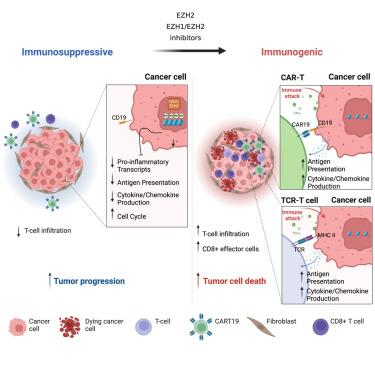
Tumor resistance to chimeric antigen receptor T cell (CAR-T) and, in general, to adoptive cell immunotherapies (ACTs) is a major challenge in the clinic. We hypothesized that inhibiting the tumor drivers’ methyltransferases EZH2 and EZH1 could enhance ACT by rewiring cancer cells to a more immunogenic state. In human B cell lymphoma, EZH2 inhibition (tazemetostat) improved the efficacy of anti-CD19 CAR-T by enhancing activation, expansion, and tumor infiltration. Mechanistically, tazemetostat-treated tumors showed upregulation of genes related to adhesion, B cell activation, and inflammatory responses, and increased avidity to CAR-T. Furthermore, tazemetostat improved CAR- and TCR-engineered T cell efficacy in multiple liquid (myeloma and acute myeloid leukemia) and solid (sarcoma, ovarian, and prostate) cancers. Lastly, combined EZH1/EZH2 inhibition (valemetostat) further boosted CAR-T efficacy and expansion in multiple cancers. This study shows that EZH1/2 inhibition reprograms tumors to a more immunogenic state and potentiates ACT in preclinical models of both liquid and solid cancers.
期刊介绍:
Cancer Cell is a journal that focuses on promoting major advances in cancer research and oncology. The primary criteria for considering manuscripts are as follows:
Major advances: Manuscripts should provide significant advancements in answering important questions related to naturally occurring cancers.
Translational research: The journal welcomes translational research, which involves the application of basic scientific findings to human health and clinical practice.
Clinical investigations: Cancer Cell is interested in publishing clinical investigations that contribute to establishing new paradigms in the treatment, diagnosis, or prevention of cancers.
Insights into cancer biology: The journal values clinical investigations that provide important insights into cancer biology beyond what has been revealed by preclinical studies.
Mechanism-based proof-of-principle studies: Cancer Cell encourages the publication of mechanism-based proof-of-principle clinical studies, which demonstrate the feasibility of a specific therapeutic approach or diagnostic test.




 京公网安备 11010802042870号
京ICP备2023020795号-1
京公网安备 11010802042870号
京ICP备2023020795号-1

 分享
分享
 求助内容:
求助内容: 应助结果提醒方式:
 扫码关注我们
