Qingjin Zhang , Zeshi Chen , Han Gao , Liangliang Fu , Guangwen Xu , Dingrong Bai
{"title":"温度对鼓泡流化床气固流动结构的影响","authors":"Qingjin Zhang , Zeshi Chen , Han Gao , Liangliang Fu , Guangwen Xu , Dingrong Bai","doi":"10.1016/j.ces.2025.121380","DOIUrl":null,"url":null,"abstract":"<div><div>The gas–solid flow structure in dense fluidized beds has been understood to be a bubble-emulsion two-phase flow characteristically dominated by bubble dynamics. Recent studies have suggested that bed temperature significantly affects this flow, but a clear understanding remains elusive. To address the issue, we investigate the impact of temperature on the gas–solid flow structure in bubbling fluidized beds by analyzing pressure fluctuation signals at various axial positions from ambient to 1500 °C. The results reveal that depending on bed temperature, two distinct flow structures can be observed in fluidized beds: a bubble-dominated flow structure below approximately 1200 °C, characterized by noticeable axial variations in the standard deviation and dominant frequency of pressure fluctuations resulting from bubble formation, coalescence, growth, and breakup along the axial direction; a homogeneous and stable bed structure above 1200 °C, featured by axially constant standard deviation and dominant frequency attributed to uniformly distributed small bubbles within constantly agglomerating and dispersing particles.</div></div>","PeriodicalId":271,"journal":{"name":"Chemical Engineering Science","volume":"308 ","pages":"Article 121380"},"PeriodicalIF":4.3000,"publicationDate":"2025-04-01","publicationTypes":"Journal Article","fieldsOfStudy":null,"isOpenAccess":false,"openAccessPdf":"","citationCount":"0","resultStr":"{\"title\":\"Effect of temperature on gas-solid flow structure in bubbling fluidized beds\",\"authors\":\"Qingjin Zhang , Zeshi Chen , Han Gao , Liangliang Fu , Guangwen Xu , Dingrong Bai\",\"doi\":\"10.1016/j.ces.2025.121380\",\"DOIUrl\":null,\"url\":null,\"abstract\":\"<div><div>The gas–solid flow structure in dense fluidized beds has been understood to be a bubble-emulsion two-phase flow characteristically dominated by bubble dynamics. Recent studies have suggested that bed temperature significantly affects this flow, but a clear understanding remains elusive. To address the issue, we investigate the impact of temperature on the gas–solid flow structure in bubbling fluidized beds by analyzing pressure fluctuation signals at various axial positions from ambient to 1500 °C. The results reveal that depending on bed temperature, two distinct flow structures can be observed in fluidized beds: a bubble-dominated flow structure below approximately 1200 °C, characterized by noticeable axial variations in the standard deviation and dominant frequency of pressure fluctuations resulting from bubble formation, coalescence, growth, and breakup along the axial direction; a homogeneous and stable bed structure above 1200 °C, featured by axially constant standard deviation and dominant frequency attributed to uniformly distributed small bubbles within constantly agglomerating and dispersing particles.</div></div>\",\"PeriodicalId\":271,\"journal\":{\"name\":\"Chemical Engineering Science\",\"volume\":\"308 \",\"pages\":\"Article 121380\"},\"PeriodicalIF\":4.3000,\"publicationDate\":\"2025-04-01\",\"publicationTypes\":\"Journal Article\",\"fieldsOfStudy\":null,\"isOpenAccess\":false,\"openAccessPdf\":\"\",\"citationCount\":\"0\",\"resultStr\":null,\"platform\":\"Semanticscholar\",\"paperid\":null,\"PeriodicalName\":\"Chemical Engineering Science\",\"FirstCategoryId\":\"5\",\"ListUrlMain\":\"https://www.sciencedirect.com/science/article/pii/S0009250925002039\",\"RegionNum\":2,\"RegionCategory\":\"工程技术\",\"ArticlePicture\":[],\"TitleCN\":null,\"AbstractTextCN\":null,\"PMCID\":null,\"EPubDate\":\"2025/2/19 0:00:00\",\"PubModel\":\"Epub\",\"JCR\":\"Q2\",\"JCRName\":\"ENGINEERING, CHEMICAL\",\"Score\":null,\"Total\":0}","platform":"Semanticscholar","paperid":null,"PeriodicalName":"Chemical Engineering Science","FirstCategoryId":"5","ListUrlMain":"https://www.sciencedirect.com/science/article/pii/S0009250925002039","RegionNum":2,"RegionCategory":"工程技术","ArticlePicture":[],"TitleCN":null,"AbstractTextCN":null,"PMCID":null,"EPubDate":"2025/2/19 0:00:00","PubModel":"Epub","JCR":"Q2","JCRName":"ENGINEERING, CHEMICAL","Score":null,"Total":0}
Effect of temperature on gas-solid flow structure in bubbling fluidized beds
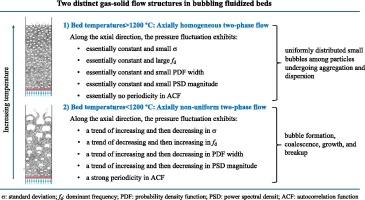
The gas–solid flow structure in dense fluidized beds has been understood to be a bubble-emulsion two-phase flow characteristically dominated by bubble dynamics. Recent studies have suggested that bed temperature significantly affects this flow, but a clear understanding remains elusive. To address the issue, we investigate the impact of temperature on the gas–solid flow structure in bubbling fluidized beds by analyzing pressure fluctuation signals at various axial positions from ambient to 1500 °C. The results reveal that depending on bed temperature, two distinct flow structures can be observed in fluidized beds: a bubble-dominated flow structure below approximately 1200 °C, characterized by noticeable axial variations in the standard deviation and dominant frequency of pressure fluctuations resulting from bubble formation, coalescence, growth, and breakup along the axial direction; a homogeneous and stable bed structure above 1200 °C, featured by axially constant standard deviation and dominant frequency attributed to uniformly distributed small bubbles within constantly agglomerating and dispersing particles.
期刊介绍:
Chemical engineering enables the transformation of natural resources and energy into useful products for society. It draws on and applies natural sciences, mathematics and economics, and has developed fundamental engineering science that underpins the discipline.
Chemical Engineering Science (CES) has been publishing papers on the fundamentals of chemical engineering since 1951. CES is the platform where the most significant advances in the discipline have ever since been published. Chemical Engineering Science has accompanied and sustained chemical engineering through its development into the vibrant and broad scientific discipline it is today.




 京公网安备 11010802042870号
京ICP备2023020795号-1
京公网安备 11010802042870号
京ICP备2023020795号-1

 分享
分享
 求助内容:
求助内容: 应助结果提醒方式:
 扫码关注我们
