Wenxing Lv , Xiaojuan Jia , Bowen Tang , Chao Ma , Xiaopeng Fang , Xurui Jin , Zhangming Niu , Xin Han
{"title":"目标蛋白降解的计算机模拟","authors":"Wenxing Lv , Xiaojuan Jia , Bowen Tang , Chao Ma , Xiaopeng Fang , Xurui Jin , Zhangming Niu , Xin Han","doi":"10.1016/j.ejmech.2025.117432","DOIUrl":null,"url":null,"abstract":"<div><div>Targeted protein degradation (TPD) techniques, particularly proteolysis-targeting chimeras (PROTAC) and molecular glue degraders (MGD), have offered novel strategies in drug discovery. With rapid advancement of computer-aided drug design (CADD) and artificial intelligence-driven drug discovery (AIDD) in the biomedical field, a major focus has become how to effectively integrate these technologies into the TPD drug discovery pipeline to accelerate development, shorten timelines, and reduce costs. Currently, the main research directions for applying CADD and AIDD in TPD include: 1) ternary complex modeling; 2) linker generation; 3) strategies to predict degrader targets, activities and ADME/T properties; 4) <em>In silico</em> degrader design and discovery. Models developed in these areas play a crucial role in target identification, drug design, and optimization at various stages of the discovery process. However, the limited size and quality of datasets related to TPD present challenges, leaving room for further improvement in these models. TPD involves the complex ubiquitin-proteasome system, with numerous factors influencing outcomes. Most current models adopt a static perspective to interpret and predict relevant tasks. In the future, it may be necessary to shift toward dynamic approaches that better capture the intricate relationships among these components. Furthermore, incorporating new and diverse chemical spaces will enhance the precision design and application of TPD agents.</div></div>","PeriodicalId":314,"journal":{"name":"European Journal of Medicinal Chemistry","volume":"289 ","pages":"Article 117432"},"PeriodicalIF":5.9000,"publicationDate":"2025-05-05","publicationTypes":"Journal Article","fieldsOfStudy":null,"isOpenAccess":false,"openAccessPdf":"","citationCount":"0","resultStr":"{\"title\":\"In silico modeling of targeted protein degradation\",\"authors\":\"Wenxing Lv , Xiaojuan Jia , Bowen Tang , Chao Ma , Xiaopeng Fang , Xurui Jin , Zhangming Niu , Xin Han\",\"doi\":\"10.1016/j.ejmech.2025.117432\",\"DOIUrl\":null,\"url\":null,\"abstract\":\"<div><div>Targeted protein degradation (TPD) techniques, particularly proteolysis-targeting chimeras (PROTAC) and molecular glue degraders (MGD), have offered novel strategies in drug discovery. With rapid advancement of computer-aided drug design (CADD) and artificial intelligence-driven drug discovery (AIDD) in the biomedical field, a major focus has become how to effectively integrate these technologies into the TPD drug discovery pipeline to accelerate development, shorten timelines, and reduce costs. Currently, the main research directions for applying CADD and AIDD in TPD include: 1) ternary complex modeling; 2) linker generation; 3) strategies to predict degrader targets, activities and ADME/T properties; 4) <em>In silico</em> degrader design and discovery. Models developed in these areas play a crucial role in target identification, drug design, and optimization at various stages of the discovery process. However, the limited size and quality of datasets related to TPD present challenges, leaving room for further improvement in these models. TPD involves the complex ubiquitin-proteasome system, with numerous factors influencing outcomes. Most current models adopt a static perspective to interpret and predict relevant tasks. In the future, it may be necessary to shift toward dynamic approaches that better capture the intricate relationships among these components. Furthermore, incorporating new and diverse chemical spaces will enhance the precision design and application of TPD agents.</div></div>\",\"PeriodicalId\":314,\"journal\":{\"name\":\"European Journal of Medicinal Chemistry\",\"volume\":\"289 \",\"pages\":\"Article 117432\"},\"PeriodicalIF\":5.9000,\"publicationDate\":\"2025-05-05\",\"publicationTypes\":\"Journal Article\",\"fieldsOfStudy\":null,\"isOpenAccess\":false,\"openAccessPdf\":\"\",\"citationCount\":\"0\",\"resultStr\":null,\"platform\":\"Semanticscholar\",\"paperid\":null,\"PeriodicalName\":\"European Journal of Medicinal Chemistry\",\"FirstCategoryId\":\"3\",\"ListUrlMain\":\"https://www.sciencedirect.com/science/article/pii/S0223523425001977\",\"RegionNum\":2,\"RegionCategory\":\"医学\",\"ArticlePicture\":[],\"TitleCN\":null,\"AbstractTextCN\":null,\"PMCID\":null,\"EPubDate\":\"2025/2/20 0:00:00\",\"PubModel\":\"Epub\",\"JCR\":\"Q1\",\"JCRName\":\"CHEMISTRY, MEDICINAL\",\"Score\":null,\"Total\":0}","platform":"Semanticscholar","paperid":null,"PeriodicalName":"European Journal of Medicinal Chemistry","FirstCategoryId":"3","ListUrlMain":"https://www.sciencedirect.com/science/article/pii/S0223523425001977","RegionNum":2,"RegionCategory":"医学","ArticlePicture":[],"TitleCN":null,"AbstractTextCN":null,"PMCID":null,"EPubDate":"2025/2/20 0:00:00","PubModel":"Epub","JCR":"Q1","JCRName":"CHEMISTRY, MEDICINAL","Score":null,"Total":0}
In silico modeling of targeted protein degradation
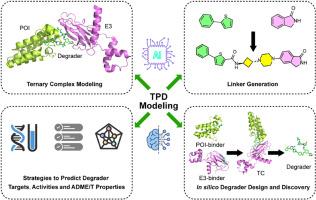
Targeted protein degradation (TPD) techniques, particularly proteolysis-targeting chimeras (PROTAC) and molecular glue degraders (MGD), have offered novel strategies in drug discovery. With rapid advancement of computer-aided drug design (CADD) and artificial intelligence-driven drug discovery (AIDD) in the biomedical field, a major focus has become how to effectively integrate these technologies into the TPD drug discovery pipeline to accelerate development, shorten timelines, and reduce costs. Currently, the main research directions for applying CADD and AIDD in TPD include: 1) ternary complex modeling; 2) linker generation; 3) strategies to predict degrader targets, activities and ADME/T properties; 4) In silico degrader design and discovery. Models developed in these areas play a crucial role in target identification, drug design, and optimization at various stages of the discovery process. However, the limited size and quality of datasets related to TPD present challenges, leaving room for further improvement in these models. TPD involves the complex ubiquitin-proteasome system, with numerous factors influencing outcomes. Most current models adopt a static perspective to interpret and predict relevant tasks. In the future, it may be necessary to shift toward dynamic approaches that better capture the intricate relationships among these components. Furthermore, incorporating new and diverse chemical spaces will enhance the precision design and application of TPD agents.
期刊介绍:
The European Journal of Medicinal Chemistry is a global journal that publishes studies on all aspects of medicinal chemistry. It provides a medium for publication of original papers and also welcomes critical review papers.
A typical paper would report on the organic synthesis, characterization and pharmacological evaluation of compounds. Other topics of interest are drug design, QSAR, molecular modeling, drug-receptor interactions, molecular aspects of drug metabolism, prodrug synthesis and drug targeting. The journal expects manuscripts to present the rational for a study, provide insight into the design of compounds or understanding of mechanism, or clarify the targets.





 京公网安备 11010802042870号
京ICP备2023020795号-1
京公网安备 11010802042870号
京ICP备2023020795号-1

 分享
分享
 求助内容:
求助内容: 应助结果提醒方式:
 扫码关注我们
