Yuexiu Liang , Wenxian Lin , Yuzhen Chen , Weijie Yang , Xiaoyu Zhou , Shishen Ai , Liqin Qiu , Rihui Cao , Junli Wang
{"title":"新型二价喹啉类靶向宫颈癌自噬抗肿瘤药物的合成及体外、体内评价","authors":"Yuexiu Liang , Wenxian Lin , Yuzhen Chen , Weijie Yang , Xiaoyu Zhou , Shishen Ai , Liqin Qiu , Rihui Cao , Junli Wang","doi":"10.1016/j.ejmech.2025.117421","DOIUrl":null,"url":null,"abstract":"<div><div>A series of novel bivalent quinolines with a spacer of four to six methylene units between the phenoxy group in the position-7 and various substituents in the position-4 of quinoline skeleton, respectively, were synthesized and evaluated as anticancer agents. The data showed that the majority of the compounds had significant antiproliferative activity with IC<sub>50</sub> values less than 50 μM against human cancer cell lines. Among them, compound <strong>4b</strong> exhibited the strongest antiproliferative activity against HCT116, A549, BGC823, HeLa and MCF-7 cell lines with an IC<sub>50</sub> values of 0.26, 2.75, 4.06, 3.71 and 3.08 μM, respectively. Further studies on the anticancer effects in mice of compound <strong>4b</strong> showed its capacity to inhibit tumor growth and markedly reduce tumor size of cervical cancer. Moreover investigation on the underlying mechanism of action indicated that compound <strong>4b</strong> didn't trigger apoptotic processes in cervical cancer cell lines, but inhibit cervical cancer growth through inducing autophagy <em>via</em> the ATG5/ATG7 pathway.</div></div>","PeriodicalId":314,"journal":{"name":"European Journal of Medicinal Chemistry","volume":"288 ","pages":"Article 117421"},"PeriodicalIF":5.9000,"publicationDate":"2025-04-15","publicationTypes":"Journal Article","fieldsOfStudy":null,"isOpenAccess":false,"openAccessPdf":"","citationCount":"0","resultStr":"{\"title\":\"Synthesis and in vitro and in vivo evaluation of novel bivalent quinolines as antitumor agents via targeting autophagy in cervical cancer\",\"authors\":\"Yuexiu Liang , Wenxian Lin , Yuzhen Chen , Weijie Yang , Xiaoyu Zhou , Shishen Ai , Liqin Qiu , Rihui Cao , Junli Wang\",\"doi\":\"10.1016/j.ejmech.2025.117421\",\"DOIUrl\":null,\"url\":null,\"abstract\":\"<div><div>A series of novel bivalent quinolines with a spacer of four to six methylene units between the phenoxy group in the position-7 and various substituents in the position-4 of quinoline skeleton, respectively, were synthesized and evaluated as anticancer agents. The data showed that the majority of the compounds had significant antiproliferative activity with IC<sub>50</sub> values less than 50 μM against human cancer cell lines. Among them, compound <strong>4b</strong> exhibited the strongest antiproliferative activity against HCT116, A549, BGC823, HeLa and MCF-7 cell lines with an IC<sub>50</sub> values of 0.26, 2.75, 4.06, 3.71 and 3.08 μM, respectively. Further studies on the anticancer effects in mice of compound <strong>4b</strong> showed its capacity to inhibit tumor growth and markedly reduce tumor size of cervical cancer. Moreover investigation on the underlying mechanism of action indicated that compound <strong>4b</strong> didn't trigger apoptotic processes in cervical cancer cell lines, but inhibit cervical cancer growth through inducing autophagy <em>via</em> the ATG5/ATG7 pathway.</div></div>\",\"PeriodicalId\":314,\"journal\":{\"name\":\"European Journal of Medicinal Chemistry\",\"volume\":\"288 \",\"pages\":\"Article 117421\"},\"PeriodicalIF\":5.9000,\"publicationDate\":\"2025-04-15\",\"publicationTypes\":\"Journal Article\",\"fieldsOfStudy\":null,\"isOpenAccess\":false,\"openAccessPdf\":\"\",\"citationCount\":\"0\",\"resultStr\":null,\"platform\":\"Semanticscholar\",\"paperid\":null,\"PeriodicalName\":\"European Journal of Medicinal Chemistry\",\"FirstCategoryId\":\"3\",\"ListUrlMain\":\"https://www.sciencedirect.com/science/article/pii/S0223523425001862\",\"RegionNum\":2,\"RegionCategory\":\"医学\",\"ArticlePicture\":[],\"TitleCN\":null,\"AbstractTextCN\":null,\"PMCID\":null,\"EPubDate\":\"2025/2/20 0:00:00\",\"PubModel\":\"Epub\",\"JCR\":\"Q1\",\"JCRName\":\"CHEMISTRY, MEDICINAL\",\"Score\":null,\"Total\":0}","platform":"Semanticscholar","paperid":null,"PeriodicalName":"European Journal of Medicinal Chemistry","FirstCategoryId":"3","ListUrlMain":"https://www.sciencedirect.com/science/article/pii/S0223523425001862","RegionNum":2,"RegionCategory":"医学","ArticlePicture":[],"TitleCN":null,"AbstractTextCN":null,"PMCID":null,"EPubDate":"2025/2/20 0:00:00","PubModel":"Epub","JCR":"Q1","JCRName":"CHEMISTRY, MEDICINAL","Score":null,"Total":0}
Synthesis and in vitro and in vivo evaluation of novel bivalent quinolines as antitumor agents via targeting autophagy in cervical cancer
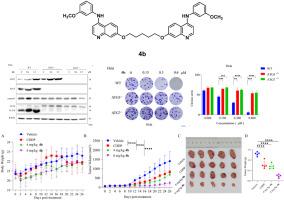
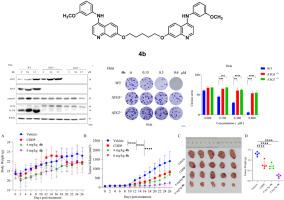
A series of novel bivalent quinolines with a spacer of four to six methylene units between the phenoxy group in the position-7 and various substituents in the position-4 of quinoline skeleton, respectively, were synthesized and evaluated as anticancer agents. The data showed that the majority of the compounds had significant antiproliferative activity with IC50 values less than 50 μM against human cancer cell lines. Among them, compound 4b exhibited the strongest antiproliferative activity against HCT116, A549, BGC823, HeLa and MCF-7 cell lines with an IC50 values of 0.26, 2.75, 4.06, 3.71 and 3.08 μM, respectively. Further studies on the anticancer effects in mice of compound 4b showed its capacity to inhibit tumor growth and markedly reduce tumor size of cervical cancer. Moreover investigation on the underlying mechanism of action indicated that compound 4b didn't trigger apoptotic processes in cervical cancer cell lines, but inhibit cervical cancer growth through inducing autophagy via the ATG5/ATG7 pathway.
期刊介绍:
The European Journal of Medicinal Chemistry is a global journal that publishes studies on all aspects of medicinal chemistry. It provides a medium for publication of original papers and also welcomes critical review papers.
A typical paper would report on the organic synthesis, characterization and pharmacological evaluation of compounds. Other topics of interest are drug design, QSAR, molecular modeling, drug-receptor interactions, molecular aspects of drug metabolism, prodrug synthesis and drug targeting. The journal expects manuscripts to present the rational for a study, provide insight into the design of compounds or understanding of mechanism, or clarify the targets.




 京公网安备 11010802042870号
京ICP备2023020795号-1
京公网安备 11010802042870号
京ICP备2023020795号-1

 分享
分享
 求助内容:
求助内容: 应助结果提醒方式:
 扫码关注我们
