Jianyuan Zhao , Guoning Zhang , YaSheng Li , Ling Ma , Dongrong Yi , Quanjie Li , Yu Shi , Saisai Guo , Tianfu Liu , Yujia Wang , Xiaoyu Li , Yucheng Wang , Wenjie Tan , Jiabin Li , Shan Cen
{"title":"新型SARS-CoV-2 RdRp抑制剂盐酸非那唑吡啶的发现与优化","authors":"Jianyuan Zhao , Guoning Zhang , YaSheng Li , Ling Ma , Dongrong Yi , Quanjie Li , Yu Shi , Saisai Guo , Tianfu Liu , Yujia Wang , Xiaoyu Li , Yucheng Wang , Wenjie Tan , Jiabin Li , Shan Cen","doi":"10.1016/j.ejmech.2025.117422","DOIUrl":null,"url":null,"abstract":"<div><div>The severe acute respiratory syndrome coronavirus-2 (SARS-CoV-2) is the pathogen of coronavirus disease (COVID-19) causing a pandemic with growing global transmission. The viral RNA-dependent RNA polymerase (RdRp) is conserved especially for variants of concern (VOCs), making it as an effective antivirals target. Due to the proofreading activity of coronavirus nsp14/nsp10, limited the efficacy of nucleoside analogs in vivo. Herein, we identified that Phenazopyridine hydrochloride (PAP) inhibits SARS-CoV-2 with EC<sub>50</sub> of 5.37 μmol/L. Furthermore, PAP can effectively inhibit SARS-CoV-2 RdRp with EC<sub>50</sub> value of 7.37 μmol/L, after further optimization, compound PAP-22 exhibits the most potential inhibition, with EC<sub>50</sub> of 1.11 μmol/L. PAP and its derivatives can bind directly to SARS-CoV-2 RdRp, fully resistance to the exoribonuclease (ExoN) and exhibit broad spectrum anti-CoV activities. Combined with the current data available on the safe and pharmacokinetics of PAP as an approved drug in clinical use, these results provide a path for the urgently needed antivirals to combat SARS-CoV-2.</div></div>","PeriodicalId":314,"journal":{"name":"European Journal of Medicinal Chemistry","volume":"288 ","pages":"Article 117422"},"PeriodicalIF":6.7000,"publicationDate":"2025-04-15","publicationTypes":"Journal Article","fieldsOfStudy":null,"isOpenAccess":false,"openAccessPdf":"","citationCount":"0","resultStr":"{\"title\":\"Discovery and optimization of phenazopyridine hydrochloride as novel SARS-CoV-2 RdRp inhibitors\",\"authors\":\"Jianyuan Zhao , Guoning Zhang , YaSheng Li , Ling Ma , Dongrong Yi , Quanjie Li , Yu Shi , Saisai Guo , Tianfu Liu , Yujia Wang , Xiaoyu Li , Yucheng Wang , Wenjie Tan , Jiabin Li , Shan Cen\",\"doi\":\"10.1016/j.ejmech.2025.117422\",\"DOIUrl\":null,\"url\":null,\"abstract\":\"<div><div>The severe acute respiratory syndrome coronavirus-2 (SARS-CoV-2) is the pathogen of coronavirus disease (COVID-19) causing a pandemic with growing global transmission. The viral RNA-dependent RNA polymerase (RdRp) is conserved especially for variants of concern (VOCs), making it as an effective antivirals target. Due to the proofreading activity of coronavirus nsp14/nsp10, limited the efficacy of nucleoside analogs in vivo. Herein, we identified that Phenazopyridine hydrochloride (PAP) inhibits SARS-CoV-2 with EC<sub>50</sub> of 5.37 μmol/L. Furthermore, PAP can effectively inhibit SARS-CoV-2 RdRp with EC<sub>50</sub> value of 7.37 μmol/L, after further optimization, compound PAP-22 exhibits the most potential inhibition, with EC<sub>50</sub> of 1.11 μmol/L. PAP and its derivatives can bind directly to SARS-CoV-2 RdRp, fully resistance to the exoribonuclease (ExoN) and exhibit broad spectrum anti-CoV activities. Combined with the current data available on the safe and pharmacokinetics of PAP as an approved drug in clinical use, these results provide a path for the urgently needed antivirals to combat SARS-CoV-2.</div></div>\",\"PeriodicalId\":314,\"journal\":{\"name\":\"European Journal of Medicinal Chemistry\",\"volume\":\"288 \",\"pages\":\"Article 117422\"},\"PeriodicalIF\":6.7000,\"publicationDate\":\"2025-04-15\",\"publicationTypes\":\"Journal Article\",\"fieldsOfStudy\":null,\"isOpenAccess\":false,\"openAccessPdf\":\"\",\"citationCount\":\"0\",\"resultStr\":null,\"platform\":\"Semanticscholar\",\"paperid\":null,\"PeriodicalName\":\"European Journal of Medicinal Chemistry\",\"FirstCategoryId\":\"3\",\"ListUrlMain\":\"https://www.sciencedirect.com/science/article/pii/S0223523425001874\",\"RegionNum\":2,\"RegionCategory\":\"医学\",\"ArticlePicture\":[],\"TitleCN\":null,\"AbstractTextCN\":null,\"PMCID\":null,\"EPubDate\":\"2025/2/20 0:00:00\",\"PubModel\":\"Epub\",\"JCR\":\"Q1\",\"JCRName\":\"CHEMISTRY, MEDICINAL\",\"Score\":null,\"Total\":0}","platform":"Semanticscholar","paperid":null,"PeriodicalName":"European Journal of Medicinal Chemistry","FirstCategoryId":"3","ListUrlMain":"https://www.sciencedirect.com/science/article/pii/S0223523425001874","RegionNum":2,"RegionCategory":"医学","ArticlePicture":[],"TitleCN":null,"AbstractTextCN":null,"PMCID":null,"EPubDate":"2025/2/20 0:00:00","PubModel":"Epub","JCR":"Q1","JCRName":"CHEMISTRY, MEDICINAL","Score":null,"Total":0}
Discovery and optimization of phenazopyridine hydrochloride as novel SARS-CoV-2 RdRp inhibitors
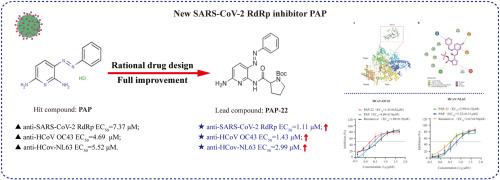
The severe acute respiratory syndrome coronavirus-2 (SARS-CoV-2) is the pathogen of coronavirus disease (COVID-19) causing a pandemic with growing global transmission. The viral RNA-dependent RNA polymerase (RdRp) is conserved especially for variants of concern (VOCs), making it as an effective antivirals target. Due to the proofreading activity of coronavirus nsp14/nsp10, limited the efficacy of nucleoside analogs in vivo. Herein, we identified that Phenazopyridine hydrochloride (PAP) inhibits SARS-CoV-2 with EC50 of 5.37 μmol/L. Furthermore, PAP can effectively inhibit SARS-CoV-2 RdRp with EC50 value of 7.37 μmol/L, after further optimization, compound PAP-22 exhibits the most potential inhibition, with EC50 of 1.11 μmol/L. PAP and its derivatives can bind directly to SARS-CoV-2 RdRp, fully resistance to the exoribonuclease (ExoN) and exhibit broad spectrum anti-CoV activities. Combined with the current data available on the safe and pharmacokinetics of PAP as an approved drug in clinical use, these results provide a path for the urgently needed antivirals to combat SARS-CoV-2.
期刊介绍:
The European Journal of Medicinal Chemistry is a global journal that publishes studies on all aspects of medicinal chemistry. It provides a medium for publication of original papers and also welcomes critical review papers.
A typical paper would report on the organic synthesis, characterization and pharmacological evaluation of compounds. Other topics of interest are drug design, QSAR, molecular modeling, drug-receptor interactions, molecular aspects of drug metabolism, prodrug synthesis and drug targeting. The journal expects manuscripts to present the rational for a study, provide insight into the design of compounds or understanding of mechanism, or clarify the targets.





 京公网安备 11010802042870号
京ICP备2023020795号-1
京公网安备 11010802042870号
京ICP备2023020795号-1

 分享
分享
 求助内容:
求助内容: 应助结果提醒方式:
 扫码关注我们
