{"title":"自组装DNA/SG-I纳米花:疾病相关标记的多功能光催化生物传感器","authors":"Shan He, Yiyu Chen, Huiting Lian, Xuegong Cao, Bin Liu, Xiaofeng Wei","doi":"10.1021/acs.analchem.4c04772","DOIUrl":null,"url":null,"abstract":"DNA nanostructures have recently attracted more attention with functionalities, programmability, and biocompatibility. Herein, a novel self-assembled photocatalytic DNA/SYBR Green I (SG-I) nanoflower (DSNF) was successfully synthesized by rolling circle amplification. DSNF was self-assembled through liquid crystallization of a high concentration of DNA in the RCA products, without relying on the Watson–Crick base-pairing principle. Interestingly, DSNF not only possessed a larger specific surface area and good stability but also exhibited excellent photocatalytic activity that generates singlet oxygen and superoxide anion to oxidate 3,3′,5,5′-tetramethylbenzidine. Meanwhile, the photocatalytic DSNF combined with an enzyme-linked immunosorbent assay to develop a new colorimetric sensor for highly specific, sensitive, and visual detection of carcinoembryonic antigens (CEAs). The colorimetric sensor achieved sensitive and low-cost quantitative detection of CEA in the linear range of 0.5–80.0 ng/mL, and the LOD was 0.5 ng/mL. In addition, three negative and seven positive clinical serum samples of CEA were obtained with 100% accuracy using the proposed colorimetric sensor, showing great potential in the clinical application of cancer diagnosis. We envision that this photocatalytic DSNF is expected to provide important perspectives in fluorescence imaging, photosensitizing cancer therapy, and clinical diagnosis fields.","PeriodicalId":27,"journal":{"name":"Analytical Chemistry","volume":"12 1","pages":""},"PeriodicalIF":7.3000,"publicationDate":"2025-02-20","publicationTypes":"Journal Article","fieldsOfStudy":null,"isOpenAccess":false,"openAccessPdf":"","citationCount":"0","resultStr":"{\"title\":\"Self-Assembled DNA/SG-I Nanoflower: Versatile Photocatalytic Biosensors for Disease-Related Markers\",\"authors\":\"Shan He, Yiyu Chen, Huiting Lian, Xuegong Cao, Bin Liu, Xiaofeng Wei\",\"doi\":\"10.1021/acs.analchem.4c04772\",\"DOIUrl\":null,\"url\":null,\"abstract\":\"DNA nanostructures have recently attracted more attention with functionalities, programmability, and biocompatibility. Herein, a novel self-assembled photocatalytic DNA/SYBR Green I (SG-I) nanoflower (DSNF) was successfully synthesized by rolling circle amplification. DSNF was self-assembled through liquid crystallization of a high concentration of DNA in the RCA products, without relying on the Watson–Crick base-pairing principle. Interestingly, DSNF not only possessed a larger specific surface area and good stability but also exhibited excellent photocatalytic activity that generates singlet oxygen and superoxide anion to oxidate 3,3′,5,5′-tetramethylbenzidine. Meanwhile, the photocatalytic DSNF combined with an enzyme-linked immunosorbent assay to develop a new colorimetric sensor for highly specific, sensitive, and visual detection of carcinoembryonic antigens (CEAs). The colorimetric sensor achieved sensitive and low-cost quantitative detection of CEA in the linear range of 0.5–80.0 ng/mL, and the LOD was 0.5 ng/mL. In addition, three negative and seven positive clinical serum samples of CEA were obtained with 100% accuracy using the proposed colorimetric sensor, showing great potential in the clinical application of cancer diagnosis. We envision that this photocatalytic DSNF is expected to provide important perspectives in fluorescence imaging, photosensitizing cancer therapy, and clinical diagnosis fields.\",\"PeriodicalId\":27,\"journal\":{\"name\":\"Analytical Chemistry\",\"volume\":\"12 1\",\"pages\":\"\"},\"PeriodicalIF\":7.3000,\"publicationDate\":\"2025-02-20\",\"publicationTypes\":\"Journal Article\",\"fieldsOfStudy\":null,\"isOpenAccess\":false,\"openAccessPdf\":\"\",\"citationCount\":\"0\",\"resultStr\":null,\"platform\":\"Semanticscholar\",\"paperid\":null,\"PeriodicalName\":\"Analytical Chemistry\",\"FirstCategoryId\":\"92\",\"ListUrlMain\":\"https://doi.org/10.1021/acs.analchem.4c04772\",\"RegionNum\":1,\"RegionCategory\":\"化学\",\"ArticlePicture\":[],\"TitleCN\":null,\"AbstractTextCN\":null,\"PMCID\":null,\"EPubDate\":\"\",\"PubModel\":\"\",\"JCR\":\"Q1\",\"JCRName\":\"CHEMISTRY, ANALYTICAL\",\"Score\":null,\"Total\":0}","platform":"Semanticscholar","paperid":null,"PeriodicalName":"Analytical Chemistry","FirstCategoryId":"92","ListUrlMain":"https://doi.org/10.1021/acs.analchem.4c04772","RegionNum":1,"RegionCategory":"化学","ArticlePicture":[],"TitleCN":null,"AbstractTextCN":null,"PMCID":null,"EPubDate":"","PubModel":"","JCR":"Q1","JCRName":"CHEMISTRY, ANALYTICAL","Score":null,"Total":0}
引用次数: 0
摘要
近年来,DNA纳米结构以其功能、可编程性和生物相容性引起了越来越多的关注。本文采用滚环扩增技术成功合成了一种新型自组装光催化DNA/SYBR Green I (SG-I)纳米花(DSNF)。DSNF是通过RCA产物中高浓度DNA的液体结晶而自组装的,不依赖于沃森-克里克碱基配对原理。有趣的是,DSNF不仅具有较大的比表面积和良好的稳定性,而且还表现出优异的光催化活性,生成单线态氧和超氧阴离子来氧化3,3 ',5,5 ' -四甲基联苯胺。同时,光催化DSNF结合酶联免疫吸附法开发了一种新的比色传感器,用于高特异性、高灵敏度和视觉检测癌胚抗原(CEAs)。该比色传感器在0.5 ~ 80.0 ng/mL线性范围内实现了CEA的灵敏、低成本定量检测,检出限为0.5 ng/mL。此外,利用该比色传感器获得了3份CEA阴性和7份阳性的临床血清样本,准确率为100%,在癌症诊断的临床应用中具有很大的潜力。我们设想这种光催化DSNF有望在荧光成像、光敏化癌症治疗和临床诊断领域提供重要的前景。
Self-Assembled DNA/SG-I Nanoflower: Versatile Photocatalytic Biosensors for Disease-Related Markers
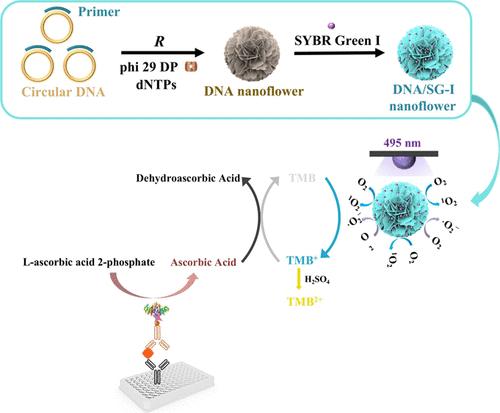
DNA nanostructures have recently attracted more attention with functionalities, programmability, and biocompatibility. Herein, a novel self-assembled photocatalytic DNA/SYBR Green I (SG-I) nanoflower (DSNF) was successfully synthesized by rolling circle amplification. DSNF was self-assembled through liquid crystallization of a high concentration of DNA in the RCA products, without relying on the Watson–Crick base-pairing principle. Interestingly, DSNF not only possessed a larger specific surface area and good stability but also exhibited excellent photocatalytic activity that generates singlet oxygen and superoxide anion to oxidate 3,3′,5,5′-tetramethylbenzidine. Meanwhile, the photocatalytic DSNF combined with an enzyme-linked immunosorbent assay to develop a new colorimetric sensor for highly specific, sensitive, and visual detection of carcinoembryonic antigens (CEAs). The colorimetric sensor achieved sensitive and low-cost quantitative detection of CEA in the linear range of 0.5–80.0 ng/mL, and the LOD was 0.5 ng/mL. In addition, three negative and seven positive clinical serum samples of CEA were obtained with 100% accuracy using the proposed colorimetric sensor, showing great potential in the clinical application of cancer diagnosis. We envision that this photocatalytic DSNF is expected to provide important perspectives in fluorescence imaging, photosensitizing cancer therapy, and clinical diagnosis fields.
期刊介绍:
Analytical Chemistry, a peer-reviewed research journal, focuses on disseminating new and original knowledge across all branches of analytical chemistry. Fundamental articles may explore general principles of chemical measurement science and need not directly address existing or potential analytical methodology. They can be entirely theoretical or report experimental results. Contributions may cover various phases of analytical operations, including sampling, bioanalysis, electrochemistry, mass spectrometry, microscale and nanoscale systems, environmental analysis, separations, spectroscopy, chemical reactions and selectivity, instrumentation, imaging, surface analysis, and data processing. Papers discussing known analytical methods should present a significant, original application of the method, a notable improvement, or results on an important analyte.




 京公网安备 11010802042870号
京ICP备2023020795号-1
京公网安备 11010802042870号
京ICP备2023020795号-1

 分享
分享
 求助内容:
求助内容: 应助结果提醒方式:
 扫码关注我们
