Zhe Zhang, Chuangang Yao, Haixia Zhang, Yuxi Sun, Baixi Xia, Wanning Liu, Jingyi Ding, Li Zhang, Xiaoshi Lang, Kedi Cai
{"title":"含锂氧化物作为固体氧化物燃料电池高性能阴极的氧还原反应动力学研究","authors":"Zhe Zhang, Chuangang Yao, Haixia Zhang, Yuxi Sun, Baixi Xia, Wanning Liu, Jingyi Ding, Li Zhang, Xiaoshi Lang, Kedi Cai","doi":"10.1021/acssuschemeng.4c09449","DOIUrl":null,"url":null,"abstract":"LiCoO<sub>2</sub> is widely used in lithium-ion batteries. Innovatively, this study reveals that by employing a synergistic strategy of Li volatilization and anion doping, LiCoO<sub>2</sub>-based materials demonstrate exceptional performance as solid oxide fuel cell (SOFC) cathodes. At high temperatures, Li volatilization forms a Co<sub>3</sub>O<sub>4</sub> phase. Concurrently, anionic doping is achieved by substituting F ions for O ions. The synergy of these two strategies increases the concentration of oxygen vacancies and the formation of heterogeneous interfaces, effectively enhancing the adsorption, dissociation, and diffusion rates of oxygen, thereby significantly improving the oxygen reduction reaction (ORR) of LiCoO<sub>2</sub> (LCO). LCOF1 (LiCoO<sub>1.9</sub>F<sub>0.1</sub>+Co<sub>3</sub>O<sub>4</sub>) exhibits an oxygen diffusion coefficient (<i>D</i><sub>chem</sub>) and surface exchange coefficient (<i>K</i><sub>chem</sub>) of 8.85 × 10<sup>–5</sup> cm<sup>2</sup> s<sup>–1</sup> and 7.61 × 10<sup>–3</sup> cm s<sup>–1</sup>, respectively, which are 45% and 26% higher than those of undoped LCO. Furthermore, at 800 °C, LCOF1 achieves a PPD of 0.86 W cm<sup>–2</sup> and an Rp as low as 0.012 Ω cm<sup>2</sup>, representing improvements of 110% in PPD and a reduction of 78.6% in Rp compared to LCO. These findings indicate that the synergistic effect of Li volatilization and F doping is an effective strategy for enhancing the performance of Li-containing cathodes, offering valuable perspectives for the development of high-performance SOFC cathodes.","PeriodicalId":25,"journal":{"name":"ACS Sustainable Chemistry & Engineering","volume":"37 1","pages":""},"PeriodicalIF":7.6000,"publicationDate":"2025-02-20","publicationTypes":"Journal Article","fieldsOfStudy":null,"isOpenAccess":false,"openAccessPdf":"","citationCount":"0","resultStr":"{\"title\":\"Enhanced Oxygen Reduction Reaction Kinetics of Li-Containing Oxide as a High-Performance Cathode for Solid Oxide Fuel Cells Through Synergistic Li Volatilization and Anion Doping\",\"authors\":\"Zhe Zhang, Chuangang Yao, Haixia Zhang, Yuxi Sun, Baixi Xia, Wanning Liu, Jingyi Ding, Li Zhang, Xiaoshi Lang, Kedi Cai\",\"doi\":\"10.1021/acssuschemeng.4c09449\",\"DOIUrl\":null,\"url\":null,\"abstract\":\"LiCoO<sub>2</sub> is widely used in lithium-ion batteries. Innovatively, this study reveals that by employing a synergistic strategy of Li volatilization and anion doping, LiCoO<sub>2</sub>-based materials demonstrate exceptional performance as solid oxide fuel cell (SOFC) cathodes. At high temperatures, Li volatilization forms a Co<sub>3</sub>O<sub>4</sub> phase. Concurrently, anionic doping is achieved by substituting F ions for O ions. The synergy of these two strategies increases the concentration of oxygen vacancies and the formation of heterogeneous interfaces, effectively enhancing the adsorption, dissociation, and diffusion rates of oxygen, thereby significantly improving the oxygen reduction reaction (ORR) of LiCoO<sub>2</sub> (LCO). LCOF1 (LiCoO<sub>1.9</sub>F<sub>0.1</sub>+Co<sub>3</sub>O<sub>4</sub>) exhibits an oxygen diffusion coefficient (<i>D</i><sub>chem</sub>) and surface exchange coefficient (<i>K</i><sub>chem</sub>) of 8.85 × 10<sup>–5</sup> cm<sup>2</sup> s<sup>–1</sup> and 7.61 × 10<sup>–3</sup> cm s<sup>–1</sup>, respectively, which are 45% and 26% higher than those of undoped LCO. Furthermore, at 800 °C, LCOF1 achieves a PPD of 0.86 W cm<sup>–2</sup> and an Rp as low as 0.012 Ω cm<sup>2</sup>, representing improvements of 110% in PPD and a reduction of 78.6% in Rp compared to LCO. These findings indicate that the synergistic effect of Li volatilization and F doping is an effective strategy for enhancing the performance of Li-containing cathodes, offering valuable perspectives for the development of high-performance SOFC cathodes.\",\"PeriodicalId\":25,\"journal\":{\"name\":\"ACS Sustainable Chemistry & Engineering\",\"volume\":\"37 1\",\"pages\":\"\"},\"PeriodicalIF\":7.6000,\"publicationDate\":\"2025-02-20\",\"publicationTypes\":\"Journal Article\",\"fieldsOfStudy\":null,\"isOpenAccess\":false,\"openAccessPdf\":\"\",\"citationCount\":\"0\",\"resultStr\":null,\"platform\":\"Semanticscholar\",\"paperid\":null,\"PeriodicalName\":\"ACS Sustainable Chemistry & Engineering\",\"FirstCategoryId\":\"92\",\"ListUrlMain\":\"https://doi.org/10.1021/acssuschemeng.4c09449\",\"RegionNum\":1,\"RegionCategory\":\"化学\",\"ArticlePicture\":[],\"TitleCN\":null,\"AbstractTextCN\":null,\"PMCID\":null,\"EPubDate\":\"\",\"PubModel\":\"\",\"JCR\":\"Q1\",\"JCRName\":\"CHEMISTRY, MULTIDISCIPLINARY\",\"Score\":null,\"Total\":0}","platform":"Semanticscholar","paperid":null,"PeriodicalName":"ACS Sustainable Chemistry & Engineering","FirstCategoryId":"92","ListUrlMain":"https://doi.org/10.1021/acssuschemeng.4c09449","RegionNum":1,"RegionCategory":"化学","ArticlePicture":[],"TitleCN":null,"AbstractTextCN":null,"PMCID":null,"EPubDate":"","PubModel":"","JCR":"Q1","JCRName":"CHEMISTRY, MULTIDISCIPLINARY","Score":null,"Total":0}
引用次数: 0
摘要
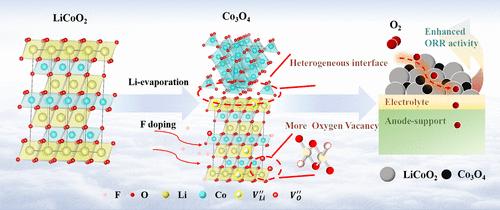
LiCoO2广泛应用于锂离子电池。创新的是,本研究揭示了通过采用锂挥发和阴离子掺杂的协同策略,licoo2基材料作为固体氧化物燃料电池(SOFC)阴极表现出卓越的性能。在高温下,Li挥发形成Co3O4相。同时,阴离子掺杂是通过用F离子代替O离子来实现的。这两种策略的协同作用增加了氧空位的浓度和非均相界面的形成,有效提高了氧的吸附、解离和扩散速率,从而显著提高了LiCoO2 (LCO)的氧还原反应(ORR)。LCOF1 (LiCoO1.9F0.1+Co3O4)的氧扩散系数(Dchem)和表面交换系数(Kchem)分别为8.85 × 10⁻⁵ cm2 s-1和7.61 × 10⁻³ cm s-1,分别比未掺杂的LCO高45%和26%。此外,在800°C时,LCOF1的PPD为0.86 W cm-2, Rp低至0.012 Ω cm2,与LCO相比,PPD提高了110%,Rp降低了78.6%。这些发现表明,Li挥发和F掺杂的协同效应是提高含锂阴极性能的有效策略,为高性能SOFC阴极的开发提供了有价值的前景。
Enhanced Oxygen Reduction Reaction Kinetics of Li-Containing Oxide as a High-Performance Cathode for Solid Oxide Fuel Cells Through Synergistic Li Volatilization and Anion Doping
LiCoO2 is widely used in lithium-ion batteries. Innovatively, this study reveals that by employing a synergistic strategy of Li volatilization and anion doping, LiCoO2-based materials demonstrate exceptional performance as solid oxide fuel cell (SOFC) cathodes. At high temperatures, Li volatilization forms a Co3O4 phase. Concurrently, anionic doping is achieved by substituting F ions for O ions. The synergy of these two strategies increases the concentration of oxygen vacancies and the formation of heterogeneous interfaces, effectively enhancing the adsorption, dissociation, and diffusion rates of oxygen, thereby significantly improving the oxygen reduction reaction (ORR) of LiCoO2 (LCO). LCOF1 (LiCoO1.9F0.1+Co3O4) exhibits an oxygen diffusion coefficient (Dchem) and surface exchange coefficient (Kchem) of 8.85 × 10⁻⁵ cm2 s–1 and 7.61 × 10⁻³ cm s–1, respectively, which are 45% and 26% higher than those of undoped LCO. Furthermore, at 800 °C, LCOF1 achieves a PPD of 0.86 W cm–2 and an Rp as low as 0.012 Ω cm2, representing improvements of 110% in PPD and a reduction of 78.6% in Rp compared to LCO. These findings indicate that the synergistic effect of Li volatilization and F doping is an effective strategy for enhancing the performance of Li-containing cathodes, offering valuable perspectives for the development of high-performance SOFC cathodes.
期刊介绍:
ACS Sustainable Chemistry & Engineering is a prestigious weekly peer-reviewed scientific journal published by the American Chemical Society. Dedicated to advancing the principles of green chemistry and green engineering, it covers a wide array of research topics including green chemistry, green engineering, biomass, alternative energy, and life cycle assessment.
The journal welcomes submissions in various formats, including Letters, Articles, Features, and Perspectives (Reviews), that address the challenges of sustainability in the chemical enterprise and contribute to the advancement of sustainable practices. Join us in shaping the future of sustainable chemistry and engineering.




 京公网安备 11010802042870号
京ICP备2023020795号-1
京公网安备 11010802042870号
京ICP备2023020795号-1

 分享
分享
 求助内容:
求助内容: 应助结果提醒方式:
 扫码关注我们
