Jeongki Kang, Jongwook Park, Jinsoo Kim, Woo-Sik Kim
{"title":"晶体尺寸控制对甘氨酸的反变换","authors":"Jeongki Kang, Jongwook Park, Jinsoo Kim, Woo-Sik Kim","doi":"10.1021/acs.oprd.4c00422","DOIUrl":null,"url":null,"abstract":"This study proposed a method for inverse phase transformation of stable γ-glycine into metastable α-glycine by using the characteristic that solubility increases as crystal size decreases according to the Ostwald–Freundlich equation. First, we measured the change in solubility according to the particle size of glycine. The solubility of γ-glycine bulk crystals at 10 °C in water was 173 g/L, and when the crystal size decreased to about 0.9 μm, the solubility increased to about 185 g/L. This concentration was higher than the solubility of α-glycine bulk crystals, 180 g/L. Based on the above results, γ-glycine can be inverse transformed into α-glycine in aqueous solution. To demonstrate this inverse transformation, in a glycine solution, γ-glycine crystals with a size of about 2 μm were ground with glass beads for 24 h to reduce the crystal size to about 0.8 μm. And the concentration of the solution was made higher than the solubility of α-glycine bulk. α-Glycine bulk crystals (about 110 μm) were placed into this solution and grown to 170 μm. Through this, inverse phase transformation was achieved in which γ-glycine crystals were dissolved and α-glycine crystals grew. The above inverse phase transformation process was confirmed using a microscope, XRD, and ATR–FTIR.","PeriodicalId":55,"journal":{"name":"Organic Process Research & Development","volume":"52 1","pages":""},"PeriodicalIF":3.5000,"publicationDate":"2025-02-18","publicationTypes":"Journal Article","fieldsOfStudy":null,"isOpenAccess":false,"openAccessPdf":"","citationCount":"0","resultStr":"{\"title\":\"Inverse Transformation of Glycine by Crystal Size Control\",\"authors\":\"Jeongki Kang, Jongwook Park, Jinsoo Kim, Woo-Sik Kim\",\"doi\":\"10.1021/acs.oprd.4c00422\",\"DOIUrl\":null,\"url\":null,\"abstract\":\"This study proposed a method for inverse phase transformation of stable γ-glycine into metastable α-glycine by using the characteristic that solubility increases as crystal size decreases according to the Ostwald–Freundlich equation. First, we measured the change in solubility according to the particle size of glycine. The solubility of γ-glycine bulk crystals at 10 °C in water was 173 g/L, and when the crystal size decreased to about 0.9 μm, the solubility increased to about 185 g/L. This concentration was higher than the solubility of α-glycine bulk crystals, 180 g/L. Based on the above results, γ-glycine can be inverse transformed into α-glycine in aqueous solution. To demonstrate this inverse transformation, in a glycine solution, γ-glycine crystals with a size of about 2 μm were ground with glass beads for 24 h to reduce the crystal size to about 0.8 μm. And the concentration of the solution was made higher than the solubility of α-glycine bulk. α-Glycine bulk crystals (about 110 μm) were placed into this solution and grown to 170 μm. Through this, inverse phase transformation was achieved in which γ-glycine crystals were dissolved and α-glycine crystals grew. The above inverse phase transformation process was confirmed using a microscope, XRD, and ATR–FTIR.\",\"PeriodicalId\":55,\"journal\":{\"name\":\"Organic Process Research & Development\",\"volume\":\"52 1\",\"pages\":\"\"},\"PeriodicalIF\":3.5000,\"publicationDate\":\"2025-02-18\",\"publicationTypes\":\"Journal Article\",\"fieldsOfStudy\":null,\"isOpenAccess\":false,\"openAccessPdf\":\"\",\"citationCount\":\"0\",\"resultStr\":null,\"platform\":\"Semanticscholar\",\"paperid\":null,\"PeriodicalName\":\"Organic Process Research & Development\",\"FirstCategoryId\":\"92\",\"ListUrlMain\":\"https://doi.org/10.1021/acs.oprd.4c00422\",\"RegionNum\":3,\"RegionCategory\":\"化学\",\"ArticlePicture\":[],\"TitleCN\":null,\"AbstractTextCN\":null,\"PMCID\":null,\"EPubDate\":\"\",\"PubModel\":\"\",\"JCR\":\"Q2\",\"JCRName\":\"CHEMISTRY, APPLIED\",\"Score\":null,\"Total\":0}","platform":"Semanticscholar","paperid":null,"PeriodicalName":"Organic Process Research & Development","FirstCategoryId":"92","ListUrlMain":"https://doi.org/10.1021/acs.oprd.4c00422","RegionNum":3,"RegionCategory":"化学","ArticlePicture":[],"TitleCN":null,"AbstractTextCN":null,"PMCID":null,"EPubDate":"","PubModel":"","JCR":"Q2","JCRName":"CHEMISTRY, APPLIED","Score":null,"Total":0}
Inverse Transformation of Glycine by Crystal Size Control
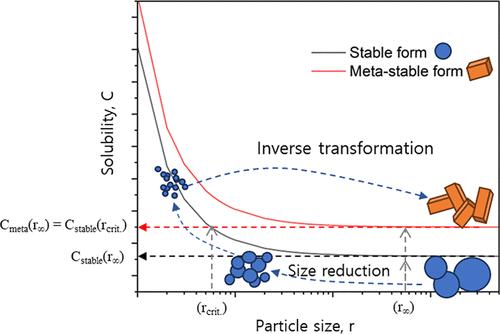
This study proposed a method for inverse phase transformation of stable γ-glycine into metastable α-glycine by using the characteristic that solubility increases as crystal size decreases according to the Ostwald–Freundlich equation. First, we measured the change in solubility according to the particle size of glycine. The solubility of γ-glycine bulk crystals at 10 °C in water was 173 g/L, and when the crystal size decreased to about 0.9 μm, the solubility increased to about 185 g/L. This concentration was higher than the solubility of α-glycine bulk crystals, 180 g/L. Based on the above results, γ-glycine can be inverse transformed into α-glycine in aqueous solution. To demonstrate this inverse transformation, in a glycine solution, γ-glycine crystals with a size of about 2 μm were ground with glass beads for 24 h to reduce the crystal size to about 0.8 μm. And the concentration of the solution was made higher than the solubility of α-glycine bulk. α-Glycine bulk crystals (about 110 μm) were placed into this solution and grown to 170 μm. Through this, inverse phase transformation was achieved in which γ-glycine crystals were dissolved and α-glycine crystals grew. The above inverse phase transformation process was confirmed using a microscope, XRD, and ATR–FTIR.
期刊介绍:
The journal Organic Process Research & Development serves as a communication tool between industrial chemists and chemists working in universities and research institutes. As such, it reports original work from the broad field of industrial process chemistry but also presents academic results that are relevant, or potentially relevant, to industrial applications. Process chemistry is the science that enables the safe, environmentally benign and ultimately economical manufacturing of organic compounds that are required in larger amounts to help address the needs of society. Consequently, the Journal encompasses every aspect of organic chemistry, including all aspects of catalysis, synthetic methodology development and synthetic strategy exploration, but also includes aspects from analytical and solid-state chemistry and chemical engineering, such as work-up tools,process safety, or flow-chemistry. The goal of development and optimization of chemical reactions and processes is their transfer to a larger scale; original work describing such studies and the actual implementation on scale is highly relevant to the journal. However, studies on new developments from either industry, research institutes or academia that have not yet been demonstrated on scale, but where an industrial utility can be expected and where the study has addressed important prerequisites for a scale-up and has given confidence into the reliability and practicality of the chemistry, also serve the mission of OPR&D as a communication tool between the different contributors to the field.




 京公网安备 11010802042870号
京ICP备2023020795号-1
京公网安备 11010802042870号
京ICP备2023020795号-1

 分享
分享
 求助内容:
求助内容: 应助结果提醒方式:
 扫码关注我们
