{"title":"蚀刻策略诱导mof及其衍生物在气敏应用中的多层结构:综述","authors":"Zhuo Liu, He Lv and Yan Xu","doi":"10.1039/D4TC05012F","DOIUrl":null,"url":null,"abstract":"<p >A growing need for accurate monitoring of both outdoor and indoor pollution sources demands enhanced gas sensors with improved sensitivity, selectivity, stability, fast response and low detection limits. Metal–organic frameworks (MOFs), a class of porous materials, stand out as superior candidates for high performance gas detection due to their exceptional structure characteristics, including tunable porosity, limitless structural motifs, and customizable chemical components. Tailoring the structure and functionalization of MOFs through etching has opened up new opportunities to adjust the gas-sensing capabilities of MOFs. In this review article, we provide a concise overview of the most recent advancements in three distinct aspects of etching MOFs: pore engineering, chemical modification, and transformation of MOFs into targeted derivatives. Despite extensive progress, research on etching strategies to elucidate the intricate relationship between the innovative structure and the sensing properties remains in its infancy. Focusing on MOFs and their derivative-based gas sensors with distinct critical structural features, the schemes to enhance sensor performance are introduced. We also outline the current barriers and future prospects in the field of gas sensing. This review seeks to offer guidance on modulating MOF-based gas sensors by strategically applying efficient etching methods, navigating contemporary challenges and future prospects in the gas sensing field.</p>","PeriodicalId":84,"journal":{"name":"Journal of Materials Chemistry C","volume":" 8","pages":" 3653-3668"},"PeriodicalIF":5.1000,"publicationDate":"2025-01-17","publicationTypes":"Journal Article","fieldsOfStudy":null,"isOpenAccess":false,"openAccessPdf":"","citationCount":"0","resultStr":"{\"title\":\"Etching strategies induced multihierarchical structures of MOFs and their derivatives for gas sensing applications: a review\",\"authors\":\"Zhuo Liu, He Lv and Yan Xu\",\"doi\":\"10.1039/D4TC05012F\",\"DOIUrl\":null,\"url\":null,\"abstract\":\"<p >A growing need for accurate monitoring of both outdoor and indoor pollution sources demands enhanced gas sensors with improved sensitivity, selectivity, stability, fast response and low detection limits. Metal–organic frameworks (MOFs), a class of porous materials, stand out as superior candidates for high performance gas detection due to their exceptional structure characteristics, including tunable porosity, limitless structural motifs, and customizable chemical components. Tailoring the structure and functionalization of MOFs through etching has opened up new opportunities to adjust the gas-sensing capabilities of MOFs. In this review article, we provide a concise overview of the most recent advancements in three distinct aspects of etching MOFs: pore engineering, chemical modification, and transformation of MOFs into targeted derivatives. Despite extensive progress, research on etching strategies to elucidate the intricate relationship between the innovative structure and the sensing properties remains in its infancy. Focusing on MOFs and their derivative-based gas sensors with distinct critical structural features, the schemes to enhance sensor performance are introduced. We also outline the current barriers and future prospects in the field of gas sensing. This review seeks to offer guidance on modulating MOF-based gas sensors by strategically applying efficient etching methods, navigating contemporary challenges and future prospects in the gas sensing field.</p>\",\"PeriodicalId\":84,\"journal\":{\"name\":\"Journal of Materials Chemistry C\",\"volume\":\" 8\",\"pages\":\" 3653-3668\"},\"PeriodicalIF\":5.1000,\"publicationDate\":\"2025-01-17\",\"publicationTypes\":\"Journal Article\",\"fieldsOfStudy\":null,\"isOpenAccess\":false,\"openAccessPdf\":\"\",\"citationCount\":\"0\",\"resultStr\":null,\"platform\":\"Semanticscholar\",\"paperid\":null,\"PeriodicalName\":\"Journal of Materials Chemistry C\",\"FirstCategoryId\":\"1\",\"ListUrlMain\":\"https://pubs.rsc.org/en/content/articlelanding/2025/tc/d4tc05012f\",\"RegionNum\":2,\"RegionCategory\":\"材料科学\",\"ArticlePicture\":[],\"TitleCN\":null,\"AbstractTextCN\":null,\"PMCID\":null,\"EPubDate\":\"\",\"PubModel\":\"\",\"JCR\":\"Q2\",\"JCRName\":\"MATERIALS SCIENCE, MULTIDISCIPLINARY\",\"Score\":null,\"Total\":0}","platform":"Semanticscholar","paperid":null,"PeriodicalName":"Journal of Materials Chemistry C","FirstCategoryId":"1","ListUrlMain":"https://pubs.rsc.org/en/content/articlelanding/2025/tc/d4tc05012f","RegionNum":2,"RegionCategory":"材料科学","ArticlePicture":[],"TitleCN":null,"AbstractTextCN":null,"PMCID":null,"EPubDate":"","PubModel":"","JCR":"Q2","JCRName":"MATERIALS SCIENCE, MULTIDISCIPLINARY","Score":null,"Total":0}
Etching strategies induced multihierarchical structures of MOFs and their derivatives for gas sensing applications: a review
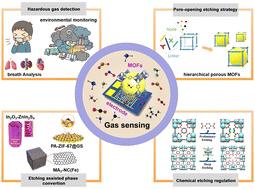
A growing need for accurate monitoring of both outdoor and indoor pollution sources demands enhanced gas sensors with improved sensitivity, selectivity, stability, fast response and low detection limits. Metal–organic frameworks (MOFs), a class of porous materials, stand out as superior candidates for high performance gas detection due to their exceptional structure characteristics, including tunable porosity, limitless structural motifs, and customizable chemical components. Tailoring the structure and functionalization of MOFs through etching has opened up new opportunities to adjust the gas-sensing capabilities of MOFs. In this review article, we provide a concise overview of the most recent advancements in three distinct aspects of etching MOFs: pore engineering, chemical modification, and transformation of MOFs into targeted derivatives. Despite extensive progress, research on etching strategies to elucidate the intricate relationship between the innovative structure and the sensing properties remains in its infancy. Focusing on MOFs and their derivative-based gas sensors with distinct critical structural features, the schemes to enhance sensor performance are introduced. We also outline the current barriers and future prospects in the field of gas sensing. This review seeks to offer guidance on modulating MOF-based gas sensors by strategically applying efficient etching methods, navigating contemporary challenges and future prospects in the gas sensing field.
期刊介绍:
The Journal of Materials Chemistry is divided into three distinct sections, A, B, and C, each catering to specific applications of the materials under study:
Journal of Materials Chemistry A focuses primarily on materials intended for applications in energy and sustainability.
Journal of Materials Chemistry B specializes in materials designed for applications in biology and medicine.
Journal of Materials Chemistry C is dedicated to materials suitable for applications in optical, magnetic, and electronic devices.
Example topic areas within the scope of Journal of Materials Chemistry C are listed below. This list is neither exhaustive nor exclusive.
Bioelectronics
Conductors
Detectors
Dielectrics
Displays
Ferroelectrics
Lasers
LEDs
Lighting
Liquid crystals
Memory
Metamaterials
Multiferroics
Photonics
Photovoltaics
Semiconductors
Sensors
Single molecule conductors
Spintronics
Superconductors
Thermoelectrics
Topological insulators
Transistors




 京公网安备 11010802042870号
京ICP备2023020795号-1
京公网安备 11010802042870号
京ICP备2023020795号-1

 分享
分享
 求助内容:
求助内容: 应助结果提醒方式:
 扫码关注我们
