Katie L Hesketh, Sam O Shepherd, Anton J M Wagenmakers, Matthew Cocks, Juliette A Strauss
{"title":"自定速冲刺间歇训练和低量HIIT对心肺健康的影响:心率和能量输出的作用。","authors":"Katie L Hesketh, Sam O Shepherd, Anton J M Wagenmakers, Matthew Cocks, Juliette A Strauss","doi":"10.3389/fphys.2025.1484722","DOIUrl":null,"url":null,"abstract":"<p><strong>Aim: </strong>The primary aim was to assess the efficacy of self-paced sprint interval training (SIT) with low-volume high-intensity interval training (LV-HIIT) when performed without encouragement on improving cardiorespiratory fitness (CRF). A secondary aim was to explore whether the effort exerted during protocols [power output (PO) and heart rate (HR)] influenced the change in CRF.</p><p><strong>Methods: </strong>In a randomised cross-over design, 82 previously inactive adults (m/f: 26/56, 28 ± 10 years, BMI 25 ± 3 kg m<sup>-2</sup>) undertook 6-weeks of self-paced SIT (4-8 × 30 s with 120 s recovery) or LV-HIIT (6-10 × 1 min with 1 min recovery) separated by a 4-week washout period. Sessions were completed 3×/week using WattBikes, and a target of >80% HRmax was suggested during the intervals. Markers of cardio-metabolic health were assessed before and after each intervention.</p><p><strong>Results: </strong>Training increased VO<sub>2peak</sub> (SIT +3.1 ± 0.4 mL kg<sup>-1</sup> min<sup>-1</sup>, LV-HIIT +2.7 ± 1.2 mL kg<sup>-1</sup> min<sup>-1</sup>, <i>P</i> < 0.001) and decreased body fat % (<i>P</i> = 0.002), aortic pulse wave velocity (<i>P</i> = 0.002) and glucose tolerance 120 min following an oral glucose tolerance test (<i>P</i> = 0.024), with no difference between protocols (<i>P</i> > 0.05). When grouping participants into tertiles based on HR and PO responses (n = 27), those achieving a low HR had similar changes in VO<sub>2peak</sub> compared to the high HR group in both interventions (<i>P</i> > 0.05). For LV-HIIT, participants in the highest tertile for peak PO had a greater change in VO<sub>2peak</sub> compared to all other participants (Low 1.8 ± 4.1 mL kg<sup>-1</sup> min<sup>-1</sup>, Medium 1.9 ± 3.3 mL kg<sup>-1</sup> min<sup>-1</sup>, High 4.3 ± 3.6 ml kg<sup>-1</sup> min<sup>-1</sup>, <i>P</i> = 0.020).</p><p><strong>Discussion: </strong>Six-weeks of self-paced SIT and LV-HIIT induce comparable improvements in CRF, body composition, arterial stiffness and glucose tolerance. Importantly, higher HR did not elicit superior changes in CRF, but PO achieved during LV-HIIT may influence improvements.</p>","PeriodicalId":12477,"journal":{"name":"Frontiers in Physiology","volume":"16 ","pages":"1484722"},"PeriodicalIF":4.3000,"publicationDate":"2025-02-05","publicationTypes":"Journal Article","fieldsOfStudy":null,"isOpenAccess":false,"openAccessPdf":"https://www.ncbi.nlm.nih.gov/pmc/articles/PMC11835828/pdf/","citationCount":"0","resultStr":"{\"title\":\"Effect of self-paced sprint interval training and low-volume HIIT on cardiorespiratory fitness: the role of heart rate and power output.\",\"authors\":\"Katie L Hesketh, Sam O Shepherd, Anton J M Wagenmakers, Matthew Cocks, Juliette A Strauss\",\"doi\":\"10.3389/fphys.2025.1484722\",\"DOIUrl\":null,\"url\":null,\"abstract\":\"<p><strong>Aim: </strong>The primary aim was to assess the efficacy of self-paced sprint interval training (SIT) with low-volume high-intensity interval training (LV-HIIT) when performed without encouragement on improving cardiorespiratory fitness (CRF). A secondary aim was to explore whether the effort exerted during protocols [power output (PO) and heart rate (HR)] influenced the change in CRF.</p><p><strong>Methods: </strong>In a randomised cross-over design, 82 previously inactive adults (m/f: 26/56, 28 ± 10 years, BMI 25 ± 3 kg m<sup>-2</sup>) undertook 6-weeks of self-paced SIT (4-8 × 30 s with 120 s recovery) or LV-HIIT (6-10 × 1 min with 1 min recovery) separated by a 4-week washout period. Sessions were completed 3×/week using WattBikes, and a target of >80% HRmax was suggested during the intervals. Markers of cardio-metabolic health were assessed before and after each intervention.</p><p><strong>Results: </strong>Training increased VO<sub>2peak</sub> (SIT +3.1 ± 0.4 mL kg<sup>-1</sup> min<sup>-1</sup>, LV-HIIT +2.7 ± 1.2 mL kg<sup>-1</sup> min<sup>-1</sup>, <i>P</i> < 0.001) and decreased body fat % (<i>P</i> = 0.002), aortic pulse wave velocity (<i>P</i> = 0.002) and glucose tolerance 120 min following an oral glucose tolerance test (<i>P</i> = 0.024), with no difference between protocols (<i>P</i> > 0.05). When grouping participants into tertiles based on HR and PO responses (n = 27), those achieving a low HR had similar changes in VO<sub>2peak</sub> compared to the high HR group in both interventions (<i>P</i> > 0.05). For LV-HIIT, participants in the highest tertile for peak PO had a greater change in VO<sub>2peak</sub> compared to all other participants (Low 1.8 ± 4.1 mL kg<sup>-1</sup> min<sup>-1</sup>, Medium 1.9 ± 3.3 mL kg<sup>-1</sup> min<sup>-1</sup>, High 4.3 ± 3.6 ml kg<sup>-1</sup> min<sup>-1</sup>, <i>P</i> = 0.020).</p><p><strong>Discussion: </strong>Six-weeks of self-paced SIT and LV-HIIT induce comparable improvements in CRF, body composition, arterial stiffness and glucose tolerance. Importantly, higher HR did not elicit superior changes in CRF, but PO achieved during LV-HIIT may influence improvements.</p>\",\"PeriodicalId\":12477,\"journal\":{\"name\":\"Frontiers in Physiology\",\"volume\":\"16 \",\"pages\":\"1484722\"},\"PeriodicalIF\":4.3000,\"publicationDate\":\"2025-02-05\",\"publicationTypes\":\"Journal Article\",\"fieldsOfStudy\":null,\"isOpenAccess\":false,\"openAccessPdf\":\"https://www.ncbi.nlm.nih.gov/pmc/articles/PMC11835828/pdf/\",\"citationCount\":\"0\",\"resultStr\":null,\"platform\":\"Semanticscholar\",\"paperid\":null,\"PeriodicalName\":\"Frontiers in Physiology\",\"FirstCategoryId\":\"3\",\"ListUrlMain\":\"https://doi.org/10.3389/fphys.2025.1484722\",\"RegionNum\":3,\"RegionCategory\":\"医学\",\"ArticlePicture\":[],\"TitleCN\":null,\"AbstractTextCN\":null,\"PMCID\":null,\"EPubDate\":\"2025/1/1 0:00:00\",\"PubModel\":\"eCollection\",\"JCR\":\"Q2\",\"JCRName\":\"PHYSIOLOGY\",\"Score\":null,\"Total\":0}","platform":"Semanticscholar","paperid":null,"PeriodicalName":"Frontiers in Physiology","FirstCategoryId":"3","ListUrlMain":"https://doi.org/10.3389/fphys.2025.1484722","RegionNum":3,"RegionCategory":"医学","ArticlePicture":[],"TitleCN":null,"AbstractTextCN":null,"PMCID":null,"EPubDate":"2025/1/1 0:00:00","PubModel":"eCollection","JCR":"Q2","JCRName":"PHYSIOLOGY","Score":null,"Total":0}
引用次数: 0
摘要
目的:主要目的是评估自定速冲刺间歇训练(SIT)与低容量高强度间歇训练(LV-HIIT)在没有鼓励的情况下对改善心肺功能(CRF)的效果。第二个目的是探讨在方案中施加的努力[功率输出(PO)和心率(HR)]是否影响CRF的变化。方法:在一项随机交叉设计中,82名先前不运动的成年人(身高:26/56,28±10岁,BMI 25±3 kg m-2)进行了6周的自定节奏SIT (4-8 × 30秒,恢复120秒)或LV-HIIT (6-10 × 1分钟,恢复1分钟),中间间隔4周洗脱期。使用WattBikes完成3次/周的训练,并建议在间歇时间内将HRmax的目标设定为80 - 80%。在每次干预前后评估心脏代谢健康指标。结果:训练提高了VO2peak (SIT +3.1±0.4 mL kg-1 min-1, LV-HIIT +2.7±1.2 mL kg-1 min-1, P < 0.001),降低了体脂率(P = 0.002)、主动脉脉波速度(P = 0.002)和口服葡萄糖耐量试验后120 min的葡萄糖耐量(P = 0.024),两种方案之间无差异(P < 0.05)。当根据HR和PO反应将参与者分组时(n = 27),在两种干预措施中,低HR组的vo2峰值变化与高HR组相似(P > 0.05)。对于LV-HIIT, PO峰值最高分位数的参与者与其他所有参与者相比,vo2峰值的变化更大(低1.8±4.1 mL kg-1 min-1,中1.9±3.3 mL kg-1 min-1,高4.3±3.6 mL kg-1 min-1, P = 0.020)。讨论:6周的自定节奏SIT和LV-HIIT可诱导CRF、身体成分、动脉硬度和葡萄糖耐量的类似改善。重要的是,更高的HR并没有引起更好的CRF变化,但在LV-HIIT期间达到的PO可能会影响改善。
Effect of self-paced sprint interval training and low-volume HIIT on cardiorespiratory fitness: the role of heart rate and power output.
Aim: The primary aim was to assess the efficacy of self-paced sprint interval training (SIT) with low-volume high-intensity interval training (LV-HIIT) when performed without encouragement on improving cardiorespiratory fitness (CRF). A secondary aim was to explore whether the effort exerted during protocols [power output (PO) and heart rate (HR)] influenced the change in CRF.
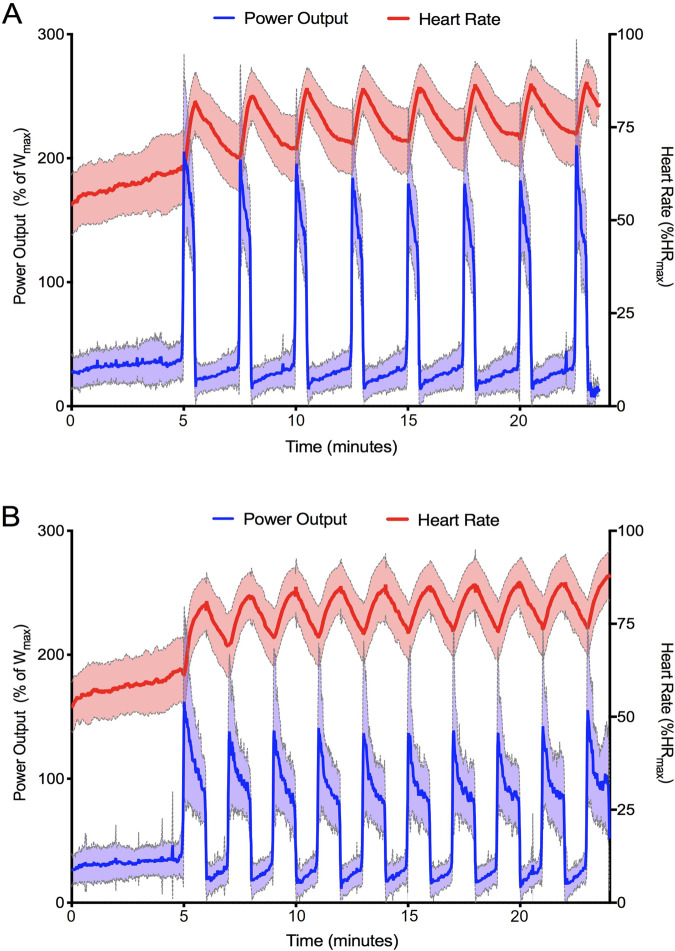
Methods: In a randomised cross-over design, 82 previously inactive adults (m/f: 26/56, 28 ± 10 years, BMI 25 ± 3 kg m-2) undertook 6-weeks of self-paced SIT (4-8 × 30 s with 120 s recovery) or LV-HIIT (6-10 × 1 min with 1 min recovery) separated by a 4-week washout period. Sessions were completed 3×/week using WattBikes, and a target of >80% HRmax was suggested during the intervals. Markers of cardio-metabolic health were assessed before and after each intervention.
Results: Training increased VO2peak (SIT +3.1 ± 0.4 mL kg-1 min-1, LV-HIIT +2.7 ± 1.2 mL kg-1 min-1, P < 0.001) and decreased body fat % (P = 0.002), aortic pulse wave velocity (P = 0.002) and glucose tolerance 120 min following an oral glucose tolerance test (P = 0.024), with no difference between protocols (P > 0.05). When grouping participants into tertiles based on HR and PO responses (n = 27), those achieving a low HR had similar changes in VO2peak compared to the high HR group in both interventions (P > 0.05). For LV-HIIT, participants in the highest tertile for peak PO had a greater change in VO2peak compared to all other participants (Low 1.8 ± 4.1 mL kg-1 min-1, Medium 1.9 ± 3.3 mL kg-1 min-1, High 4.3 ± 3.6 ml kg-1 min-1, P = 0.020).
Discussion: Six-weeks of self-paced SIT and LV-HIIT induce comparable improvements in CRF, body composition, arterial stiffness and glucose tolerance. Importantly, higher HR did not elicit superior changes in CRF, but PO achieved during LV-HIIT may influence improvements.
期刊介绍:
Frontiers in Physiology is a leading journal in its field, publishing rigorously peer-reviewed research on the physiology of living systems, from the subcellular and molecular domains to the intact organism, and its interaction with the environment. Field Chief Editor George E. Billman at the Ohio State University Columbus is supported by an outstanding Editorial Board of international researchers. This multidisciplinary open-access journal is at the forefront of disseminating and communicating scientific knowledge and impactful discoveries to researchers, academics, clinicians and the public worldwide.






 京公网安备 11010802042870号
京ICP备2023020795号-1
京公网安备 11010802042870号
京ICP备2023020795号-1

 分享
分享
 求助内容:
求助内容: 应助结果提醒方式:
 扫码关注我们
