{"title":"免疫效应细胞相关的血液毒性:机制、临床表现和管理策略。","authors":"Ofrat Beyar-Katz, Kai Rejeski, Roni Shouval","doi":"10.3324/haematol.2024.286027","DOIUrl":null,"url":null,"abstract":"<p><p>Chimeric antigen receptor (CAR) T-cell therapy has transformed the treatment landscape for hematologic malignancies. However, it is frequently complicated by immune effector cell-associated hematotoxicity (ICAHT), a potentially life-threatening adverse event encompassing neutropenia, anemia, and thrombocytopenia. These cytopenias elevate the risk of severe infections, transfusion dependence, and prolonged hospital stays, contributing substantially to morbidity and non-relapse mortality. This review delineates the incidence, mechanisms, and risk factors for ICAHT, highlighting the complex interplay between disease burden, a patient's immune status, and features of the CAR T-cell products. Standardized grading systems, based on the depth and duration of neutropenia, have improved the classification of ICAHT and enabled more consistent risk stratification. Current prophylactic and therapeutic strategies, ranging from growth factor administration to hematopoietic stem cell boosts for refractory cases, are discussed, emphasizing tailored approaches to mitigate severe and prolonged hematotoxicity. These management strategies highlight the need for targeted interventions to prevent ICAHT without compromising the efficacy of the CAR T cells. As CAR T-cell therapy broadens to new indications, optimized ICAHT management could enhance patients' outcomes, reduce healthcare utilization, and increase therapy accessibility.</p>","PeriodicalId":12964,"journal":{"name":"Haematologica","volume":" ","pages":"1254-1268"},"PeriodicalIF":7.9000,"publicationDate":"2025-06-01","publicationTypes":"Journal Article","fieldsOfStudy":null,"isOpenAccess":false,"openAccessPdf":"https://www.ncbi.nlm.nih.gov/pmc/articles/PMC12130777/pdf/","citationCount":"0","resultStr":"{\"title\":\"Immune effector cell-associated hematotoxicity: mechanisms, clinical manifestations, and management strategies.\",\"authors\":\"Ofrat Beyar-Katz, Kai Rejeski, Roni Shouval\",\"doi\":\"10.3324/haematol.2024.286027\",\"DOIUrl\":null,\"url\":null,\"abstract\":\"<p><p>Chimeric antigen receptor (CAR) T-cell therapy has transformed the treatment landscape for hematologic malignancies. However, it is frequently complicated by immune effector cell-associated hematotoxicity (ICAHT), a potentially life-threatening adverse event encompassing neutropenia, anemia, and thrombocytopenia. These cytopenias elevate the risk of severe infections, transfusion dependence, and prolonged hospital stays, contributing substantially to morbidity and non-relapse mortality. This review delineates the incidence, mechanisms, and risk factors for ICAHT, highlighting the complex interplay between disease burden, a patient's immune status, and features of the CAR T-cell products. Standardized grading systems, based on the depth and duration of neutropenia, have improved the classification of ICAHT and enabled more consistent risk stratification. Current prophylactic and therapeutic strategies, ranging from growth factor administration to hematopoietic stem cell boosts for refractory cases, are discussed, emphasizing tailored approaches to mitigate severe and prolonged hematotoxicity. These management strategies highlight the need for targeted interventions to prevent ICAHT without compromising the efficacy of the CAR T cells. As CAR T-cell therapy broadens to new indications, optimized ICAHT management could enhance patients' outcomes, reduce healthcare utilization, and increase therapy accessibility.</p>\",\"PeriodicalId\":12964,\"journal\":{\"name\":\"Haematologica\",\"volume\":\" \",\"pages\":\"1254-1268\"},\"PeriodicalIF\":7.9000,\"publicationDate\":\"2025-06-01\",\"publicationTypes\":\"Journal Article\",\"fieldsOfStudy\":null,\"isOpenAccess\":false,\"openAccessPdf\":\"https://www.ncbi.nlm.nih.gov/pmc/articles/PMC12130777/pdf/\",\"citationCount\":\"0\",\"resultStr\":null,\"platform\":\"Semanticscholar\",\"paperid\":null,\"PeriodicalName\":\"Haematologica\",\"FirstCategoryId\":\"3\",\"ListUrlMain\":\"https://doi.org/10.3324/haematol.2024.286027\",\"RegionNum\":1,\"RegionCategory\":\"医学\",\"ArticlePicture\":[],\"TitleCN\":null,\"AbstractTextCN\":null,\"PMCID\":null,\"EPubDate\":\"2025/2/20 0:00:00\",\"PubModel\":\"Epub\",\"JCR\":\"Q1\",\"JCRName\":\"HEMATOLOGY\",\"Score\":null,\"Total\":0}","platform":"Semanticscholar","paperid":null,"PeriodicalName":"Haematologica","FirstCategoryId":"3","ListUrlMain":"https://doi.org/10.3324/haematol.2024.286027","RegionNum":1,"RegionCategory":"医学","ArticlePicture":[],"TitleCN":null,"AbstractTextCN":null,"PMCID":null,"EPubDate":"2025/2/20 0:00:00","PubModel":"Epub","JCR":"Q1","JCRName":"HEMATOLOGY","Score":null,"Total":0}
Immune effector cell-associated hematotoxicity: mechanisms, clinical manifestations, and management strategies.
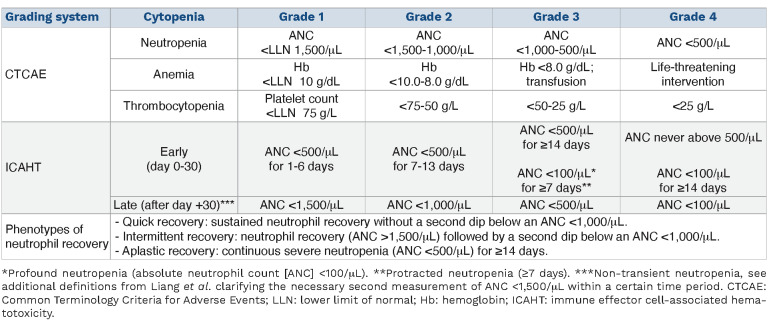
Chimeric antigen receptor (CAR) T-cell therapy has transformed the treatment landscape for hematologic malignancies. However, it is frequently complicated by immune effector cell-associated hematotoxicity (ICAHT), a potentially life-threatening adverse event encompassing neutropenia, anemia, and thrombocytopenia. These cytopenias elevate the risk of severe infections, transfusion dependence, and prolonged hospital stays, contributing substantially to morbidity and non-relapse mortality. This review delineates the incidence, mechanisms, and risk factors for ICAHT, highlighting the complex interplay between disease burden, a patient's immune status, and features of the CAR T-cell products. Standardized grading systems, based on the depth and duration of neutropenia, have improved the classification of ICAHT and enabled more consistent risk stratification. Current prophylactic and therapeutic strategies, ranging from growth factor administration to hematopoietic stem cell boosts for refractory cases, are discussed, emphasizing tailored approaches to mitigate severe and prolonged hematotoxicity. These management strategies highlight the need for targeted interventions to prevent ICAHT without compromising the efficacy of the CAR T cells. As CAR T-cell therapy broadens to new indications, optimized ICAHT management could enhance patients' outcomes, reduce healthcare utilization, and increase therapy accessibility.
期刊介绍:
Haematologica is a journal that publishes articles within the broad field of hematology. It reports on novel findings in basic, clinical, and translational research.
Scope:
The scope of the journal includes reporting novel research results that:
Have a significant impact on understanding normal hematology or the development of hematological diseases.
Are likely to bring important changes to the diagnosis or treatment of hematological diseases.






 京公网安备 11010802042870号
京ICP备2023020795号-1
京公网安备 11010802042870号
京ICP备2023020795号-1

 分享
分享
 求助内容:
求助内容: 应助结果提醒方式:
 扫码关注我们
