Mark Damante, Santino Cua, Daniel Kreatsoulas, Pierre Giglio, Luma Ghalib, Chandrima Biswas, Kyle C Wu, Daniel M Prevedello
{"title":"BRAF和MEK抑制时代乳头状颅咽管瘤的治疗。","authors":"Mark Damante, Santino Cua, Daniel Kreatsoulas, Pierre Giglio, Luma Ghalib, Chandrima Biswas, Kyle C Wu, Daniel M Prevedello","doi":"10.1007/s11060-025-04969-3","DOIUrl":null,"url":null,"abstract":"<p><strong>Purpose: </strong>Papillary craniopharyngioma is a rare entity, demonstrating BRAF-V600E mutations in approximately 95% of patients. Recently, a phase 2 trial of patients treated with surgery and BRAF/MEKi demonstrated 91% reduction in residual tumor volume. This study allowed for additional treatments at the discretion of the treatment team without reporting subsequent rates of endocrinopathy or visual decline. We aimed to evaluate the possibility of employing BRAF/MEKi without the need for adjuvant radiotherapy therapies.</p><p><strong>Methods: </strong>A retrospective report of two patients treated with resection and BRAF/MEKi without additional treatment were analyzed. Patient demographics, treatment characteristics, pre- and post-treatment radiographic volumes, adverse events, and endocrinologic and visual outcomes, were recorded and analyzed.</p><p><strong>Results: </strong>Two patients underwent subtotal resection followed by BRAF/MEKi without adjuvant treatment. Mean length of BRAF therapy was 21.4 months and MEKi therapy was 12.94 months. Mean preoperative nodule volume was 0.33 cm [3] and 2.29 cm [3] and cystic volume was 5.04 cm [3] and 6.18 cm [3] in case 1 and case 2, respectively. Neither patient received radiation. Grade 3 cardiotoxicity developed in case 1 after 6.5 months, with function recovering completely following discontinuation of MEKi. BRAF therapy was discontinued electively after 23.5 months. The second patient remains on dual inhibition therapy without toxicity. For these cases, post-treatment nodule volumes are 0.07 cm [3] (98.4% reduction) and 0.04 cm [3] (99.2% reduction), respectively, and cystic volume 0.0 cm [3] in both patients. Progression free survival is 100% with a mean follow up of 36-months.</p><p><strong>Conclusions: </strong>Utilizing surgery and BRAF/MEKi without adjuvant radiation, we demonstrate excellent disease control with reversible toxicity. Avoiding additional treatments may spare vital functions and unnecessary procedures.</p>","PeriodicalId":16425,"journal":{"name":"Journal of Neuro-Oncology","volume":" ","pages":"225-232"},"PeriodicalIF":3.1000,"publicationDate":"2025-05-01","publicationTypes":"Journal Article","fieldsOfStudy":null,"isOpenAccess":false,"openAccessPdf":"https://www.ncbi.nlm.nih.gov/pmc/articles/PMC12041032/pdf/","citationCount":"0","resultStr":"{\"title\":\"Papillary craniopharyngioma management in the era of BRAF and MEK inhibition.\",\"authors\":\"Mark Damante, Santino Cua, Daniel Kreatsoulas, Pierre Giglio, Luma Ghalib, Chandrima Biswas, Kyle C Wu, Daniel M Prevedello\",\"doi\":\"10.1007/s11060-025-04969-3\",\"DOIUrl\":null,\"url\":null,\"abstract\":\"<p><strong>Purpose: </strong>Papillary craniopharyngioma is a rare entity, demonstrating BRAF-V600E mutations in approximately 95% of patients. Recently, a phase 2 trial of patients treated with surgery and BRAF/MEKi demonstrated 91% reduction in residual tumor volume. This study allowed for additional treatments at the discretion of the treatment team without reporting subsequent rates of endocrinopathy or visual decline. We aimed to evaluate the possibility of employing BRAF/MEKi without the need for adjuvant radiotherapy therapies.</p><p><strong>Methods: </strong>A retrospective report of two patients treated with resection and BRAF/MEKi without additional treatment were analyzed. Patient demographics, treatment characteristics, pre- and post-treatment radiographic volumes, adverse events, and endocrinologic and visual outcomes, were recorded and analyzed.</p><p><strong>Results: </strong>Two patients underwent subtotal resection followed by BRAF/MEKi without adjuvant treatment. Mean length of BRAF therapy was 21.4 months and MEKi therapy was 12.94 months. Mean preoperative nodule volume was 0.33 cm [3] and 2.29 cm [3] and cystic volume was 5.04 cm [3] and 6.18 cm [3] in case 1 and case 2, respectively. Neither patient received radiation. Grade 3 cardiotoxicity developed in case 1 after 6.5 months, with function recovering completely following discontinuation of MEKi. BRAF therapy was discontinued electively after 23.5 months. The second patient remains on dual inhibition therapy without toxicity. For these cases, post-treatment nodule volumes are 0.07 cm [3] (98.4% reduction) and 0.04 cm [3] (99.2% reduction), respectively, and cystic volume 0.0 cm [3] in both patients. Progression free survival is 100% with a mean follow up of 36-months.</p><p><strong>Conclusions: </strong>Utilizing surgery and BRAF/MEKi without adjuvant radiation, we demonstrate excellent disease control with reversible toxicity. Avoiding additional treatments may spare vital functions and unnecessary procedures.</p>\",\"PeriodicalId\":16425,\"journal\":{\"name\":\"Journal of Neuro-Oncology\",\"volume\":\" \",\"pages\":\"225-232\"},\"PeriodicalIF\":3.1000,\"publicationDate\":\"2025-05-01\",\"publicationTypes\":\"Journal Article\",\"fieldsOfStudy\":null,\"isOpenAccess\":false,\"openAccessPdf\":\"https://www.ncbi.nlm.nih.gov/pmc/articles/PMC12041032/pdf/\",\"citationCount\":\"0\",\"resultStr\":null,\"platform\":\"Semanticscholar\",\"paperid\":null,\"PeriodicalName\":\"Journal of Neuro-Oncology\",\"FirstCategoryId\":\"3\",\"ListUrlMain\":\"https://doi.org/10.1007/s11060-025-04969-3\",\"RegionNum\":2,\"RegionCategory\":\"医学\",\"ArticlePicture\":[],\"TitleCN\":null,\"AbstractTextCN\":null,\"PMCID\":null,\"EPubDate\":\"2025/2/20 0:00:00\",\"PubModel\":\"Epub\",\"JCR\":\"Q2\",\"JCRName\":\"CLINICAL NEUROLOGY\",\"Score\":null,\"Total\":0}","platform":"Semanticscholar","paperid":null,"PeriodicalName":"Journal of Neuro-Oncology","FirstCategoryId":"3","ListUrlMain":"https://doi.org/10.1007/s11060-025-04969-3","RegionNum":2,"RegionCategory":"医学","ArticlePicture":[],"TitleCN":null,"AbstractTextCN":null,"PMCID":null,"EPubDate":"2025/2/20 0:00:00","PubModel":"Epub","JCR":"Q2","JCRName":"CLINICAL NEUROLOGY","Score":null,"Total":0}
Papillary craniopharyngioma management in the era of BRAF and MEK inhibition.
Purpose: Papillary craniopharyngioma is a rare entity, demonstrating BRAF-V600E mutations in approximately 95% of patients. Recently, a phase 2 trial of patients treated with surgery and BRAF/MEKi demonstrated 91% reduction in residual tumor volume. This study allowed for additional treatments at the discretion of the treatment team without reporting subsequent rates of endocrinopathy or visual decline. We aimed to evaluate the possibility of employing BRAF/MEKi without the need for adjuvant radiotherapy therapies.
Methods: A retrospective report of two patients treated with resection and BRAF/MEKi without additional treatment were analyzed. Patient demographics, treatment characteristics, pre- and post-treatment radiographic volumes, adverse events, and endocrinologic and visual outcomes, were recorded and analyzed.
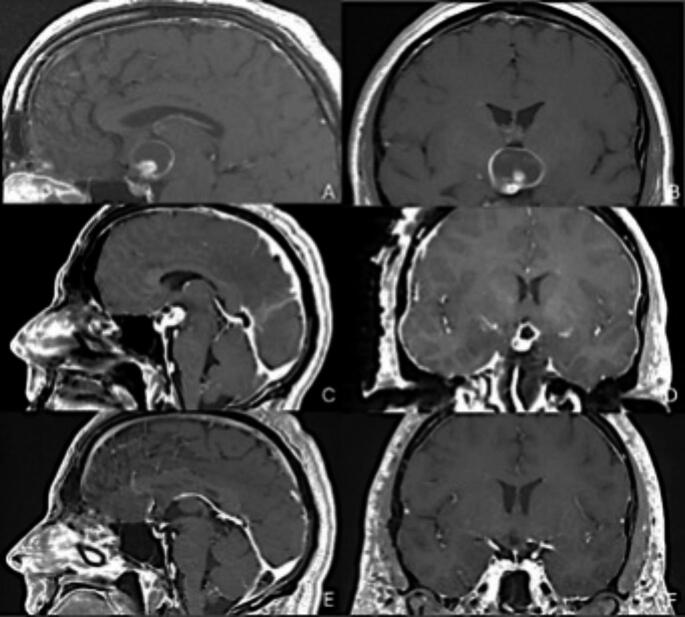
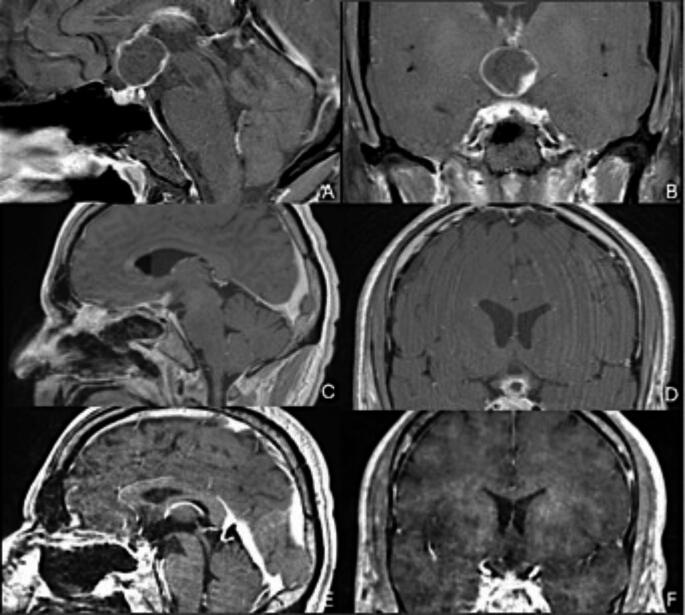
Results: Two patients underwent subtotal resection followed by BRAF/MEKi without adjuvant treatment. Mean length of BRAF therapy was 21.4 months and MEKi therapy was 12.94 months. Mean preoperative nodule volume was 0.33 cm [3] and 2.29 cm [3] and cystic volume was 5.04 cm [3] and 6.18 cm [3] in case 1 and case 2, respectively. Neither patient received radiation. Grade 3 cardiotoxicity developed in case 1 after 6.5 months, with function recovering completely following discontinuation of MEKi. BRAF therapy was discontinued electively after 23.5 months. The second patient remains on dual inhibition therapy without toxicity. For these cases, post-treatment nodule volumes are 0.07 cm [3] (98.4% reduction) and 0.04 cm [3] (99.2% reduction), respectively, and cystic volume 0.0 cm [3] in both patients. Progression free survival is 100% with a mean follow up of 36-months.
Conclusions: Utilizing surgery and BRAF/MEKi without adjuvant radiation, we demonstrate excellent disease control with reversible toxicity. Avoiding additional treatments may spare vital functions and unnecessary procedures.
期刊介绍:
The Journal of Neuro-Oncology is a multi-disciplinary journal encompassing basic, applied, and clinical investigations in all research areas as they relate to cancer and the central nervous system. It provides a single forum for communication among neurologists, neurosurgeons, radiotherapists, medical oncologists, neuropathologists, neurodiagnosticians, and laboratory-based oncologists conducting relevant research. The Journal of Neuro-Oncology does not seek to isolate the field, but rather to focus the efforts of many disciplines in one publication through a format which pulls together these diverse interests. More than any other field of oncology, cancer of the central nervous system requires multi-disciplinary approaches. To alleviate having to scan dozens of journals of cell biology, pathology, laboratory and clinical endeavours, JNO is a periodical in which current, high-quality, relevant research in all aspects of neuro-oncology may be found.




 京公网安备 11010802042870号
京ICP备2023020795号-1
京公网安备 11010802042870号
京ICP备2023020795号-1

 分享
分享
 求助内容:
求助内容: 应助结果提醒方式:
 扫码关注我们
