Natalia Saudade de Aguiar , Gustavo Galo Marcheafave , Elis Daiane Pauli , Manoela Mendes Duarte , Ieda Spacino Scarminio , Roy Edward Bruns , Romà Tauler , Marcelo Lazzarotto , Ivar Wendling
{"title":"利用AComDim进行多块近红外和MIR光谱打印,评价生长地点、收获季节和无性系对马茶叶片成分的影响","authors":"Natalia Saudade de Aguiar , Gustavo Galo Marcheafave , Elis Daiane Pauli , Manoela Mendes Duarte , Ieda Spacino Scarminio , Roy Edward Bruns , Romà Tauler , Marcelo Lazzarotto , Ivar Wendling","doi":"10.1016/j.foodchem.2025.143459","DOIUrl":null,"url":null,"abstract":"<div><div>The composition of yerba mate implies significant potential in the food, pharmaceutical, and cosmetic industries, which requires standardization of the raw material. This study explores the simultaneous influence of growing sites, harvest seasons, and clones on the spectralprint of leaves through near-infrared (NIR) and mid-infrared (MIR) spectroscopy coupled with ANOVA Common Dimensions (AComDim) multivariate analysis. MIR spectroscopy identifies only the main effects of growing site and harvesting season, and the interaction between these factors. The NIR spectralprint identifies all main effects and interactions. Growing site and harvesting season individually account for approximately 7 % of the variance in the chemical composition of yerba mate, with their interaction contributing with 5.7 %. Clonal variation significantly affects the spectral profile with approximately 4 % variance, which allowed the identification of clones with the highest chemical divergence. The study demonstrates that biospectroscopics and chemometrics can enhance yerba mate quality through clonal selection and optimized agricultural practices.</div></div>","PeriodicalId":318,"journal":{"name":"Food Chemistry","volume":"477 ","pages":"Article 143459"},"PeriodicalIF":9.8000,"publicationDate":"2025-06-15","publicationTypes":"Journal Article","fieldsOfStudy":null,"isOpenAccess":false,"openAccessPdf":"","citationCount":"0","resultStr":"{\"title\":\"Multiblock NIR and MIR spectralprint through AComDim to evaluate the effects of growing site, harvest season, and clone on yerba mate leaves composition\",\"authors\":\"Natalia Saudade de Aguiar , Gustavo Galo Marcheafave , Elis Daiane Pauli , Manoela Mendes Duarte , Ieda Spacino Scarminio , Roy Edward Bruns , Romà Tauler , Marcelo Lazzarotto , Ivar Wendling\",\"doi\":\"10.1016/j.foodchem.2025.143459\",\"DOIUrl\":null,\"url\":null,\"abstract\":\"<div><div>The composition of yerba mate implies significant potential in the food, pharmaceutical, and cosmetic industries, which requires standardization of the raw material. This study explores the simultaneous influence of growing sites, harvest seasons, and clones on the spectralprint of leaves through near-infrared (NIR) and mid-infrared (MIR) spectroscopy coupled with ANOVA Common Dimensions (AComDim) multivariate analysis. MIR spectroscopy identifies only the main effects of growing site and harvesting season, and the interaction between these factors. The NIR spectralprint identifies all main effects and interactions. Growing site and harvesting season individually account for approximately 7 % of the variance in the chemical composition of yerba mate, with their interaction contributing with 5.7 %. Clonal variation significantly affects the spectral profile with approximately 4 % variance, which allowed the identification of clones with the highest chemical divergence. The study demonstrates that biospectroscopics and chemometrics can enhance yerba mate quality through clonal selection and optimized agricultural practices.</div></div>\",\"PeriodicalId\":318,\"journal\":{\"name\":\"Food Chemistry\",\"volume\":\"477 \",\"pages\":\"Article 143459\"},\"PeriodicalIF\":9.8000,\"publicationDate\":\"2025-06-15\",\"publicationTypes\":\"Journal Article\",\"fieldsOfStudy\":null,\"isOpenAccess\":false,\"openAccessPdf\":\"\",\"citationCount\":\"0\",\"resultStr\":null,\"platform\":\"Semanticscholar\",\"paperid\":null,\"PeriodicalName\":\"Food Chemistry\",\"FirstCategoryId\":\"97\",\"ListUrlMain\":\"https://www.sciencedirect.com/science/article/pii/S0308814625007101\",\"RegionNum\":1,\"RegionCategory\":\"农林科学\",\"ArticlePicture\":[],\"TitleCN\":null,\"AbstractTextCN\":null,\"PMCID\":null,\"EPubDate\":\"2025/2/20 0:00:00\",\"PubModel\":\"Epub\",\"JCR\":\"Q1\",\"JCRName\":\"CHEMISTRY, APPLIED\",\"Score\":null,\"Total\":0}","platform":"Semanticscholar","paperid":null,"PeriodicalName":"Food Chemistry","FirstCategoryId":"97","ListUrlMain":"https://www.sciencedirect.com/science/article/pii/S0308814625007101","RegionNum":1,"RegionCategory":"农林科学","ArticlePicture":[],"TitleCN":null,"AbstractTextCN":null,"PMCID":null,"EPubDate":"2025/2/20 0:00:00","PubModel":"Epub","JCR":"Q1","JCRName":"CHEMISTRY, APPLIED","Score":null,"Total":0}
引用次数: 0
摘要
马黛茶的成分在食品、制药和化妆品行业中具有巨大的潜力,这些行业需要对原料进行标准化。本研究通过近红外(NIR)和中红外(MIR)光谱结合方差分析(ANOVA Common Dimensions, AComDim)多变量分析,探讨了生长地点、收获季节和无性系对叶片光谱图谱的同时影响。MIR光谱只确定生长地点和收获季节的主要影响,以及这些因素之间的相互作用。近红外光谱识别所有主要影响和相互作用。生长地点和收获季节单独占马黛茶化学成分方差的约7 %,其相互作用贡献5.7% %。克隆变异对光谱分布有显著影响,方差约为4 %,这使得鉴定具有最高化学差异的克隆成为可能。研究表明,生物光谱和化学计量学可以通过克隆选择和优化农业实践来提高马黛茶的品质。
Multiblock NIR and MIR spectralprint through AComDim to evaluate the effects of growing site, harvest season, and clone on yerba mate leaves composition
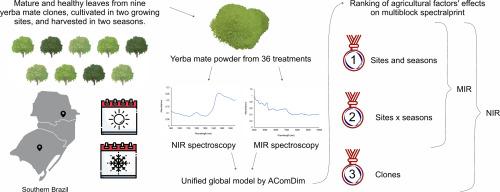
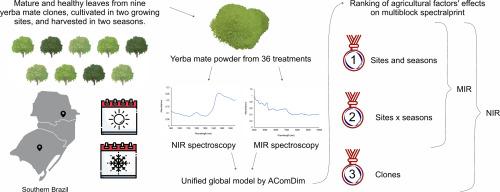
The composition of yerba mate implies significant potential in the food, pharmaceutical, and cosmetic industries, which requires standardization of the raw material. This study explores the simultaneous influence of growing sites, harvest seasons, and clones on the spectralprint of leaves through near-infrared (NIR) and mid-infrared (MIR) spectroscopy coupled with ANOVA Common Dimensions (AComDim) multivariate analysis. MIR spectroscopy identifies only the main effects of growing site and harvesting season, and the interaction between these factors. The NIR spectralprint identifies all main effects and interactions. Growing site and harvesting season individually account for approximately 7 % of the variance in the chemical composition of yerba mate, with their interaction contributing with 5.7 %. Clonal variation significantly affects the spectral profile with approximately 4 % variance, which allowed the identification of clones with the highest chemical divergence. The study demonstrates that biospectroscopics and chemometrics can enhance yerba mate quality through clonal selection and optimized agricultural practices.
期刊介绍:
Food Chemistry publishes original research papers dealing with the advancement of the chemistry and biochemistry of foods or the analytical methods/ approach used. All papers should focus on the novelty of the research carried out.





 京公网安备 11010802042870号
京ICP备2023020795号-1
京公网安备 11010802042870号
京ICP备2023020795号-1

 分享
分享
 求助内容:
求助内容: 应助结果提醒方式:
 扫码关注我们
