Jakob A. Meckes, Zachary W. Schroeder, Diganta Sarkar, Riley W. Hooper, Clara E. Faraday-Smith, Alex Brown, Rik R. Tykwinski, Vladimir K. Michaelis
{"title":"高场动态核极化核磁共振中硫醇基自由基的研究","authors":"Jakob A. Meckes, Zachary W. Schroeder, Diganta Sarkar, Riley W. Hooper, Clara E. Faraday-Smith, Alex Brown, Rik R. Tykwinski, Vladimir K. Michaelis","doi":"10.1021/jacs.4c13374","DOIUrl":null,"url":null,"abstract":"High-field dynamic nuclear polarization nuclear magnetic resonance (DNP NMR) spectroscopy transfers polarization from unpaired electrons in polarizing agents to nuclei of interest to boost NMR sensitivity. Verdazyl biradicals are a promising choice as polarizing agents because they have been found to generate narrower electron paramagnetic resonance (EPR) signals compared to nitroxide biradicals; an advantageous characteristic for high-field DNP when operating above 400 MHz/263 GHz. The use of verdazyl radicals as DNP polarizing agents has been very limited to date, yet, recent numerical simulations have predicted that verdazyl-nitroxide hybrid biradicals could be more effective polarizing agents than nitroxide-nitroxide biradicals. Herein, the syntheses of a series of verdazyl mono- and biradicals, as well as verdazyl-nitroxide biradicals are described. These radicals were examined in high-field DNP NMR experiments (600 MHz/395 GHz), by measuring <sup>1</sup>H signal enhancements directly and through <sup>13</sup>C{<sup>1</sup>H} cross-polarization experiments. X-band EPR, <sup>1</sup>H DNP field profiles, and experiments to determine the nuclear build-up times were performed for verdazyl-nitroxide biradicals <b>VerTEMPol</b> and <b>VerTEKol</b>. These hybrid biradicals provide enhancements of up to 100-fold increased signal intensities (i.e., representing >10<sup>4</sup>-fold time savings), approximately four times higher than that of the nitroxide biradical <b>TEKPol</b>, a commonly used polarizing agent in the field.","PeriodicalId":49,"journal":{"name":"Journal of the American Chemical Society","volume":"34 1","pages":""},"PeriodicalIF":15.6000,"publicationDate":"2025-02-21","publicationTypes":"Journal Article","fieldsOfStudy":null,"isOpenAccess":false,"openAccessPdf":"","citationCount":"0","resultStr":"{\"title\":\"Verdazyl-Based Radicals for High-Field Dynamic Nuclear Polarization NMR\",\"authors\":\"Jakob A. Meckes, Zachary W. Schroeder, Diganta Sarkar, Riley W. Hooper, Clara E. Faraday-Smith, Alex Brown, Rik R. Tykwinski, Vladimir K. Michaelis\",\"doi\":\"10.1021/jacs.4c13374\",\"DOIUrl\":null,\"url\":null,\"abstract\":\"High-field dynamic nuclear polarization nuclear magnetic resonance (DNP NMR) spectroscopy transfers polarization from unpaired electrons in polarizing agents to nuclei of interest to boost NMR sensitivity. Verdazyl biradicals are a promising choice as polarizing agents because they have been found to generate narrower electron paramagnetic resonance (EPR) signals compared to nitroxide biradicals; an advantageous characteristic for high-field DNP when operating above 400 MHz/263 GHz. The use of verdazyl radicals as DNP polarizing agents has been very limited to date, yet, recent numerical simulations have predicted that verdazyl-nitroxide hybrid biradicals could be more effective polarizing agents than nitroxide-nitroxide biradicals. Herein, the syntheses of a series of verdazyl mono- and biradicals, as well as verdazyl-nitroxide biradicals are described. These radicals were examined in high-field DNP NMR experiments (600 MHz/395 GHz), by measuring <sup>1</sup>H signal enhancements directly and through <sup>13</sup>C{<sup>1</sup>H} cross-polarization experiments. X-band EPR, <sup>1</sup>H DNP field profiles, and experiments to determine the nuclear build-up times were performed for verdazyl-nitroxide biradicals <b>VerTEMPol</b> and <b>VerTEKol</b>. These hybrid biradicals provide enhancements of up to 100-fold increased signal intensities (i.e., representing >10<sup>4</sup>-fold time savings), approximately four times higher than that of the nitroxide biradical <b>TEKPol</b>, a commonly used polarizing agent in the field.\",\"PeriodicalId\":49,\"journal\":{\"name\":\"Journal of the American Chemical Society\",\"volume\":\"34 1\",\"pages\":\"\"},\"PeriodicalIF\":15.6000,\"publicationDate\":\"2025-02-21\",\"publicationTypes\":\"Journal Article\",\"fieldsOfStudy\":null,\"isOpenAccess\":false,\"openAccessPdf\":\"\",\"citationCount\":\"0\",\"resultStr\":null,\"platform\":\"Semanticscholar\",\"paperid\":null,\"PeriodicalName\":\"Journal of the American Chemical Society\",\"FirstCategoryId\":\"92\",\"ListUrlMain\":\"https://doi.org/10.1021/jacs.4c13374\",\"RegionNum\":1,\"RegionCategory\":\"化学\",\"ArticlePicture\":[],\"TitleCN\":null,\"AbstractTextCN\":null,\"PMCID\":null,\"EPubDate\":\"\",\"PubModel\":\"\",\"JCR\":\"Q1\",\"JCRName\":\"CHEMISTRY, MULTIDISCIPLINARY\",\"Score\":null,\"Total\":0}","platform":"Semanticscholar","paperid":null,"PeriodicalName":"Journal of the American Chemical Society","FirstCategoryId":"92","ListUrlMain":"https://doi.org/10.1021/jacs.4c13374","RegionNum":1,"RegionCategory":"化学","ArticlePicture":[],"TitleCN":null,"AbstractTextCN":null,"PMCID":null,"EPubDate":"","PubModel":"","JCR":"Q1","JCRName":"CHEMISTRY, MULTIDISCIPLINARY","Score":null,"Total":0}
Verdazyl-Based Radicals for High-Field Dynamic Nuclear Polarization NMR
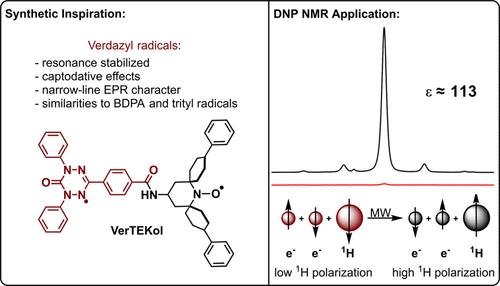
High-field dynamic nuclear polarization nuclear magnetic resonance (DNP NMR) spectroscopy transfers polarization from unpaired electrons in polarizing agents to nuclei of interest to boost NMR sensitivity. Verdazyl biradicals are a promising choice as polarizing agents because they have been found to generate narrower electron paramagnetic resonance (EPR) signals compared to nitroxide biradicals; an advantageous characteristic for high-field DNP when operating above 400 MHz/263 GHz. The use of verdazyl radicals as DNP polarizing agents has been very limited to date, yet, recent numerical simulations have predicted that verdazyl-nitroxide hybrid biradicals could be more effective polarizing agents than nitroxide-nitroxide biradicals. Herein, the syntheses of a series of verdazyl mono- and biradicals, as well as verdazyl-nitroxide biradicals are described. These radicals were examined in high-field DNP NMR experiments (600 MHz/395 GHz), by measuring 1H signal enhancements directly and through 13C{1H} cross-polarization experiments. X-band EPR, 1H DNP field profiles, and experiments to determine the nuclear build-up times were performed for verdazyl-nitroxide biradicals VerTEMPol and VerTEKol. These hybrid biradicals provide enhancements of up to 100-fold increased signal intensities (i.e., representing >104-fold time savings), approximately four times higher than that of the nitroxide biradical TEKPol, a commonly used polarizing agent in the field.
期刊介绍:
The flagship journal of the American Chemical Society, known as the Journal of the American Chemical Society (JACS), has been a prestigious publication since its establishment in 1879. It holds a preeminent position in the field of chemistry and related interdisciplinary sciences. JACS is committed to disseminating cutting-edge research papers, covering a wide range of topics, and encompasses approximately 19,000 pages of Articles, Communications, and Perspectives annually. With a weekly publication frequency, JACS plays a vital role in advancing the field of chemistry by providing essential research.




 京公网安备 11010802042870号
京ICP备2023020795号-1
京公网安备 11010802042870号
京ICP备2023020795号-1

 分享
分享
 求助内容:
求助内容: 应助结果提醒方式:
 扫码关注我们
