Remi Nguyen, Samy Halloumi, Irene Malpartida, Christophe Len
{"title":"利用ICHeM技术通过互补机械化学、双相和催化方法从甘油无溶剂生产三乙酸酯","authors":"Remi Nguyen, Samy Halloumi, Irene Malpartida, Christophe Len","doi":"10.1021/acs.oprd.4c00501","DOIUrl":null,"url":null,"abstract":"Impact in Continuous Flow Heated Mechanochemistry (ICHeM) was utilized for the biphasic acetylation of glycerol with immiscible acetic anhydride in the presence of homogeneous acid catalysts. This innovative technology combines efficient phase dispersion with continuous flow, offering the following benefits: (i) improved mixing of the two immiscible components (liquid glycerol and highly reactive acetic anhydride); (ii) mechanochemical energy generated by bead impact in continuous flow, eliminating the need for additional heating energy; and (iii) an alternative to single- and double-screw extruders, which are ineffective with liquid reaction media. Under our optimized conditions, triacetin “<i>t</i>” can be obtained with a 99% yield (100% conversion and 99% selectivity) in a solvent-free biphasic continuous flow process with a residence time of 15–30 min, using efficient homogeneous Lewis acids like iron triflate II or Brönsted acids like sulfuric acid.","PeriodicalId":55,"journal":{"name":"Organic Process Research & Development","volume":"19 1","pages":""},"PeriodicalIF":3.3000,"publicationDate":"2025-02-19","publicationTypes":"Journal Article","fieldsOfStudy":null,"isOpenAccess":false,"openAccessPdf":"","citationCount":"0","resultStr":"{\"title\":\"Solvent-Free Production of Triacetin from Glycerol through Complementary Mechanochemical, Biphasic, and Catalytic Approaches Using ICHeM Technology\",\"authors\":\"Remi Nguyen, Samy Halloumi, Irene Malpartida, Christophe Len\",\"doi\":\"10.1021/acs.oprd.4c00501\",\"DOIUrl\":null,\"url\":null,\"abstract\":\"Impact in Continuous Flow Heated Mechanochemistry (ICHeM) was utilized for the biphasic acetylation of glycerol with immiscible acetic anhydride in the presence of homogeneous acid catalysts. This innovative technology combines efficient phase dispersion with continuous flow, offering the following benefits: (i) improved mixing of the two immiscible components (liquid glycerol and highly reactive acetic anhydride); (ii) mechanochemical energy generated by bead impact in continuous flow, eliminating the need for additional heating energy; and (iii) an alternative to single- and double-screw extruders, which are ineffective with liquid reaction media. Under our optimized conditions, triacetin “<i>t</i>” can be obtained with a 99% yield (100% conversion and 99% selectivity) in a solvent-free biphasic continuous flow process with a residence time of 15–30 min, using efficient homogeneous Lewis acids like iron triflate II or Brönsted acids like sulfuric acid.\",\"PeriodicalId\":55,\"journal\":{\"name\":\"Organic Process Research & Development\",\"volume\":\"19 1\",\"pages\":\"\"},\"PeriodicalIF\":3.3000,\"publicationDate\":\"2025-02-19\",\"publicationTypes\":\"Journal Article\",\"fieldsOfStudy\":null,\"isOpenAccess\":false,\"openAccessPdf\":\"\",\"citationCount\":\"0\",\"resultStr\":null,\"platform\":\"Semanticscholar\",\"paperid\":null,\"PeriodicalName\":\"Organic Process Research & Development\",\"FirstCategoryId\":\"92\",\"ListUrlMain\":\"https://doi.org/10.1021/acs.oprd.4c00501\",\"RegionNum\":3,\"RegionCategory\":\"化学\",\"ArticlePicture\":[],\"TitleCN\":null,\"AbstractTextCN\":null,\"PMCID\":null,\"EPubDate\":\"\",\"PubModel\":\"\",\"JCR\":\"Q2\",\"JCRName\":\"CHEMISTRY, APPLIED\",\"Score\":null,\"Total\":0}","platform":"Semanticscholar","paperid":null,"PeriodicalName":"Organic Process Research & Development","FirstCategoryId":"92","ListUrlMain":"https://doi.org/10.1021/acs.oprd.4c00501","RegionNum":3,"RegionCategory":"化学","ArticlePicture":[],"TitleCN":null,"AbstractTextCN":null,"PMCID":null,"EPubDate":"","PubModel":"","JCR":"Q2","JCRName":"CHEMISTRY, APPLIED","Score":null,"Total":0}
Solvent-Free Production of Triacetin from Glycerol through Complementary Mechanochemical, Biphasic, and Catalytic Approaches Using ICHeM Technology
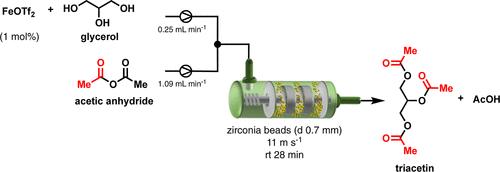
Impact in Continuous Flow Heated Mechanochemistry (ICHeM) was utilized for the biphasic acetylation of glycerol with immiscible acetic anhydride in the presence of homogeneous acid catalysts. This innovative technology combines efficient phase dispersion with continuous flow, offering the following benefits: (i) improved mixing of the two immiscible components (liquid glycerol and highly reactive acetic anhydride); (ii) mechanochemical energy generated by bead impact in continuous flow, eliminating the need for additional heating energy; and (iii) an alternative to single- and double-screw extruders, which are ineffective with liquid reaction media. Under our optimized conditions, triacetin “t” can be obtained with a 99% yield (100% conversion and 99% selectivity) in a solvent-free biphasic continuous flow process with a residence time of 15–30 min, using efficient homogeneous Lewis acids like iron triflate II or Brönsted acids like sulfuric acid.
期刊介绍:
The journal Organic Process Research & Development serves as a communication tool between industrial chemists and chemists working in universities and research institutes. As such, it reports original work from the broad field of industrial process chemistry but also presents academic results that are relevant, or potentially relevant, to industrial applications. Process chemistry is the science that enables the safe, environmentally benign and ultimately economical manufacturing of organic compounds that are required in larger amounts to help address the needs of society. Consequently, the Journal encompasses every aspect of organic chemistry, including all aspects of catalysis, synthetic methodology development and synthetic strategy exploration, but also includes aspects from analytical and solid-state chemistry and chemical engineering, such as work-up tools,process safety, or flow-chemistry. The goal of development and optimization of chemical reactions and processes is their transfer to a larger scale; original work describing such studies and the actual implementation on scale is highly relevant to the journal. However, studies on new developments from either industry, research institutes or academia that have not yet been demonstrated on scale, but where an industrial utility can be expected and where the study has addressed important prerequisites for a scale-up and has given confidence into the reliability and practicality of the chemistry, also serve the mission of OPR&D as a communication tool between the different contributors to the field.




 京公网安备 11010802042870号
京ICP备2023020795号-1
京公网安备 11010802042870号
京ICP备2023020795号-1

 分享
分享
 求助内容:
求助内容: 应助结果提醒方式:
 扫码关注我们
