M. S. Rumyantsev, I. Yu Kalagaev, I. N. Senchikhin
{"title":"甲基丙烯酸硫缩水甘油酯基反应性聚亚烯硫化树脂与单质硫反应的替代底物:高粘接抗拉强度和耐化学性的富硫塑料的合成特点、热力学和力学性能","authors":"M. S. Rumyantsev, I. Yu Kalagaev, I. N. Senchikhin","doi":"10.1021/acs.macromol.4c02435","DOIUrl":null,"url":null,"abstract":"The search for chemical and technological solutions to process cheap and available elemental sulfur to produce valuable multifunctional materials is one of the current challenging tasks. Instead of extensively used low-molecular-weight monomers, we proposed to use the original reactive polyalkylene sulfide resin as an alternative reagent containing pendant methacrylic groups. The use of a reactive viscous resin instead of monomers allows the syntheses to be carried out under reduced pressure conditions and high temperature, which allows volatile impurities and byproducts to be removed from the reaction zone. Peculiarities in the glass transition temperatures, heat capacities, and onsets of thermal degradation were addressed in the paper. Two glass transition temperatures were demonstrated to be the unique feature of the synthesized materials. This phenomenon was attributed to the enhanced chain mobility of the polyalkylene sulfide resin used, which was consequently expressed as a specific chain organization in the systems studied. Assuming the analysis of the literature data and the results presented in this work, it was concluded that in order to obtain more homogeneous materials less susceptible to undesirable aging, it is preferred to use the ratio of double bonds to sulfur, providing the formation of short cross-links consisting of 2–3 sulfur atoms. The materials obtained showed relatively high values of the onset of thermal degradation exceeding 270 °C and very high adhesion to glass and steel. In both cases, the adhesion tensile strength values exceeded 10 MPa. Furthermore, the obtained materials showed high chemical resistance to basic organic solvents.","PeriodicalId":51,"journal":{"name":"Macromolecules","volume":"4 1","pages":""},"PeriodicalIF":5.2000,"publicationDate":"2025-02-20","publicationTypes":"Journal Article","fieldsOfStudy":null,"isOpenAccess":false,"openAccessPdf":"","citationCount":"0","resultStr":"{\"title\":\"Thioglycidyl Methacrylate-Based Reactive Polyalkylene Sulfide Resin as an Alternative Substrate for the Reaction with Elemental Sulfur: Peculiarities of Synthesis, Thermodynamic and Mechanical Properties of Sulfur-Rich Plastics with High Adhesive Tensile Strength and Chemical Resistance\",\"authors\":\"M. S. Rumyantsev, I. Yu Kalagaev, I. N. Senchikhin\",\"doi\":\"10.1021/acs.macromol.4c02435\",\"DOIUrl\":null,\"url\":null,\"abstract\":\"The search for chemical and technological solutions to process cheap and available elemental sulfur to produce valuable multifunctional materials is one of the current challenging tasks. Instead of extensively used low-molecular-weight monomers, we proposed to use the original reactive polyalkylene sulfide resin as an alternative reagent containing pendant methacrylic groups. The use of a reactive viscous resin instead of monomers allows the syntheses to be carried out under reduced pressure conditions and high temperature, which allows volatile impurities and byproducts to be removed from the reaction zone. Peculiarities in the glass transition temperatures, heat capacities, and onsets of thermal degradation were addressed in the paper. Two glass transition temperatures were demonstrated to be the unique feature of the synthesized materials. This phenomenon was attributed to the enhanced chain mobility of the polyalkylene sulfide resin used, which was consequently expressed as a specific chain organization in the systems studied. Assuming the analysis of the literature data and the results presented in this work, it was concluded that in order to obtain more homogeneous materials less susceptible to undesirable aging, it is preferred to use the ratio of double bonds to sulfur, providing the formation of short cross-links consisting of 2–3 sulfur atoms. The materials obtained showed relatively high values of the onset of thermal degradation exceeding 270 °C and very high adhesion to glass and steel. In both cases, the adhesion tensile strength values exceeded 10 MPa. Furthermore, the obtained materials showed high chemical resistance to basic organic solvents.\",\"PeriodicalId\":51,\"journal\":{\"name\":\"Macromolecules\",\"volume\":\"4 1\",\"pages\":\"\"},\"PeriodicalIF\":5.2000,\"publicationDate\":\"2025-02-20\",\"publicationTypes\":\"Journal Article\",\"fieldsOfStudy\":null,\"isOpenAccess\":false,\"openAccessPdf\":\"\",\"citationCount\":\"0\",\"resultStr\":null,\"platform\":\"Semanticscholar\",\"paperid\":null,\"PeriodicalName\":\"Macromolecules\",\"FirstCategoryId\":\"92\",\"ListUrlMain\":\"https://doi.org/10.1021/acs.macromol.4c02435\",\"RegionNum\":1,\"RegionCategory\":\"化学\",\"ArticlePicture\":[],\"TitleCN\":null,\"AbstractTextCN\":null,\"PMCID\":null,\"EPubDate\":\"\",\"PubModel\":\"\",\"JCR\":\"Q1\",\"JCRName\":\"POLYMER SCIENCE\",\"Score\":null,\"Total\":0}","platform":"Semanticscholar","paperid":null,"PeriodicalName":"Macromolecules","FirstCategoryId":"92","ListUrlMain":"https://doi.org/10.1021/acs.macromol.4c02435","RegionNum":1,"RegionCategory":"化学","ArticlePicture":[],"TitleCN":null,"AbstractTextCN":null,"PMCID":null,"EPubDate":"","PubModel":"","JCR":"Q1","JCRName":"POLYMER SCIENCE","Score":null,"Total":0}
Thioglycidyl Methacrylate-Based Reactive Polyalkylene Sulfide Resin as an Alternative Substrate for the Reaction with Elemental Sulfur: Peculiarities of Synthesis, Thermodynamic and Mechanical Properties of Sulfur-Rich Plastics with High Adhesive Tensile Strength and Chemical Resistance
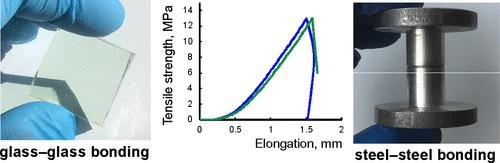
The search for chemical and technological solutions to process cheap and available elemental sulfur to produce valuable multifunctional materials is one of the current challenging tasks. Instead of extensively used low-molecular-weight monomers, we proposed to use the original reactive polyalkylene sulfide resin as an alternative reagent containing pendant methacrylic groups. The use of a reactive viscous resin instead of monomers allows the syntheses to be carried out under reduced pressure conditions and high temperature, which allows volatile impurities and byproducts to be removed from the reaction zone. Peculiarities in the glass transition temperatures, heat capacities, and onsets of thermal degradation were addressed in the paper. Two glass transition temperatures were demonstrated to be the unique feature of the synthesized materials. This phenomenon was attributed to the enhanced chain mobility of the polyalkylene sulfide resin used, which was consequently expressed as a specific chain organization in the systems studied. Assuming the analysis of the literature data and the results presented in this work, it was concluded that in order to obtain more homogeneous materials less susceptible to undesirable aging, it is preferred to use the ratio of double bonds to sulfur, providing the formation of short cross-links consisting of 2–3 sulfur atoms. The materials obtained showed relatively high values of the onset of thermal degradation exceeding 270 °C and very high adhesion to glass and steel. In both cases, the adhesion tensile strength values exceeded 10 MPa. Furthermore, the obtained materials showed high chemical resistance to basic organic solvents.
期刊介绍:
Macromolecules publishes original, fundamental, and impactful research on all aspects of polymer science. Topics of interest include synthesis (e.g., controlled polymerizations, polymerization catalysis, post polymerization modification, new monomer structures and polymer architectures, and polymerization mechanisms/kinetics analysis); phase behavior, thermodynamics, dynamic, and ordering/disordering phenomena (e.g., self-assembly, gelation, crystallization, solution/melt/solid-state characteristics); structure and properties (e.g., mechanical and rheological properties, surface/interfacial characteristics, electronic and transport properties); new state of the art characterization (e.g., spectroscopy, scattering, microscopy, rheology), simulation (e.g., Monte Carlo, molecular dynamics, multi-scale/coarse-grained modeling), and theoretical methods. Renewable/sustainable polymers, polymer networks, responsive polymers, electro-, magneto- and opto-active macromolecules, inorganic polymers, charge-transporting polymers (ion-containing, semiconducting, and conducting), nanostructured polymers, and polymer composites are also of interest. Typical papers published in Macromolecules showcase important and innovative concepts, experimental methods/observations, and theoretical/computational approaches that demonstrate a fundamental advance in the understanding of polymers.




 京公网安备 11010802042870号
京ICP备2023020795号-1
京公网安备 11010802042870号
京ICP备2023020795号-1

 分享
分享
 求助内容:
求助内容: 应助结果提醒方式:
 扫码关注我们
