{"title":"高性能锂离子电池用二茂铁基聚合物有机阴极中离子和电子输运的平衡","authors":"Mengjia Yin, Zhigang Xue","doi":"10.1021/acs.macromol.4c02970","DOIUrl":null,"url":null,"abstract":"Polymer organic electrodes with unique electron storage and ion storage mechanisms have achieved remarkable development in recent years. However, the specific capacity and rate capability of organic electrodes are still unsatisfactory due to the slow ion and electron transport. Most importantly, some measures used to improve electron or ion transport come at the expense of slowing down the transport of the other. Therefore, achieving a balance between ion and electron transport and accelerating electrode reaction kinetics through underlying molecular design remain a formidable task. Herein, we adopted a measure of combining the rigidity and flexibility of the polymer backbone to realize fast electron and ion transport simultaneously. When the prepared polymer Fc-EDA was used as the cathode for lithium-ion batteries, it provided a high capacity of 160 mA h g<sup>–1</sup> at 0.1 A g<sup>–1</sup>, corresponding to an active site utilization of up to 83%. Fc-EDA had excellent rate capability, with the capacities at 2 A g<sup>–1</sup> and 10 A g<sup>–1</sup> being 60% and 40% of that at 0.1 A g<sup>–1</sup>, respectively. In addition, it could be cycled over 3500 times at 2 A g<sup>–1</sup> with a capacity retention of 60%.","PeriodicalId":51,"journal":{"name":"Macromolecules","volume":"22 1","pages":""},"PeriodicalIF":5.2000,"publicationDate":"2025-02-20","publicationTypes":"Journal Article","fieldsOfStudy":null,"isOpenAccess":false,"openAccessPdf":"","citationCount":"0","resultStr":"{\"title\":\"Balance of Ion and Electron Transport in Ferrocene-Based Polymer Organic Cathode for High-Performance Lithium-Ion Batteries\",\"authors\":\"Mengjia Yin, Zhigang Xue\",\"doi\":\"10.1021/acs.macromol.4c02970\",\"DOIUrl\":null,\"url\":null,\"abstract\":\"Polymer organic electrodes with unique electron storage and ion storage mechanisms have achieved remarkable development in recent years. However, the specific capacity and rate capability of organic electrodes are still unsatisfactory due to the slow ion and electron transport. Most importantly, some measures used to improve electron or ion transport come at the expense of slowing down the transport of the other. Therefore, achieving a balance between ion and electron transport and accelerating electrode reaction kinetics through underlying molecular design remain a formidable task. Herein, we adopted a measure of combining the rigidity and flexibility of the polymer backbone to realize fast electron and ion transport simultaneously. When the prepared polymer Fc-EDA was used as the cathode for lithium-ion batteries, it provided a high capacity of 160 mA h g<sup>–1</sup> at 0.1 A g<sup>–1</sup>, corresponding to an active site utilization of up to 83%. Fc-EDA had excellent rate capability, with the capacities at 2 A g<sup>–1</sup> and 10 A g<sup>–1</sup> being 60% and 40% of that at 0.1 A g<sup>–1</sup>, respectively. In addition, it could be cycled over 3500 times at 2 A g<sup>–1</sup> with a capacity retention of 60%.\",\"PeriodicalId\":51,\"journal\":{\"name\":\"Macromolecules\",\"volume\":\"22 1\",\"pages\":\"\"},\"PeriodicalIF\":5.2000,\"publicationDate\":\"2025-02-20\",\"publicationTypes\":\"Journal Article\",\"fieldsOfStudy\":null,\"isOpenAccess\":false,\"openAccessPdf\":\"\",\"citationCount\":\"0\",\"resultStr\":null,\"platform\":\"Semanticscholar\",\"paperid\":null,\"PeriodicalName\":\"Macromolecules\",\"FirstCategoryId\":\"92\",\"ListUrlMain\":\"https://doi.org/10.1021/acs.macromol.4c02970\",\"RegionNum\":1,\"RegionCategory\":\"化学\",\"ArticlePicture\":[],\"TitleCN\":null,\"AbstractTextCN\":null,\"PMCID\":null,\"EPubDate\":\"\",\"PubModel\":\"\",\"JCR\":\"Q1\",\"JCRName\":\"POLYMER SCIENCE\",\"Score\":null,\"Total\":0}","platform":"Semanticscholar","paperid":null,"PeriodicalName":"Macromolecules","FirstCategoryId":"92","ListUrlMain":"https://doi.org/10.1021/acs.macromol.4c02970","RegionNum":1,"RegionCategory":"化学","ArticlePicture":[],"TitleCN":null,"AbstractTextCN":null,"PMCID":null,"EPubDate":"","PubModel":"","JCR":"Q1","JCRName":"POLYMER SCIENCE","Score":null,"Total":0}
引用次数: 0
摘要
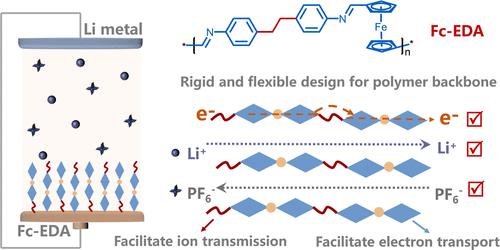
聚合物有机电极具有独特的电子存储和离子存储机制,近年来取得了显著的发展。然而,由于离子和电子传输缓慢,有机电极的比容量和速率能力仍然令人不满意。最重要的是,一些用来改善电子或离子传输的措施是以减慢另一方的传输为代价的。因此,通过潜在的分子设计实现离子和电子传递之间的平衡以及加速电极反应动力学仍然是一项艰巨的任务。在此,我们采用了一种结合聚合物骨架刚性和柔韧性的措施来同时实现电子和离子的快速传递。当制备的聚合物Fc-EDA用作锂离子电池的阴极时,它在0.1 a g-1下提供160 mA h g-1的高容量,对应的活性位点利用率高达83%。Fc-EDA具有优异的速率能力,2 A g-1和10 A g-1时的容量分别是0.1 A g-1时的60%和40%。此外,它可以在2 A g-1下循环3500次以上,容量保持率为60%。
Balance of Ion and Electron Transport in Ferrocene-Based Polymer Organic Cathode for High-Performance Lithium-Ion Batteries
Polymer organic electrodes with unique electron storage and ion storage mechanisms have achieved remarkable development in recent years. However, the specific capacity and rate capability of organic electrodes are still unsatisfactory due to the slow ion and electron transport. Most importantly, some measures used to improve electron or ion transport come at the expense of slowing down the transport of the other. Therefore, achieving a balance between ion and electron transport and accelerating electrode reaction kinetics through underlying molecular design remain a formidable task. Herein, we adopted a measure of combining the rigidity and flexibility of the polymer backbone to realize fast electron and ion transport simultaneously. When the prepared polymer Fc-EDA was used as the cathode for lithium-ion batteries, it provided a high capacity of 160 mA h g–1 at 0.1 A g–1, corresponding to an active site utilization of up to 83%. Fc-EDA had excellent rate capability, with the capacities at 2 A g–1 and 10 A g–1 being 60% and 40% of that at 0.1 A g–1, respectively. In addition, it could be cycled over 3500 times at 2 A g–1 with a capacity retention of 60%.
期刊介绍:
Macromolecules publishes original, fundamental, and impactful research on all aspects of polymer science. Topics of interest include synthesis (e.g., controlled polymerizations, polymerization catalysis, post polymerization modification, new monomer structures and polymer architectures, and polymerization mechanisms/kinetics analysis); phase behavior, thermodynamics, dynamic, and ordering/disordering phenomena (e.g., self-assembly, gelation, crystallization, solution/melt/solid-state characteristics); structure and properties (e.g., mechanical and rheological properties, surface/interfacial characteristics, electronic and transport properties); new state of the art characterization (e.g., spectroscopy, scattering, microscopy, rheology), simulation (e.g., Monte Carlo, molecular dynamics, multi-scale/coarse-grained modeling), and theoretical methods. Renewable/sustainable polymers, polymer networks, responsive polymers, electro-, magneto- and opto-active macromolecules, inorganic polymers, charge-transporting polymers (ion-containing, semiconducting, and conducting), nanostructured polymers, and polymer composites are also of interest. Typical papers published in Macromolecules showcase important and innovative concepts, experimental methods/observations, and theoretical/computational approaches that demonstrate a fundamental advance in the understanding of polymers.




 京公网安备 11010802042870号
京ICP备2023020795号-1
京公网安备 11010802042870号
京ICP备2023020795号-1

 分享
分享
 求助内容:
求助内容: 应助结果提醒方式:
 扫码关注我们
