Wenping Yin , Yong Xue , Ziqi Liu , Hao Li , Martin Werner
{"title":"利用多模态数据隐含地理信息的llm增强灾害地理定位:以飓风哈维为例","authors":"Wenping Yin , Yong Xue , Ziqi Liu , Hao Li , Martin Werner","doi":"10.1016/j.jag.2025.104423","DOIUrl":null,"url":null,"abstract":"<div><div>Timely and accurate geolocalization of natural disasters is crucial for effective emergency response, which is foundational for risk mitigation and resilience development. Although social media texts have been widely used to recognize and resolve disaster geolocations, the implicit geoinformation in social media images remains largely underexplored. In this paper, we propose a novel large language model (LLM)-enhanced disaster geolocalization method that considers both explicit and implicit geoinformation from multimodal data. Based on the recognition of geolocations in disaster-related images and texts, geolocalization results were obtained by combining LLMs with map services. The selection of a geolocalization strategy depends on the available geoinformation modality and the presence of spatial relationships. A multimodal dataset of 1,000 images and 1,000 texts from the Hurricane Harvey Twitter dataset was constructed to evaluate geolocalization accuracy through error distance. The results demonstrated that the proposed method achieves significant improvements over baseline geocoding and toponym retrieval methods, with overall accuracies of 81.45%, 78.40%, 74.60%, 65.20%, and 44.95% within 161, 100, 50, 10, and 1 km, respectively. These findings confirm the potential of LLMs in enhancing geolocalization by considering implicit geoinformation from multimodal data for future disaster response and broader GeoAI applications.</div></div>","PeriodicalId":73423,"journal":{"name":"International journal of applied earth observation and geoinformation : ITC journal","volume":"137 ","pages":"Article 104423"},"PeriodicalIF":8.6000,"publicationDate":"2025-03-01","publicationTypes":"Journal Article","fieldsOfStudy":null,"isOpenAccess":false,"openAccessPdf":"","citationCount":"0","resultStr":"{\"title\":\"LLM-enhanced disaster geolocalization using implicit geoinformation from multimodal data: A case study of Hurricane Harvey\",\"authors\":\"Wenping Yin , Yong Xue , Ziqi Liu , Hao Li , Martin Werner\",\"doi\":\"10.1016/j.jag.2025.104423\",\"DOIUrl\":null,\"url\":null,\"abstract\":\"<div><div>Timely and accurate geolocalization of natural disasters is crucial for effective emergency response, which is foundational for risk mitigation and resilience development. Although social media texts have been widely used to recognize and resolve disaster geolocations, the implicit geoinformation in social media images remains largely underexplored. In this paper, we propose a novel large language model (LLM)-enhanced disaster geolocalization method that considers both explicit and implicit geoinformation from multimodal data. Based on the recognition of geolocations in disaster-related images and texts, geolocalization results were obtained by combining LLMs with map services. The selection of a geolocalization strategy depends on the available geoinformation modality and the presence of spatial relationships. A multimodal dataset of 1,000 images and 1,000 texts from the Hurricane Harvey Twitter dataset was constructed to evaluate geolocalization accuracy through error distance. The results demonstrated that the proposed method achieves significant improvements over baseline geocoding and toponym retrieval methods, with overall accuracies of 81.45%, 78.40%, 74.60%, 65.20%, and 44.95% within 161, 100, 50, 10, and 1 km, respectively. These findings confirm the potential of LLMs in enhancing geolocalization by considering implicit geoinformation from multimodal data for future disaster response and broader GeoAI applications.</div></div>\",\"PeriodicalId\":73423,\"journal\":{\"name\":\"International journal of applied earth observation and geoinformation : ITC journal\",\"volume\":\"137 \",\"pages\":\"Article 104423\"},\"PeriodicalIF\":8.6000,\"publicationDate\":\"2025-03-01\",\"publicationTypes\":\"Journal Article\",\"fieldsOfStudy\":null,\"isOpenAccess\":false,\"openAccessPdf\":\"\",\"citationCount\":\"0\",\"resultStr\":null,\"platform\":\"Semanticscholar\",\"paperid\":null,\"PeriodicalName\":\"International journal of applied earth observation and geoinformation : ITC journal\",\"FirstCategoryId\":\"1085\",\"ListUrlMain\":\"https://www.sciencedirect.com/science/article/pii/S1569843225000706\",\"RegionNum\":0,\"RegionCategory\":null,\"ArticlePicture\":[],\"TitleCN\":null,\"AbstractTextCN\":null,\"PMCID\":null,\"EPubDate\":\"2025/2/21 0:00:00\",\"PubModel\":\"Epub\",\"JCR\":\"Q1\",\"JCRName\":\"REMOTE SENSING\",\"Score\":null,\"Total\":0}","platform":"Semanticscholar","paperid":null,"PeriodicalName":"International journal of applied earth observation and geoinformation : ITC journal","FirstCategoryId":"1085","ListUrlMain":"https://www.sciencedirect.com/science/article/pii/S1569843225000706","RegionNum":0,"RegionCategory":null,"ArticlePicture":[],"TitleCN":null,"AbstractTextCN":null,"PMCID":null,"EPubDate":"2025/2/21 0:00:00","PubModel":"Epub","JCR":"Q1","JCRName":"REMOTE SENSING","Score":null,"Total":0}
LLM-enhanced disaster geolocalization using implicit geoinformation from multimodal data: A case study of Hurricane Harvey
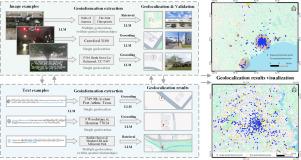
Timely and accurate geolocalization of natural disasters is crucial for effective emergency response, which is foundational for risk mitigation and resilience development. Although social media texts have been widely used to recognize and resolve disaster geolocations, the implicit geoinformation in social media images remains largely underexplored. In this paper, we propose a novel large language model (LLM)-enhanced disaster geolocalization method that considers both explicit and implicit geoinformation from multimodal data. Based on the recognition of geolocations in disaster-related images and texts, geolocalization results were obtained by combining LLMs with map services. The selection of a geolocalization strategy depends on the available geoinformation modality and the presence of spatial relationships. A multimodal dataset of 1,000 images and 1,000 texts from the Hurricane Harvey Twitter dataset was constructed to evaluate geolocalization accuracy through error distance. The results demonstrated that the proposed method achieves significant improvements over baseline geocoding and toponym retrieval methods, with overall accuracies of 81.45%, 78.40%, 74.60%, 65.20%, and 44.95% within 161, 100, 50, 10, and 1 km, respectively. These findings confirm the potential of LLMs in enhancing geolocalization by considering implicit geoinformation from multimodal data for future disaster response and broader GeoAI applications.
期刊介绍:
The International Journal of Applied Earth Observation and Geoinformation publishes original papers that utilize earth observation data for natural resource and environmental inventory and management. These data primarily originate from remote sensing platforms, including satellites and aircraft, supplemented by surface and subsurface measurements. Addressing natural resources such as forests, agricultural land, soils, and water, as well as environmental concerns like biodiversity, land degradation, and hazards, the journal explores conceptual and data-driven approaches. It covers geoinformation themes like capturing, databasing, visualization, interpretation, data quality, and spatial uncertainty.




 京公网安备 11010802042870号
京ICP备2023020795号-1
京公网安备 11010802042870号
京ICP备2023020795号-1

 分享
分享
 求助内容:
求助内容: 应助结果提醒方式:
 扫码关注我们
