Jiabin Li, Dongxue Wang, Xiya Chen, Yao Zhou, Huanteng Luo, Tu Zhao, Sheng Hu, Zhaoqiang Zheng, Wei Gao and Xiao Liu
{"title":"0D-2D混合光电探测器的工程能带:iii型SnSe2/MoTe2异质结上的cu掺杂InP量子点。","authors":"Jiabin Li, Dongxue Wang, Xiya Chen, Yao Zhou, Huanteng Luo, Tu Zhao, Sheng Hu, Zhaoqiang Zheng, Wei Gao and Xiao Liu","doi":"10.1039/D4NH00663A","DOIUrl":null,"url":null,"abstract":"<p >Two-dimensional (2D) self-driven photodetectors have emerged as a compelling area of research, offering advantages such as miniaturization, weak light detection, high photosensitivity, and low noise levels. However, current type-III 2D heterojunction photodetectors often suffer from low self-driven responsivity and medium <em>I</em><small><sub>light</sub></small>/<em>I</em><small><sub>dark</sub></small> ratios. In this work, a novel device architecture that addresses these challenges is constructed by incorporating Cu-doped InP/ZnSeS/ZnS core–shell quantum dots (QDs) onto a type-III SnSe<small><sub>2</sub></small>/MoTe<small><sub>2</sub></small> 2D heterojunction. The strategically engineered energy band structure of the Cu-doped QDs facilitates carrier transport with SnSe<small><sub>2</sub></small>/MoTe<small><sub>2</sub></small> to form back-to-back type-II and type-III band alignments. As a result, under 532 nm illumination, the hybrid device exhibits remarkable visible light self-driven performance metrics with the help of the photogating effect: an ultra-low dark current of 23 fA, with responsivity and external quantum efficiency enhanced to 459 mA W<small><sup>−1</sup></small> and 109%, respectively, surpassing theoretical values by fourfold compared to those of pure SnSe<small><sub>2</sub></small>/MoTe<small><sub>2</sub></small>, a low noise equivalent power (NEP) of 0.87 × 10<small><sup>−2</sup></small> pW Hz<small><sup>−1/2</sup></small>, a realistic specific detectivity of 1.45 × 10<small><sup>11</sup></small> Jones, a large <em>I</em><small><sub>light</sub></small>/<em>I</em><small><sub>dark</sub></small> ratio of 10<small><sup>6</sup></small> and a swift response time of 1.16 ms/1.14 ms with stable operation. These results demonstrate that energy band engineering of Cu-doped QDs can significantly enhance the performance of 2D type-III heterojunctions in the visible range, laying a foundation for future gate-tunable optoelectronic devices.</p>","PeriodicalId":93,"journal":{"name":"Nanoscale Horizons","volume":" 5","pages":" 922-932"},"PeriodicalIF":6.4000,"publicationDate":"2025-02-14","publicationTypes":"Journal Article","fieldsOfStudy":null,"isOpenAccess":false,"openAccessPdf":"","citationCount":"0","resultStr":"{\"title\":\"Engineering energy bands in 0D–2D hybrid photodetectors: Cu-doped InP quantum dots on a type-III SnSe2/MoTe2 heterojunction†\",\"authors\":\"Jiabin Li, Dongxue Wang, Xiya Chen, Yao Zhou, Huanteng Luo, Tu Zhao, Sheng Hu, Zhaoqiang Zheng, Wei Gao and Xiao Liu\",\"doi\":\"10.1039/D4NH00663A\",\"DOIUrl\":null,\"url\":null,\"abstract\":\"<p >Two-dimensional (2D) self-driven photodetectors have emerged as a compelling area of research, offering advantages such as miniaturization, weak light detection, high photosensitivity, and low noise levels. However, current type-III 2D heterojunction photodetectors often suffer from low self-driven responsivity and medium <em>I</em><small><sub>light</sub></small>/<em>I</em><small><sub>dark</sub></small> ratios. In this work, a novel device architecture that addresses these challenges is constructed by incorporating Cu-doped InP/ZnSeS/ZnS core–shell quantum dots (QDs) onto a type-III SnSe<small><sub>2</sub></small>/MoTe<small><sub>2</sub></small> 2D heterojunction. The strategically engineered energy band structure of the Cu-doped QDs facilitates carrier transport with SnSe<small><sub>2</sub></small>/MoTe<small><sub>2</sub></small> to form back-to-back type-II and type-III band alignments. As a result, under 532 nm illumination, the hybrid device exhibits remarkable visible light self-driven performance metrics with the help of the photogating effect: an ultra-low dark current of 23 fA, with responsivity and external quantum efficiency enhanced to 459 mA W<small><sup>−1</sup></small> and 109%, respectively, surpassing theoretical values by fourfold compared to those of pure SnSe<small><sub>2</sub></small>/MoTe<small><sub>2</sub></small>, a low noise equivalent power (NEP) of 0.87 × 10<small><sup>−2</sup></small> pW Hz<small><sup>−1/2</sup></small>, a realistic specific detectivity of 1.45 × 10<small><sup>11</sup></small> Jones, a large <em>I</em><small><sub>light</sub></small>/<em>I</em><small><sub>dark</sub></small> ratio of 10<small><sup>6</sup></small> and a swift response time of 1.16 ms/1.14 ms with stable operation. These results demonstrate that energy band engineering of Cu-doped QDs can significantly enhance the performance of 2D type-III heterojunctions in the visible range, laying a foundation for future gate-tunable optoelectronic devices.</p>\",\"PeriodicalId\":93,\"journal\":{\"name\":\"Nanoscale Horizons\",\"volume\":\" 5\",\"pages\":\" 922-932\"},\"PeriodicalIF\":6.4000,\"publicationDate\":\"2025-02-14\",\"publicationTypes\":\"Journal Article\",\"fieldsOfStudy\":null,\"isOpenAccess\":false,\"openAccessPdf\":\"\",\"citationCount\":\"0\",\"resultStr\":null,\"platform\":\"Semanticscholar\",\"paperid\":null,\"PeriodicalName\":\"Nanoscale Horizons\",\"FirstCategoryId\":\"88\",\"ListUrlMain\":\"https://pubs.rsc.org/en/content/articlelanding/2025/nh/d4nh00663a\",\"RegionNum\":2,\"RegionCategory\":\"材料科学\",\"ArticlePicture\":[],\"TitleCN\":null,\"AbstractTextCN\":null,\"PMCID\":null,\"EPubDate\":\"\",\"PubModel\":\"\",\"JCR\":\"Q1\",\"JCRName\":\"CHEMISTRY, PHYSICAL\",\"Score\":null,\"Total\":0}","platform":"Semanticscholar","paperid":null,"PeriodicalName":"Nanoscale Horizons","FirstCategoryId":"88","ListUrlMain":"https://pubs.rsc.org/en/content/articlelanding/2025/nh/d4nh00663a","RegionNum":2,"RegionCategory":"材料科学","ArticlePicture":[],"TitleCN":null,"AbstractTextCN":null,"PMCID":null,"EPubDate":"","PubModel":"","JCR":"Q1","JCRName":"CHEMISTRY, PHYSICAL","Score":null,"Total":0}
Engineering energy bands in 0D–2D hybrid photodetectors: Cu-doped InP quantum dots on a type-III SnSe2/MoTe2 heterojunction†
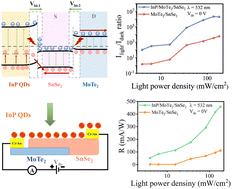
Two-dimensional (2D) self-driven photodetectors have emerged as a compelling area of research, offering advantages such as miniaturization, weak light detection, high photosensitivity, and low noise levels. However, current type-III 2D heterojunction photodetectors often suffer from low self-driven responsivity and medium Ilight/Idark ratios. In this work, a novel device architecture that addresses these challenges is constructed by incorporating Cu-doped InP/ZnSeS/ZnS core–shell quantum dots (QDs) onto a type-III SnSe2/MoTe2 2D heterojunction. The strategically engineered energy band structure of the Cu-doped QDs facilitates carrier transport with SnSe2/MoTe2 to form back-to-back type-II and type-III band alignments. As a result, under 532 nm illumination, the hybrid device exhibits remarkable visible light self-driven performance metrics with the help of the photogating effect: an ultra-low dark current of 23 fA, with responsivity and external quantum efficiency enhanced to 459 mA W−1 and 109%, respectively, surpassing theoretical values by fourfold compared to those of pure SnSe2/MoTe2, a low noise equivalent power (NEP) of 0.87 × 10⁻² pW Hz−1/2, a realistic specific detectivity of 1.45 × 10¹¹ Jones, a large Ilight/Idark ratio of 106 and a swift response time of 1.16 ms/1.14 ms with stable operation. These results demonstrate that energy band engineering of Cu-doped QDs can significantly enhance the performance of 2D type-III heterojunctions in the visible range, laying a foundation for future gate-tunable optoelectronic devices.
期刊介绍:
Nanoscale Horizons stands out as a premier journal for publishing exceptionally high-quality and innovative nanoscience and nanotechnology. The emphasis lies on original research that introduces a new concept or a novel perspective (a conceptual advance), prioritizing this over reporting technological improvements. Nevertheless, outstanding articles showcasing truly groundbreaking developments, including record-breaking performance, may also find a place in the journal. Published work must be of substantial general interest to our broad and diverse readership across the nanoscience and nanotechnology community.




 京公网安备 11010802042870号
京ICP备2023020795号-1
京公网安备 11010802042870号
京ICP备2023020795号-1

 分享
分享
 求助内容:
求助内容: 应助结果提醒方式:
 扫码关注我们
