{"title":"医生主导的药物调解对门诊患者使用PharmaCloud系统的结果的影响。","authors":"Ya-Yuan Yu, Po-Hsun Wu, Chung-Han Ho, Chia-Jung Chen, Chung-Feng Liu, Hui-Chen Su, Hsu-Feng Hsiao, Chien-Chin Hsu, Chia-Ti Wang, Chien-Cheng Huang","doi":"10.1186/s12913-025-12421-5","DOIUrl":null,"url":null,"abstract":"<p><strong>Background: </strong>Taiwan introduced PharmaCloud, a system designed to streamline access to comprehensive medication records from various healthcare settings. Despite its potential, the impact of physician-led medication reconciliation (MR) utilizing PharmaCloud on outpatient outcomes remains unclear. This study aims to address this gap by evaluating the effectiveness of PharmaCloud-enabled MR in improving patient outcomes.</p><p><strong>Methods: </strong>We collected data from outpatients with major polypharmacy (≥ 10 medications) between May 19, 2019, and April 18, 2020, comparing those who received MR with those who did not. Outcomes including total medical expenditures, ED visits, hospitalizations, mortality rate, and number of medications were compared between the two cohorts over a 12-month follow-up period.</p><p><strong>Results: </strong>The study enrolled 209 patients with MR and 9,053 patients without MR. Patients who received MR were older, had lower body mass index, took more medications, and had a higher prevalence of hypertension, cerebrovascular disease, chronic kidney disease, and mental disorder. After 12 months of follow-up, patients who received MR had a higher proportion of reduced medications (adjusted odds ratio: 1.4; 95% confidence interval: 1.0 - 2.0), but also had more ED visits in the first 12 months compared to those who did not receive MR. The study did not find any significant differences in total medical expenditures, hospitalizations, and mortality rates between the two cohorts.</p><p><strong>Conclusions: </strong>The model reduced medication use. Further research, including prospective designs, pharmacist involvement, and evaluations of reduced complications from fewer medications, is needed to better clarify patient outcomes.</p>","PeriodicalId":9012,"journal":{"name":"BMC Health Services Research","volume":"25 1","pages":"283"},"PeriodicalIF":3.0000,"publicationDate":"2025-02-20","publicationTypes":"Journal Article","fieldsOfStudy":null,"isOpenAccess":false,"openAccessPdf":"https://www.ncbi.nlm.nih.gov/pmc/articles/PMC11841220/pdf/","citationCount":"0","resultStr":"{\"title\":\"Effects of physician-led medication reconciliation on the outcomes of outpatients utilizing the PharmaCloud system.\",\"authors\":\"Ya-Yuan Yu, Po-Hsun Wu, Chung-Han Ho, Chia-Jung Chen, Chung-Feng Liu, Hui-Chen Su, Hsu-Feng Hsiao, Chien-Chin Hsu, Chia-Ti Wang, Chien-Cheng Huang\",\"doi\":\"10.1186/s12913-025-12421-5\",\"DOIUrl\":null,\"url\":null,\"abstract\":\"<p><strong>Background: </strong>Taiwan introduced PharmaCloud, a system designed to streamline access to comprehensive medication records from various healthcare settings. Despite its potential, the impact of physician-led medication reconciliation (MR) utilizing PharmaCloud on outpatient outcomes remains unclear. This study aims to address this gap by evaluating the effectiveness of PharmaCloud-enabled MR in improving patient outcomes.</p><p><strong>Methods: </strong>We collected data from outpatients with major polypharmacy (≥ 10 medications) between May 19, 2019, and April 18, 2020, comparing those who received MR with those who did not. Outcomes including total medical expenditures, ED visits, hospitalizations, mortality rate, and number of medications were compared between the two cohorts over a 12-month follow-up period.</p><p><strong>Results: </strong>The study enrolled 209 patients with MR and 9,053 patients without MR. Patients who received MR were older, had lower body mass index, took more medications, and had a higher prevalence of hypertension, cerebrovascular disease, chronic kidney disease, and mental disorder. After 12 months of follow-up, patients who received MR had a higher proportion of reduced medications (adjusted odds ratio: 1.4; 95% confidence interval: 1.0 - 2.0), but also had more ED visits in the first 12 months compared to those who did not receive MR. The study did not find any significant differences in total medical expenditures, hospitalizations, and mortality rates between the two cohorts.</p><p><strong>Conclusions: </strong>The model reduced medication use. Further research, including prospective designs, pharmacist involvement, and evaluations of reduced complications from fewer medications, is needed to better clarify patient outcomes.</p>\",\"PeriodicalId\":9012,\"journal\":{\"name\":\"BMC Health Services Research\",\"volume\":\"25 1\",\"pages\":\"283\"},\"PeriodicalIF\":3.0000,\"publicationDate\":\"2025-02-20\",\"publicationTypes\":\"Journal Article\",\"fieldsOfStudy\":null,\"isOpenAccess\":false,\"openAccessPdf\":\"https://www.ncbi.nlm.nih.gov/pmc/articles/PMC11841220/pdf/\",\"citationCount\":\"0\",\"resultStr\":null,\"platform\":\"Semanticscholar\",\"paperid\":null,\"PeriodicalName\":\"BMC Health Services Research\",\"FirstCategoryId\":\"3\",\"ListUrlMain\":\"https://doi.org/10.1186/s12913-025-12421-5\",\"RegionNum\":3,\"RegionCategory\":\"医学\",\"ArticlePicture\":[],\"TitleCN\":null,\"AbstractTextCN\":null,\"PMCID\":null,\"EPubDate\":\"\",\"PubModel\":\"\",\"JCR\":\"Q2\",\"JCRName\":\"HEALTH CARE SCIENCES & SERVICES\",\"Score\":null,\"Total\":0}","platform":"Semanticscholar","paperid":null,"PeriodicalName":"BMC Health Services Research","FirstCategoryId":"3","ListUrlMain":"https://doi.org/10.1186/s12913-025-12421-5","RegionNum":3,"RegionCategory":"医学","ArticlePicture":[],"TitleCN":null,"AbstractTextCN":null,"PMCID":null,"EPubDate":"","PubModel":"","JCR":"Q2","JCRName":"HEALTH CARE SCIENCES & SERVICES","Score":null,"Total":0}
Effects of physician-led medication reconciliation on the outcomes of outpatients utilizing the PharmaCloud system.
Background: Taiwan introduced PharmaCloud, a system designed to streamline access to comprehensive medication records from various healthcare settings. Despite its potential, the impact of physician-led medication reconciliation (MR) utilizing PharmaCloud on outpatient outcomes remains unclear. This study aims to address this gap by evaluating the effectiveness of PharmaCloud-enabled MR in improving patient outcomes.
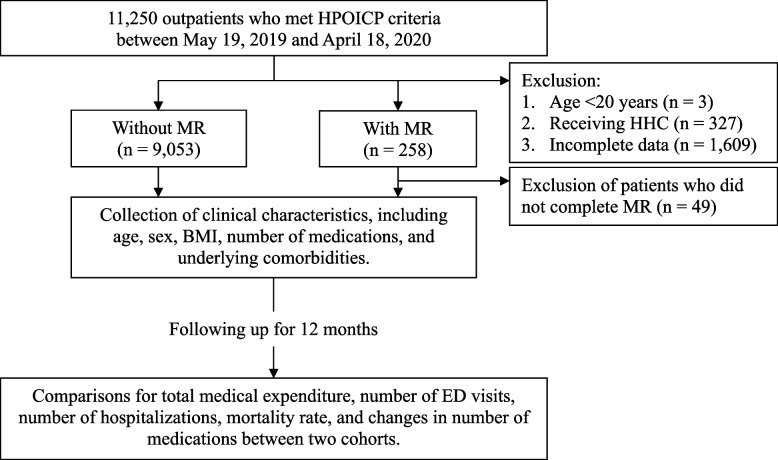
Methods: We collected data from outpatients with major polypharmacy (≥ 10 medications) between May 19, 2019, and April 18, 2020, comparing those who received MR with those who did not. Outcomes including total medical expenditures, ED visits, hospitalizations, mortality rate, and number of medications were compared between the two cohorts over a 12-month follow-up period.
Results: The study enrolled 209 patients with MR and 9,053 patients without MR. Patients who received MR were older, had lower body mass index, took more medications, and had a higher prevalence of hypertension, cerebrovascular disease, chronic kidney disease, and mental disorder. After 12 months of follow-up, patients who received MR had a higher proportion of reduced medications (adjusted odds ratio: 1.4; 95% confidence interval: 1.0 - 2.0), but also had more ED visits in the first 12 months compared to those who did not receive MR. The study did not find any significant differences in total medical expenditures, hospitalizations, and mortality rates between the two cohorts.
Conclusions: The model reduced medication use. Further research, including prospective designs, pharmacist involvement, and evaluations of reduced complications from fewer medications, is needed to better clarify patient outcomes.
期刊介绍:
BMC Health Services Research is an open access, peer-reviewed journal that considers articles on all aspects of health services research, including delivery of care, management of health services, assessment of healthcare needs, measurement of outcomes, allocation of healthcare resources, evaluation of different health markets and health services organizations, international comparative analysis of health systems, health economics and the impact of health policies and regulations.




 京公网安备 11010802042870号
京ICP备2023020795号-1
京公网安备 11010802042870号
京ICP备2023020795号-1

 分享
分享
 求助内容:
求助内容: 应助结果提醒方式:
 扫码关注我们
