{"title":"虚弱和炎症对中老年人群心血管疾病风险的相互作用和联合作用及炎症的中介作用","authors":"Zihan Xu, Yingbai Wang, Xiaolin Li, Xuefei Hou, Suru Yue, Jia Wang, Shicai Ye, Jiayuan Wu","doi":"10.1186/s12872-025-04567-1","DOIUrl":null,"url":null,"abstract":"<p><strong>Background: </strong>Frailty and inflammation may increase the risk of cardiovascular disease (CVD), but their interacting and joint effects on CVDs remain unclear. To explore the interaction effects of frailty and inflammation on CVDs and the role of inflammation in the relationship between frailty and CVDs to provide better understanding of the underlying pathogenesis of CVD.</p><p><strong>Methods: </strong>A total of 220,608 initially CVD-free participants were recruited from the UK Biobank database and were categorized into non-frailty, pre-frailty, and frailty groups based on Fried's criteria. The participants were also grouped according to the low-grade inflammation (INFLA) score and its components: the neutrophil-lymphocyte ratio, C-reactive protein, white blood cell count, and platelet count. Cox proportional hazards models with hazard ratios (HRs) and 95% confidence intervals (CIs) were used to assess the effects of frailty phenotypes and inflammation on CVD risk. Mediation analysis was used to quantify the role of inflammation in the association between frailty and CVDs. The potential interactions between frailty and inflammation in terms of CVD risk were also evaluated using additive and multiplicative scales.</p><p><strong>Results: </strong>During a median follow-up of 13.3 years, 48,978 participants developed CVDs. After adjusting for various confounders, participants with pre-frailty and frailty had a higher risk of CVDs than those with non-frailty (HRs: 1.20 (95% CI: 1.18-1.23) and 1.80 (95% CI: 1.69-1.91), respectively). A higher risk of CVDs was observed among participants with moderate and high INFLA scores than those with low INFLA scores (HRs: 1.09 (95% CI: 1.07-1.12) and 1.27 (95% CI: 1.24-1.30), respectively). The INFLA score and its components had limited mediating effects in the association between frailty and CVDs. Significant interactions were observed between frailty phenotypes and INFLA scores on CVDs on the multiplicative scale but not on the additive scale.</p><p><strong>Conclusion: </strong>Inflammation may amplify the harmful effect of frailty on the incidence of CVDs. Improving frailty alone might not substantially reduce the risk of CVDs, but effectively controlling inflammation might help to reduce the negative effects of frailty on cardiovascular health.</p>","PeriodicalId":9195,"journal":{"name":"BMC Cardiovascular Disorders","volume":"25 1","pages":"118"},"PeriodicalIF":2.3000,"publicationDate":"2025-02-20","publicationTypes":"Journal Article","fieldsOfStudy":null,"isOpenAccess":false,"openAccessPdf":"https://www.ncbi.nlm.nih.gov/pmc/articles/PMC11841180/pdf/","citationCount":"0","resultStr":"{\"title\":\"Interacting and joint effects of frailty and inflammation on cardiovascular disease risk and the mediating role of inflammation in middle-aged and elderly populations.\",\"authors\":\"Zihan Xu, Yingbai Wang, Xiaolin Li, Xuefei Hou, Suru Yue, Jia Wang, Shicai Ye, Jiayuan Wu\",\"doi\":\"10.1186/s12872-025-04567-1\",\"DOIUrl\":null,\"url\":null,\"abstract\":\"<p><strong>Background: </strong>Frailty and inflammation may increase the risk of cardiovascular disease (CVD), but their interacting and joint effects on CVDs remain unclear. To explore the interaction effects of frailty and inflammation on CVDs and the role of inflammation in the relationship between frailty and CVDs to provide better understanding of the underlying pathogenesis of CVD.</p><p><strong>Methods: </strong>A total of 220,608 initially CVD-free participants were recruited from the UK Biobank database and were categorized into non-frailty, pre-frailty, and frailty groups based on Fried's criteria. The participants were also grouped according to the low-grade inflammation (INFLA) score and its components: the neutrophil-lymphocyte ratio, C-reactive protein, white blood cell count, and platelet count. Cox proportional hazards models with hazard ratios (HRs) and 95% confidence intervals (CIs) were used to assess the effects of frailty phenotypes and inflammation on CVD risk. Mediation analysis was used to quantify the role of inflammation in the association between frailty and CVDs. The potential interactions between frailty and inflammation in terms of CVD risk were also evaluated using additive and multiplicative scales.</p><p><strong>Results: </strong>During a median follow-up of 13.3 years, 48,978 participants developed CVDs. After adjusting for various confounders, participants with pre-frailty and frailty had a higher risk of CVDs than those with non-frailty (HRs: 1.20 (95% CI: 1.18-1.23) and 1.80 (95% CI: 1.69-1.91), respectively). A higher risk of CVDs was observed among participants with moderate and high INFLA scores than those with low INFLA scores (HRs: 1.09 (95% CI: 1.07-1.12) and 1.27 (95% CI: 1.24-1.30), respectively). The INFLA score and its components had limited mediating effects in the association between frailty and CVDs. Significant interactions were observed between frailty phenotypes and INFLA scores on CVDs on the multiplicative scale but not on the additive scale.</p><p><strong>Conclusion: </strong>Inflammation may amplify the harmful effect of frailty on the incidence of CVDs. Improving frailty alone might not substantially reduce the risk of CVDs, but effectively controlling inflammation might help to reduce the negative effects of frailty on cardiovascular health.</p>\",\"PeriodicalId\":9195,\"journal\":{\"name\":\"BMC Cardiovascular Disorders\",\"volume\":\"25 1\",\"pages\":\"118\"},\"PeriodicalIF\":2.3000,\"publicationDate\":\"2025-02-20\",\"publicationTypes\":\"Journal Article\",\"fieldsOfStudy\":null,\"isOpenAccess\":false,\"openAccessPdf\":\"https://www.ncbi.nlm.nih.gov/pmc/articles/PMC11841180/pdf/\",\"citationCount\":\"0\",\"resultStr\":null,\"platform\":\"Semanticscholar\",\"paperid\":null,\"PeriodicalName\":\"BMC Cardiovascular Disorders\",\"FirstCategoryId\":\"3\",\"ListUrlMain\":\"https://doi.org/10.1186/s12872-025-04567-1\",\"RegionNum\":3,\"RegionCategory\":\"医学\",\"ArticlePicture\":[],\"TitleCN\":null,\"AbstractTextCN\":null,\"PMCID\":null,\"EPubDate\":\"\",\"PubModel\":\"\",\"JCR\":\"Q3\",\"JCRName\":\"CARDIAC & CARDIOVASCULAR SYSTEMS\",\"Score\":null,\"Total\":0}","platform":"Semanticscholar","paperid":null,"PeriodicalName":"BMC Cardiovascular Disorders","FirstCategoryId":"3","ListUrlMain":"https://doi.org/10.1186/s12872-025-04567-1","RegionNum":3,"RegionCategory":"医学","ArticlePicture":[],"TitleCN":null,"AbstractTextCN":null,"PMCID":null,"EPubDate":"","PubModel":"","JCR":"Q3","JCRName":"CARDIAC & CARDIOVASCULAR SYSTEMS","Score":null,"Total":0}
Interacting and joint effects of frailty and inflammation on cardiovascular disease risk and the mediating role of inflammation in middle-aged and elderly populations.
Background: Frailty and inflammation may increase the risk of cardiovascular disease (CVD), but their interacting and joint effects on CVDs remain unclear. To explore the interaction effects of frailty and inflammation on CVDs and the role of inflammation in the relationship between frailty and CVDs to provide better understanding of the underlying pathogenesis of CVD.
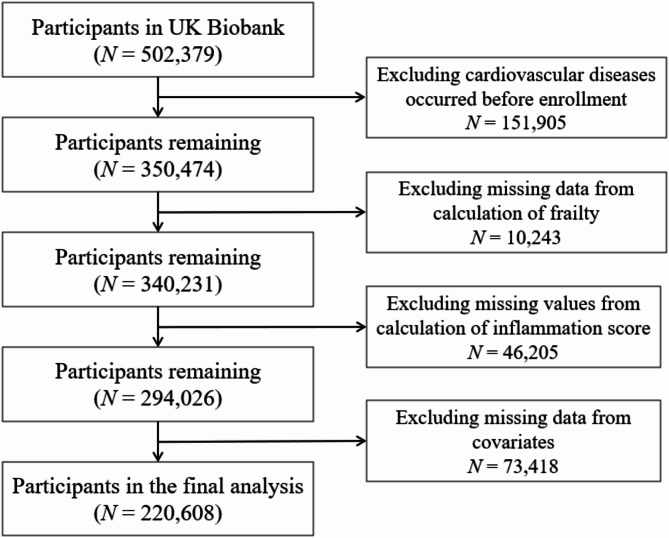
Methods: A total of 220,608 initially CVD-free participants were recruited from the UK Biobank database and were categorized into non-frailty, pre-frailty, and frailty groups based on Fried's criteria. The participants were also grouped according to the low-grade inflammation (INFLA) score and its components: the neutrophil-lymphocyte ratio, C-reactive protein, white blood cell count, and platelet count. Cox proportional hazards models with hazard ratios (HRs) and 95% confidence intervals (CIs) were used to assess the effects of frailty phenotypes and inflammation on CVD risk. Mediation analysis was used to quantify the role of inflammation in the association between frailty and CVDs. The potential interactions between frailty and inflammation in terms of CVD risk were also evaluated using additive and multiplicative scales.
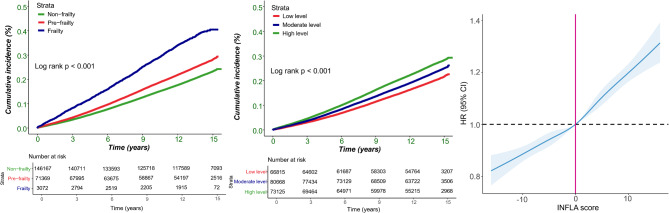
Results: During a median follow-up of 13.3 years, 48,978 participants developed CVDs. After adjusting for various confounders, participants with pre-frailty and frailty had a higher risk of CVDs than those with non-frailty (HRs: 1.20 (95% CI: 1.18-1.23) and 1.80 (95% CI: 1.69-1.91), respectively). A higher risk of CVDs was observed among participants with moderate and high INFLA scores than those with low INFLA scores (HRs: 1.09 (95% CI: 1.07-1.12) and 1.27 (95% CI: 1.24-1.30), respectively). The INFLA score and its components had limited mediating effects in the association between frailty and CVDs. Significant interactions were observed between frailty phenotypes and INFLA scores on CVDs on the multiplicative scale but not on the additive scale.
Conclusion: Inflammation may amplify the harmful effect of frailty on the incidence of CVDs. Improving frailty alone might not substantially reduce the risk of CVDs, but effectively controlling inflammation might help to reduce the negative effects of frailty on cardiovascular health.
期刊介绍:
BMC Cardiovascular Disorders is an open access, peer-reviewed journal that considers articles on all aspects of the prevention, diagnosis and management of disorders of the heart and circulatory system, as well as related molecular and cell biology, genetics, pathophysiology, epidemiology, and controlled trials.





 京公网安备 11010802042870号
京ICP备2023020795号-1
京公网安备 11010802042870号
京ICP备2023020795号-1

 分享
分享
 求助内容:
求助内容: 应助结果提醒方式:
 扫码关注我们
