{"title":"连云港地区幽门螺杆菌感染及耐药现状及危险因素分析","authors":"Chuchu Yang, Huahui Zhang, Shouying Li, Zhimei Zhang","doi":"10.1186/s12876-025-03692-7","DOIUrl":null,"url":null,"abstract":"<p><strong>Objective: </strong>Helicobacter pylori (H. pylori) has attracted much attention since its discovery. This bacterium has had a substantial impact on society, the economy, and public health. In recent years, with the continuous increase in drug resistance in H. pylori and the emergence of multidrug resistant strains, the existing diagnostic and treatment options are no longer able to meet clinical needs, so we need to understand the dynamically changing nature of drug resistance of H. pylori in our region. This study collected stool samples from community residents in Lianyungang to analyse the local H. pylori infection status, resistance to commonly used antibacterial agents, and risk factors to provide a reference for local clinical empirical treatment.</p><p><strong>Methods: </strong>Human stool samples from Lianyungang residents were collected, the DNA of H. pylori in the positive samples was extracted, the sites of mutated genes were determined by PCR and nucleic acid mass spectrometry, and genotypes of cytotoxin-associated gene A (CagA) and vacuolating cytotoxin A (VacA) were tested. The resistance rates of local H. pylori strains to five antibacterial agents, levofloxacin, clarithromycin, furazolidone, amoxicillin, and tetracycline, were collected, and the risk factors for drug resistance were analysed statistically based on questionnaire results.</p><p><strong>Results: </strong>A total of 221 residents with qualified stool samples were enrolled. The infection rate was 25.3%. DNA was extracted from 56 H. pylori samples. Among them, only 17 H. pylori strains were sensitive to all five antibiotics, and a total of five drug resistance patterns were detected. The main drug resistance patterns were single drug resistance to clarithromycin (30.4%) and double drug resistance to levofloxacin + clarithromycin (21.4%). The levofloxacin resistance mutations were mainly located at N87K and D91Y of the gyrA sequence, and the clarithromycin resistance mutations were mainly located at A2143G in the 23S rRNA sequence. Age, gastrointestinal symptoms, and previous history of H. pylori infection were risk factors for resistant H. pylori. A previous history of H. pylori infection was an independent risk factor for the development of drug resistance in H. pylori.</p><p><strong>Conclusion: </strong>The H. pylori infection rate in the Lianyungang area is lower than the national rate, but the rates of resistance to levofloxacin and clarithromycin are quite high. Drug sensitivity testing is needed to provide more accurate individualized treatment and improve the eradication rate of H. pylori. Continuous monitoring of local antibiotic resistance patterns remains the first choice for empirical treatment.</p>","PeriodicalId":9129,"journal":{"name":"BMC Gastroenterology","volume":"25 1","pages":"96"},"PeriodicalIF":3.2000,"publicationDate":"2025-02-20","publicationTypes":"Journal Article","fieldsOfStudy":null,"isOpenAccess":false,"openAccessPdf":"https://www.ncbi.nlm.nih.gov/pmc/articles/PMC11843961/pdf/","citationCount":"0","resultStr":"{\"title\":\"Analysis of the status and risk factors for Helicobacter pylori infection and drug resistance in the Lianyungang area, China.\",\"authors\":\"Chuchu Yang, Huahui Zhang, Shouying Li, Zhimei Zhang\",\"doi\":\"10.1186/s12876-025-03692-7\",\"DOIUrl\":null,\"url\":null,\"abstract\":\"<p><strong>Objective: </strong>Helicobacter pylori (H. pylori) has attracted much attention since its discovery. This bacterium has had a substantial impact on society, the economy, and public health. In recent years, with the continuous increase in drug resistance in H. pylori and the emergence of multidrug resistant strains, the existing diagnostic and treatment options are no longer able to meet clinical needs, so we need to understand the dynamically changing nature of drug resistance of H. pylori in our region. This study collected stool samples from community residents in Lianyungang to analyse the local H. pylori infection status, resistance to commonly used antibacterial agents, and risk factors to provide a reference for local clinical empirical treatment.</p><p><strong>Methods: </strong>Human stool samples from Lianyungang residents were collected, the DNA of H. pylori in the positive samples was extracted, the sites of mutated genes were determined by PCR and nucleic acid mass spectrometry, and genotypes of cytotoxin-associated gene A (CagA) and vacuolating cytotoxin A (VacA) were tested. The resistance rates of local H. pylori strains to five antibacterial agents, levofloxacin, clarithromycin, furazolidone, amoxicillin, and tetracycline, were collected, and the risk factors for drug resistance were analysed statistically based on questionnaire results.</p><p><strong>Results: </strong>A total of 221 residents with qualified stool samples were enrolled. The infection rate was 25.3%. DNA was extracted from 56 H. pylori samples. Among them, only 17 H. pylori strains were sensitive to all five antibiotics, and a total of five drug resistance patterns were detected. The main drug resistance patterns were single drug resistance to clarithromycin (30.4%) and double drug resistance to levofloxacin + clarithromycin (21.4%). The levofloxacin resistance mutations were mainly located at N87K and D91Y of the gyrA sequence, and the clarithromycin resistance mutations were mainly located at A2143G in the 23S rRNA sequence. Age, gastrointestinal symptoms, and previous history of H. pylori infection were risk factors for resistant H. pylori. A previous history of H. pylori infection was an independent risk factor for the development of drug resistance in H. pylori.</p><p><strong>Conclusion: </strong>The H. pylori infection rate in the Lianyungang area is lower than the national rate, but the rates of resistance to levofloxacin and clarithromycin are quite high. Drug sensitivity testing is needed to provide more accurate individualized treatment and improve the eradication rate of H. pylori. Continuous monitoring of local antibiotic resistance patterns remains the first choice for empirical treatment.</p>\",\"PeriodicalId\":9129,\"journal\":{\"name\":\"BMC Gastroenterology\",\"volume\":\"25 1\",\"pages\":\"96\"},\"PeriodicalIF\":3.2000,\"publicationDate\":\"2025-02-20\",\"publicationTypes\":\"Journal Article\",\"fieldsOfStudy\":null,\"isOpenAccess\":false,\"openAccessPdf\":\"https://www.ncbi.nlm.nih.gov/pmc/articles/PMC11843961/pdf/\",\"citationCount\":\"0\",\"resultStr\":null,\"platform\":\"Semanticscholar\",\"paperid\":null,\"PeriodicalName\":\"BMC Gastroenterology\",\"FirstCategoryId\":\"3\",\"ListUrlMain\":\"https://doi.org/10.1186/s12876-025-03692-7\",\"RegionNum\":3,\"RegionCategory\":\"医学\",\"ArticlePicture\":[],\"TitleCN\":null,\"AbstractTextCN\":null,\"PMCID\":null,\"EPubDate\":\"\",\"PubModel\":\"\",\"JCR\":\"Q2\",\"JCRName\":\"GASTROENTEROLOGY & HEPATOLOGY\",\"Score\":null,\"Total\":0}","platform":"Semanticscholar","paperid":null,"PeriodicalName":"BMC Gastroenterology","FirstCategoryId":"3","ListUrlMain":"https://doi.org/10.1186/s12876-025-03692-7","RegionNum":3,"RegionCategory":"医学","ArticlePicture":[],"TitleCN":null,"AbstractTextCN":null,"PMCID":null,"EPubDate":"","PubModel":"","JCR":"Q2","JCRName":"GASTROENTEROLOGY & HEPATOLOGY","Score":null,"Total":0}
引用次数: 0
摘要
目的:幽门螺杆菌(Helicobacter pylori, H. pylori)自发现以来一直备受关注。这种细菌对社会、经济和公共卫生产生了重大影响。近年来,随着幽门螺杆菌耐药性的不断增加和多重耐药菌株的出现,现有的诊断和治疗方案已不能满足临床需要,因此我们需要了解本地区幽门螺杆菌耐药性的动态变化性质。本研究收集连云港市社区居民粪便样本,分析当地幽门螺杆菌感染状况、常用抗菌药物耐药性及危险因素,为当地临床经验性治疗提供参考。方法:采集连云港市居民粪便标本,提取阳性标本中幽门螺杆菌DNA,采用PCR和核酸质谱法检测突变基因位点,检测细胞毒素相关基因A (CagA)和空泡细胞毒素A (VacA)基因型。收集当地幽门螺杆菌菌株对左氧氟沙星、克拉霉素、呋喃唑酮、阿莫西林、四环素5种抗菌药物的耐药率,并根据问卷调查结果统计分析耐药危险因素。结果:共纳入221名符合条件的居民粪便样本。感染率为25.3%。从56份幽门螺杆菌样本中提取DNA。其中,仅有17株幽门螺杆菌对5种抗生素均敏感,共检出5种耐药模式。主要耐药方式为对克拉霉素单耐(30.4%)和对左氧氟沙星+克拉霉素双耐(21.4%)。左氧氟沙星耐药突变主要位于gyrA序列的N87K和D91Y位点,克拉霉素耐药突变主要位于23S rRNA序列的A2143G位点。年龄、胃肠道症状和幽门螺杆菌感染史是发生耐药幽门螺杆菌的危险因素。既往幽门螺杆菌感染史是幽门螺杆菌耐药发展的独立危险因素。结论:连云港地区幽门螺旋杆菌感染率低于全国水平,但对左氧氟沙星和克拉霉素的耐药率较高。为了提供更准确的个体化治疗,提高幽门螺杆菌的根除率,需要进行药敏试验。持续监测当地抗生素耐药模式仍然是经验性治疗的首选。
Analysis of the status and risk factors for Helicobacter pylori infection and drug resistance in the Lianyungang area, China.
Objective: Helicobacter pylori (H. pylori) has attracted much attention since its discovery. This bacterium has had a substantial impact on society, the economy, and public health. In recent years, with the continuous increase in drug resistance in H. pylori and the emergence of multidrug resistant strains, the existing diagnostic and treatment options are no longer able to meet clinical needs, so we need to understand the dynamically changing nature of drug resistance of H. pylori in our region. This study collected stool samples from community residents in Lianyungang to analyse the local H. pylori infection status, resistance to commonly used antibacterial agents, and risk factors to provide a reference for local clinical empirical treatment.
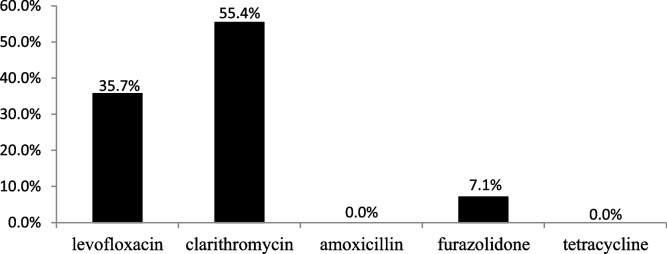
Methods: Human stool samples from Lianyungang residents were collected, the DNA of H. pylori in the positive samples was extracted, the sites of mutated genes were determined by PCR and nucleic acid mass spectrometry, and genotypes of cytotoxin-associated gene A (CagA) and vacuolating cytotoxin A (VacA) were tested. The resistance rates of local H. pylori strains to five antibacterial agents, levofloxacin, clarithromycin, furazolidone, amoxicillin, and tetracycline, were collected, and the risk factors for drug resistance were analysed statistically based on questionnaire results.
Results: A total of 221 residents with qualified stool samples were enrolled. The infection rate was 25.3%. DNA was extracted from 56 H. pylori samples. Among them, only 17 H. pylori strains were sensitive to all five antibiotics, and a total of five drug resistance patterns were detected. The main drug resistance patterns were single drug resistance to clarithromycin (30.4%) and double drug resistance to levofloxacin + clarithromycin (21.4%). The levofloxacin resistance mutations were mainly located at N87K and D91Y of the gyrA sequence, and the clarithromycin resistance mutations were mainly located at A2143G in the 23S rRNA sequence. Age, gastrointestinal symptoms, and previous history of H. pylori infection were risk factors for resistant H. pylori. A previous history of H. pylori infection was an independent risk factor for the development of drug resistance in H. pylori.
Conclusion: The H. pylori infection rate in the Lianyungang area is lower than the national rate, but the rates of resistance to levofloxacin and clarithromycin are quite high. Drug sensitivity testing is needed to provide more accurate individualized treatment and improve the eradication rate of H. pylori. Continuous monitoring of local antibiotic resistance patterns remains the first choice for empirical treatment.
期刊介绍:
BMC Gastroenterology is an open access, peer-reviewed journal that considers articles on all aspects of the prevention, diagnosis and management of gastrointestinal and hepatobiliary disorders, as well as related molecular genetics, pathophysiology, and epidemiology.




 京公网安备 11010802042870号
京ICP备2023020795号-1
京公网安备 11010802042870号
京ICP备2023020795号-1

 分享
分享
 求助内容:
求助内容: 应助结果提醒方式:
 扫码关注我们
