Yunrui Li, Hao Xu, Ambrish Kumar, Duo-Sheng Wang, Christian Heiss, Parastoo Azadi, Pengyu Hong
{"title":"TransPeakNet通过多任务预训练和无监督学习进行溶剂感知的二维核磁共振预测。","authors":"Yunrui Li, Hao Xu, Ambrish Kumar, Duo-Sheng Wang, Christian Heiss, Parastoo Azadi, Pengyu Hong","doi":"10.1038/s42004-025-01455-9","DOIUrl":null,"url":null,"abstract":"<p><p>Nuclear Magnetic Resonance (NMR) spectroscopy is essential for revealing molecular structure, electronic environment, and dynamics. Accurate NMR shift prediction allows researchers to validate structures by comparing predicted and observed shifts. While Machine Learning (ML) has improved one-dimensional (1D) NMR shift prediction, predicting 2D NMR remains challenging due to limited annotated data. To address this, we introduce an unsupervised training framework for predicting cross-peaks in 2D NMR, specifically Heteronuclear Single Quantum Coherence (HSQC). Our approach pretrains an ML model on an annotated 1D dataset of <sup>1</sup>H and <sup>13</sup>C shifts, then finetunes it in an unsupervised manner using unlabeled HSQC data, which simultaneously generates cross-peak annotations. Our model also adjusts for solvent effects. Evaluation on 479 expert-annotated HSQC spectra demonstrates our model's superiority over traditional methods (ChemDraw and Mestrenova), achieving Mean Absolute Errors (MAEs) of 2.05 ppm and 0.165 ppm for <sup>13</sup>C shifts and <sup>1</sup>H shifts respectively. Our algorithmic annotations show a 95.21% concordance with experts' assignments, underscoring the approach's potential for structural elucidation in fields like organic chemistry, pharmaceuticals, and natural products.</p>","PeriodicalId":10529,"journal":{"name":"Communications Chemistry","volume":"8 1","pages":"51"},"PeriodicalIF":6.2000,"publicationDate":"2025-02-20","publicationTypes":"Journal Article","fieldsOfStudy":null,"isOpenAccess":false,"openAccessPdf":"https://www.ncbi.nlm.nih.gov/pmc/articles/PMC11842623/pdf/","citationCount":"0","resultStr":"{\"title\":\"TransPeakNet for solvent-aware 2D NMR prediction via multi-task pre-training and unsupervised learning.\",\"authors\":\"Yunrui Li, Hao Xu, Ambrish Kumar, Duo-Sheng Wang, Christian Heiss, Parastoo Azadi, Pengyu Hong\",\"doi\":\"10.1038/s42004-025-01455-9\",\"DOIUrl\":null,\"url\":null,\"abstract\":\"<p><p>Nuclear Magnetic Resonance (NMR) spectroscopy is essential for revealing molecular structure, electronic environment, and dynamics. Accurate NMR shift prediction allows researchers to validate structures by comparing predicted and observed shifts. While Machine Learning (ML) has improved one-dimensional (1D) NMR shift prediction, predicting 2D NMR remains challenging due to limited annotated data. To address this, we introduce an unsupervised training framework for predicting cross-peaks in 2D NMR, specifically Heteronuclear Single Quantum Coherence (HSQC). Our approach pretrains an ML model on an annotated 1D dataset of <sup>1</sup>H and <sup>13</sup>C shifts, then finetunes it in an unsupervised manner using unlabeled HSQC data, which simultaneously generates cross-peak annotations. Our model also adjusts for solvent effects. Evaluation on 479 expert-annotated HSQC spectra demonstrates our model's superiority over traditional methods (ChemDraw and Mestrenova), achieving Mean Absolute Errors (MAEs) of 2.05 ppm and 0.165 ppm for <sup>13</sup>C shifts and <sup>1</sup>H shifts respectively. Our algorithmic annotations show a 95.21% concordance with experts' assignments, underscoring the approach's potential for structural elucidation in fields like organic chemistry, pharmaceuticals, and natural products.</p>\",\"PeriodicalId\":10529,\"journal\":{\"name\":\"Communications Chemistry\",\"volume\":\"8 1\",\"pages\":\"51\"},\"PeriodicalIF\":6.2000,\"publicationDate\":\"2025-02-20\",\"publicationTypes\":\"Journal Article\",\"fieldsOfStudy\":null,\"isOpenAccess\":false,\"openAccessPdf\":\"https://www.ncbi.nlm.nih.gov/pmc/articles/PMC11842623/pdf/\",\"citationCount\":\"0\",\"resultStr\":null,\"platform\":\"Semanticscholar\",\"paperid\":null,\"PeriodicalName\":\"Communications Chemistry\",\"FirstCategoryId\":\"92\",\"ListUrlMain\":\"https://doi.org/10.1038/s42004-025-01455-9\",\"RegionNum\":2,\"RegionCategory\":\"化学\",\"ArticlePicture\":[],\"TitleCN\":null,\"AbstractTextCN\":null,\"PMCID\":null,\"EPubDate\":\"\",\"PubModel\":\"\",\"JCR\":\"Q1\",\"JCRName\":\"CHEMISTRY, MULTIDISCIPLINARY\",\"Score\":null,\"Total\":0}","platform":"Semanticscholar","paperid":null,"PeriodicalName":"Communications Chemistry","FirstCategoryId":"92","ListUrlMain":"https://doi.org/10.1038/s42004-025-01455-9","RegionNum":2,"RegionCategory":"化学","ArticlePicture":[],"TitleCN":null,"AbstractTextCN":null,"PMCID":null,"EPubDate":"","PubModel":"","JCR":"Q1","JCRName":"CHEMISTRY, MULTIDISCIPLINARY","Score":null,"Total":0}
TransPeakNet for solvent-aware 2D NMR prediction via multi-task pre-training and unsupervised learning.
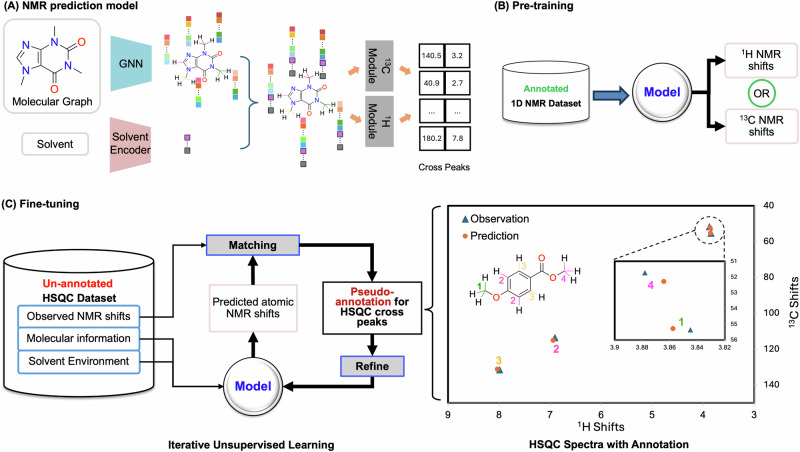
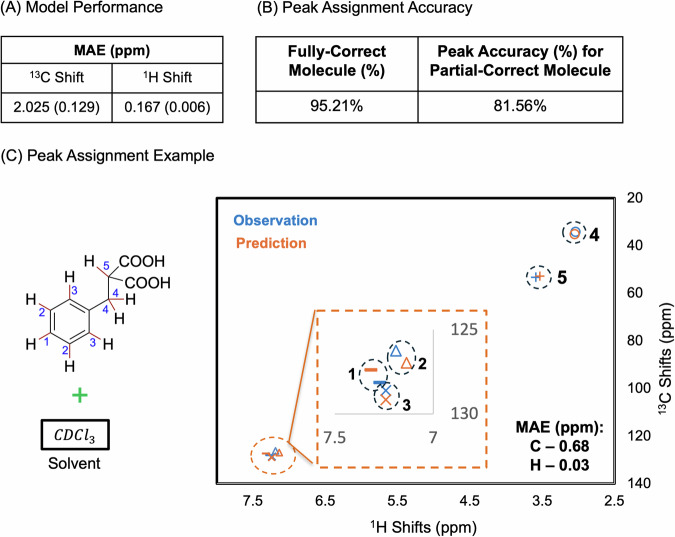
Nuclear Magnetic Resonance (NMR) spectroscopy is essential for revealing molecular structure, electronic environment, and dynamics. Accurate NMR shift prediction allows researchers to validate structures by comparing predicted and observed shifts. While Machine Learning (ML) has improved one-dimensional (1D) NMR shift prediction, predicting 2D NMR remains challenging due to limited annotated data. To address this, we introduce an unsupervised training framework for predicting cross-peaks in 2D NMR, specifically Heteronuclear Single Quantum Coherence (HSQC). Our approach pretrains an ML model on an annotated 1D dataset of 1H and 13C shifts, then finetunes it in an unsupervised manner using unlabeled HSQC data, which simultaneously generates cross-peak annotations. Our model also adjusts for solvent effects. Evaluation on 479 expert-annotated HSQC spectra demonstrates our model's superiority over traditional methods (ChemDraw and Mestrenova), achieving Mean Absolute Errors (MAEs) of 2.05 ppm and 0.165 ppm for 13C shifts and 1H shifts respectively. Our algorithmic annotations show a 95.21% concordance with experts' assignments, underscoring the approach's potential for structural elucidation in fields like organic chemistry, pharmaceuticals, and natural products.
期刊介绍:
Communications Chemistry is an open access journal from Nature Research publishing high-quality research, reviews and commentary in all areas of the chemical sciences. Research papers published by the journal represent significant advances bringing new chemical insight to a specialized area of research. We also aim to provide a community forum for issues of importance to all chemists, regardless of sub-discipline.




 京公网安备 11010802042870号
京ICP备2023020795号-1
京公网安备 11010802042870号
京ICP备2023020795号-1

 分享
分享
 求助内容:
求助内容: 应助结果提醒方式:
 扫码关注我们
