Tom Murphy RCES , Ryle Przybylowicz MD , Jose Lozano Garcia MD , Francis Phan MD , Saket Sanghai MD, FHRS , Charles A. Henrikson MD, MPH, FHRS , Seshadri Balaji MBBS, MRCP, PhD, FHRS , Eric C. Stecker MD, MPH, FHRS
{"title":"用于绘制单向附属通路上游插入图的新型起搏方法","authors":"Tom Murphy RCES , Ryle Przybylowicz MD , Jose Lozano Garcia MD , Francis Phan MD , Saket Sanghai MD, FHRS , Charles A. Henrikson MD, MPH, FHRS , Seshadri Balaji MBBS, MRCP, PhD, FHRS , Eric C. Stecker MD, MPH, FHRS","doi":"10.1016/j.hrthm.2025.02.022","DOIUrl":null,"url":null,"abstract":"<div><h3>Background</h3><div>Anatomic characterization of unidirectional accessory pathways (APs) is inherently limited to the localization of the downstream insertion site. The inability to define the full anatomic course of unidirectional pathways can limit the safety and effectiveness of ablation in the setting of complex pathways, slanted pathways, unstable catheter positioning at downstream insertions, or insertions near the conduction system.</div></div><div><h3>Objective</h3><div>We aimed to develop novel pacing maneuvers to localize upstream insertions of unidirectional APs.</div></div><div><h3>Methods</h3><div>Two methods were evaluated: localizing the shortest transit time from roving pacing sites to a fixed reference in the opposite chamber (upstream transit mapping); and identifying the site at which the latest atrial or ventricular extrastimulus reset atrioventricular reciprocating tachycardia (late reset mapping). Unidirectional APs were included to test utility and feasibility of the techniques, and bidirectional APs were included to test anatomic accuracy.</div></div><div><h3>Results</h3><div>A total of 13 patients were included, 8 unidirectional APs and 5 bidirectional APs. Blind side mapping was successfully performed in all cases and showed excellent spatial correlation to conventional mapping methods (mean, 4.2 mm; SD, 1.3 mm) as well as to the site of successful ablation (mean, 2.5 mm; SD, 2.9 mm). The upstream transit mapping method was critical for successful ablation after conventional techniques proved inadequate in 2 cases.</div></div><div><h3>Conclusion</h3><div>Two novel methods, upstream transit mapping and late reset mapping, were used to localize the previously unmappable upstream insertions of unidirectional pathways. These methods expand the diagnostic toolbox to facilitate successful ablation in challenging cases.</div></div>","PeriodicalId":12886,"journal":{"name":"Heart rhythm","volume":"22 12","pages":"Pages 3121-3130"},"PeriodicalIF":5.7000,"publicationDate":"2025-12-01","publicationTypes":"Journal Article","fieldsOfStudy":null,"isOpenAccess":false,"openAccessPdf":"","citationCount":"0","resultStr":"{\"title\":\"Novel pacing maneuvers for mapping the upstream insertion of unidirectional accessory pathways\",\"authors\":\"Tom Murphy RCES , Ryle Przybylowicz MD , Jose Lozano Garcia MD , Francis Phan MD , Saket Sanghai MD, FHRS , Charles A. Henrikson MD, MPH, FHRS , Seshadri Balaji MBBS, MRCP, PhD, FHRS , Eric C. Stecker MD, MPH, FHRS\",\"doi\":\"10.1016/j.hrthm.2025.02.022\",\"DOIUrl\":null,\"url\":null,\"abstract\":\"<div><h3>Background</h3><div>Anatomic characterization of unidirectional accessory pathways (APs) is inherently limited to the localization of the downstream insertion site. The inability to define the full anatomic course of unidirectional pathways can limit the safety and effectiveness of ablation in the setting of complex pathways, slanted pathways, unstable catheter positioning at downstream insertions, or insertions near the conduction system.</div></div><div><h3>Objective</h3><div>We aimed to develop novel pacing maneuvers to localize upstream insertions of unidirectional APs.</div></div><div><h3>Methods</h3><div>Two methods were evaluated: localizing the shortest transit time from roving pacing sites to a fixed reference in the opposite chamber (upstream transit mapping); and identifying the site at which the latest atrial or ventricular extrastimulus reset atrioventricular reciprocating tachycardia (late reset mapping). Unidirectional APs were included to test utility and feasibility of the techniques, and bidirectional APs were included to test anatomic accuracy.</div></div><div><h3>Results</h3><div>A total of 13 patients were included, 8 unidirectional APs and 5 bidirectional APs. Blind side mapping was successfully performed in all cases and showed excellent spatial correlation to conventional mapping methods (mean, 4.2 mm; SD, 1.3 mm) as well as to the site of successful ablation (mean, 2.5 mm; SD, 2.9 mm). The upstream transit mapping method was critical for successful ablation after conventional techniques proved inadequate in 2 cases.</div></div><div><h3>Conclusion</h3><div>Two novel methods, upstream transit mapping and late reset mapping, were used to localize the previously unmappable upstream insertions of unidirectional pathways. These methods expand the diagnostic toolbox to facilitate successful ablation in challenging cases.</div></div>\",\"PeriodicalId\":12886,\"journal\":{\"name\":\"Heart rhythm\",\"volume\":\"22 12\",\"pages\":\"Pages 3121-3130\"},\"PeriodicalIF\":5.7000,\"publicationDate\":\"2025-12-01\",\"publicationTypes\":\"Journal Article\",\"fieldsOfStudy\":null,\"isOpenAccess\":false,\"openAccessPdf\":\"\",\"citationCount\":\"0\",\"resultStr\":null,\"platform\":\"Semanticscholar\",\"paperid\":null,\"PeriodicalName\":\"Heart rhythm\",\"FirstCategoryId\":\"3\",\"ListUrlMain\":\"https://www.sciencedirect.com/science/article/pii/S1547527125001912\",\"RegionNum\":2,\"RegionCategory\":\"医学\",\"ArticlePicture\":[],\"TitleCN\":null,\"AbstractTextCN\":null,\"PMCID\":null,\"EPubDate\":\"2025/2/18 0:00:00\",\"PubModel\":\"Epub\",\"JCR\":\"Q1\",\"JCRName\":\"CARDIAC & CARDIOVASCULAR SYSTEMS\",\"Score\":null,\"Total\":0}","platform":"Semanticscholar","paperid":null,"PeriodicalName":"Heart rhythm","FirstCategoryId":"3","ListUrlMain":"https://www.sciencedirect.com/science/article/pii/S1547527125001912","RegionNum":2,"RegionCategory":"医学","ArticlePicture":[],"TitleCN":null,"AbstractTextCN":null,"PMCID":null,"EPubDate":"2025/2/18 0:00:00","PubModel":"Epub","JCR":"Q1","JCRName":"CARDIAC & CARDIOVASCULAR SYSTEMS","Score":null,"Total":0}
Novel pacing maneuvers for mapping the upstream insertion of unidirectional accessory pathways
Background
Anatomic characterization of unidirectional accessory pathways (APs) is inherently limited to the localization of the downstream insertion site. The inability to define the full anatomic course of unidirectional pathways can limit the safety and effectiveness of ablation in the setting of complex pathways, slanted pathways, unstable catheter positioning at downstream insertions, or insertions near the conduction system.
Objective
We aimed to develop novel pacing maneuvers to localize upstream insertions of unidirectional APs.
Methods
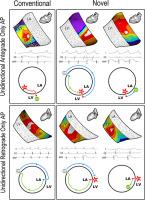
Two methods were evaluated: localizing the shortest transit time from roving pacing sites to a fixed reference in the opposite chamber (upstream transit mapping); and identifying the site at which the latest atrial or ventricular extrastimulus reset atrioventricular reciprocating tachycardia (late reset mapping). Unidirectional APs were included to test utility and feasibility of the techniques, and bidirectional APs were included to test anatomic accuracy.
Results
A total of 13 patients were included, 8 unidirectional APs and 5 bidirectional APs. Blind side mapping was successfully performed in all cases and showed excellent spatial correlation to conventional mapping methods (mean, 4.2 mm; SD, 1.3 mm) as well as to the site of successful ablation (mean, 2.5 mm; SD, 2.9 mm). The upstream transit mapping method was critical for successful ablation after conventional techniques proved inadequate in 2 cases.
Conclusion
Two novel methods, upstream transit mapping and late reset mapping, were used to localize the previously unmappable upstream insertions of unidirectional pathways. These methods expand the diagnostic toolbox to facilitate successful ablation in challenging cases.
期刊介绍:
HeartRhythm, the official Journal of the Heart Rhythm Society and the Cardiac Electrophysiology Society, is a unique journal for fundamental discovery and clinical applicability.
HeartRhythm integrates the entire cardiac electrophysiology (EP) community from basic and clinical academic researchers, private practitioners, engineers, allied professionals, industry, and trainees, all of whom are vital and interdependent members of our EP community.
The Heart Rhythm Society is the international leader in science, education, and advocacy for cardiac arrhythmia professionals and patients, and the primary information resource on heart rhythm disorders. Its mission is to improve the care of patients by promoting research, education, and optimal health care policies and standards.




 京公网安备 11010802042870号
京ICP备2023020795号-1
京公网安备 11010802042870号
京ICP备2023020795号-1

 分享
分享
 求助内容:
求助内容: 应助结果提醒方式:
 扫码关注我们
