Nikhil Ahluwalia, David Bruce, Ashley Ashdown, Fabrizio Focacci, Hakam Abbass, Shohreh Honarbakhsh, Anthony Chow, Mehul Dhinoja, Ross J. Hunter, Steffen Petersen, Guy Lloyd, Richard J. Schilling
{"title":"导管消融改善心房纤颤介导的心肌病的通气效率。","authors":"Nikhil Ahluwalia, David Bruce, Ashley Ashdown, Fabrizio Focacci, Hakam Abbass, Shohreh Honarbakhsh, Anthony Chow, Mehul Dhinoja, Ross J. Hunter, Steffen Petersen, Guy Lloyd, Richard J. Schilling","doi":"10.1111/jce.16606","DOIUrl":null,"url":null,"abstract":"<div>\n \n \n <section>\n \n <h3> Background</h3>\n \n <p>Exercise Oscillatory Ventilation (EOV) and a steep ventilatory efficiency (VE/VCO2) slope are features of ventilatory inefficiency on cardiopulmonary exercise testing (CPET), both associated with poor prognosis in patients with heart failure (HF). The prevalence in patients with co-existent atrial fibrillation (AF) and the impact of catheter ablation (CA) is unknown.</p>\n </section>\n \n <section>\n \n <h3> Objectives</h3>\n \n <p>To characterize ventilatory inefficiency in patients with persistent AF and Left Ventricular Systolic Dysfunction (LVSD) and assess the impact of CA.</p>\n </section>\n \n <section>\n \n <h3> Methods</h3>\n \n <p>Patients with persistent AF and Left Ventricular Ejection Fraction (LVEF) < 50% undergoing first-time CA were prospectively enrolled. Echocardiography and CPET were performed at baseline and 6 months post-CA. EOV was defined using the Kremser–Corrà criteria, and VE/VCO2 slope gradient > 30 was considered abnormal.</p>\n </section>\n \n <section>\n \n <h3> Results</h3>\n \n <p>A total of 53 participants were enrolled (mean LVEF of 34 ± 9%). A total of 10 (19.2%) exhibited EOV at baseline. These patients had larger indexed left atrial (41.6 ± 13.1 mL/m<sup>2</sup> vs. 33.3 ± 9.3 mL/m<sup>2</sup>, <i>p</i> = 0.03) and ventricular volumes [65.7 mL/m<sup>2</sup> (57.1, 89.0) vs. 46.7 mL/m<sup>2</sup> (39.8, 61.4), <i>p</i> = 0.03]. The partial pressure of end-tidal carbon dioxide (P<sub>ET</sub>CO<sub>2</sub>) at peak exercise increased (33.7 ± 6.1 mmHg to 41.2 ± 5.8 mmHg, <i>p</i> < 0.001) and correlated with improvement in HF symptoms (<i>p</i> = −0.003) and objective HF markers. A total of 25 (48.1%) had an abnormal VE/VCO2 gradient. The EOV pattern resolved in eight (80%) participants due to a reduction in EOV burden (71.1 ± 11.9% vs. 48.8 ± 14.8%, <i>p</i> = 0.006) and the component amplitude of minute ventilation cycles (2.6 L/min (2.5,3.2) vs 2.2 L/min (1.8,2.6), <i>p</i> = 0.028). Fewer patients had an abnormal VE/VCO2 gradient after CA [25 (48.1%) vs. 16 (34.0%), <i>p</i> = 0.004].</p>\n </section>\n \n <section>\n \n <h3> Conclusions</h3>\n \n <p>Ventilatory inefficiency is common in patients with AF and LVSD. CA improves both EOV and VE/VCO2 in AF-induced cardiomyopathy. Improvement in P<sub>ET</sub>CO<sub>2</sub> is also seen and correlates with HF symptom burden.</p>\n </section>\n </div>","PeriodicalId":15178,"journal":{"name":"Journal of Cardiovascular Electrophysiology","volume":"36 5","pages":"945-951"},"PeriodicalIF":2.6000,"publicationDate":"2025-02-21","publicationTypes":"Journal Article","fieldsOfStudy":null,"isOpenAccess":false,"openAccessPdf":"https://onlinelibrary.wiley.com/doi/epdf/10.1111/jce.16606","citationCount":"0","resultStr":"{\"title\":\"Catheter Ablation Improves Ventilatory Efficiency in Atrial Fibrillation-Mediated Cardiomyopathy\",\"authors\":\"Nikhil Ahluwalia, David Bruce, Ashley Ashdown, Fabrizio Focacci, Hakam Abbass, Shohreh Honarbakhsh, Anthony Chow, Mehul Dhinoja, Ross J. Hunter, Steffen Petersen, Guy Lloyd, Richard J. Schilling\",\"doi\":\"10.1111/jce.16606\",\"DOIUrl\":null,\"url\":null,\"abstract\":\"<div>\\n \\n \\n <section>\\n \\n <h3> Background</h3>\\n \\n <p>Exercise Oscillatory Ventilation (EOV) and a steep ventilatory efficiency (VE/VCO2) slope are features of ventilatory inefficiency on cardiopulmonary exercise testing (CPET), both associated with poor prognosis in patients with heart failure (HF). The prevalence in patients with co-existent atrial fibrillation (AF) and the impact of catheter ablation (CA) is unknown.</p>\\n </section>\\n \\n <section>\\n \\n <h3> Objectives</h3>\\n \\n <p>To characterize ventilatory inefficiency in patients with persistent AF and Left Ventricular Systolic Dysfunction (LVSD) and assess the impact of CA.</p>\\n </section>\\n \\n <section>\\n \\n <h3> Methods</h3>\\n \\n <p>Patients with persistent AF and Left Ventricular Ejection Fraction (LVEF) < 50% undergoing first-time CA were prospectively enrolled. Echocardiography and CPET were performed at baseline and 6 months post-CA. EOV was defined using the Kremser–Corrà criteria, and VE/VCO2 slope gradient > 30 was considered abnormal.</p>\\n </section>\\n \\n <section>\\n \\n <h3> Results</h3>\\n \\n <p>A total of 53 participants were enrolled (mean LVEF of 34 ± 9%). A total of 10 (19.2%) exhibited EOV at baseline. These patients had larger indexed left atrial (41.6 ± 13.1 mL/m<sup>2</sup> vs. 33.3 ± 9.3 mL/m<sup>2</sup>, <i>p</i> = 0.03) and ventricular volumes [65.7 mL/m<sup>2</sup> (57.1, 89.0) vs. 46.7 mL/m<sup>2</sup> (39.8, 61.4), <i>p</i> = 0.03]. The partial pressure of end-tidal carbon dioxide (P<sub>ET</sub>CO<sub>2</sub>) at peak exercise increased (33.7 ± 6.1 mmHg to 41.2 ± 5.8 mmHg, <i>p</i> < 0.001) and correlated with improvement in HF symptoms (<i>p</i> = −0.003) and objective HF markers. A total of 25 (48.1%) had an abnormal VE/VCO2 gradient. The EOV pattern resolved in eight (80%) participants due to a reduction in EOV burden (71.1 ± 11.9% vs. 48.8 ± 14.8%, <i>p</i> = 0.006) and the component amplitude of minute ventilation cycles (2.6 L/min (2.5,3.2) vs 2.2 L/min (1.8,2.6), <i>p</i> = 0.028). Fewer patients had an abnormal VE/VCO2 gradient after CA [25 (48.1%) vs. 16 (34.0%), <i>p</i> = 0.004].</p>\\n </section>\\n \\n <section>\\n \\n <h3> Conclusions</h3>\\n \\n <p>Ventilatory inefficiency is common in patients with AF and LVSD. CA improves both EOV and VE/VCO2 in AF-induced cardiomyopathy. Improvement in P<sub>ET</sub>CO<sub>2</sub> is also seen and correlates with HF symptom burden.</p>\\n </section>\\n </div>\",\"PeriodicalId\":15178,\"journal\":{\"name\":\"Journal of Cardiovascular Electrophysiology\",\"volume\":\"36 5\",\"pages\":\"945-951\"},\"PeriodicalIF\":2.6000,\"publicationDate\":\"2025-02-21\",\"publicationTypes\":\"Journal Article\",\"fieldsOfStudy\":null,\"isOpenAccess\":false,\"openAccessPdf\":\"https://onlinelibrary.wiley.com/doi/epdf/10.1111/jce.16606\",\"citationCount\":\"0\",\"resultStr\":null,\"platform\":\"Semanticscholar\",\"paperid\":null,\"PeriodicalName\":\"Journal of Cardiovascular Electrophysiology\",\"FirstCategoryId\":\"3\",\"ListUrlMain\":\"https://onlinelibrary.wiley.com/doi/10.1111/jce.16606\",\"RegionNum\":3,\"RegionCategory\":\"医学\",\"ArticlePicture\":[],\"TitleCN\":null,\"AbstractTextCN\":null,\"PMCID\":null,\"EPubDate\":\"\",\"PubModel\":\"\",\"JCR\":\"Q2\",\"JCRName\":\"CARDIAC & CARDIOVASCULAR SYSTEMS\",\"Score\":null,\"Total\":0}","platform":"Semanticscholar","paperid":null,"PeriodicalName":"Journal of Cardiovascular Electrophysiology","FirstCategoryId":"3","ListUrlMain":"https://onlinelibrary.wiley.com/doi/10.1111/jce.16606","RegionNum":3,"RegionCategory":"医学","ArticlePicture":[],"TitleCN":null,"AbstractTextCN":null,"PMCID":null,"EPubDate":"","PubModel":"","JCR":"Q2","JCRName":"CARDIAC & CARDIOVASCULAR SYSTEMS","Score":null,"Total":0}
引用次数: 0
摘要
背景:运动振荡通气(EOV)和较大的通气效率(VE/VCO2)斜率是心肺运动试验(CPET)通气效率低下的特征,两者都与心力衰竭(HF)患者的预后不良有关。并发心房颤动(AF)患者的患病率和导管消融(CA)的影响尚不清楚。目的:探讨持续性房颤合并左室收缩功能不全(LVSD)患者通气效率低下的特征,并评估ca的影响。方法:持续性房颤合并左室射血分数(LVEF) 30为异常。结果:共纳入53例受试者(平均LVEF为34±9%)。共有10例(19.2%)在基线时表现为EOV。这些患者的左心房指数(41.6±13.1 mL/m2 vs. 33.3±9.3 mL/m2, p = 0.03)和心室容积较大[65.7 mL/m2 (57.1, 89.0) vs. 46.7 mL/m2 (39.8, 61.4), p = 0.03]。运动高峰时潮末二氧化碳分压(PETCO2)升高(33.7±6.1 mmHg)至41.2±5.8 mmHg, p结论:房颤合并LVSD患者通气效率低下。CA可改善af诱导心肌病患者的EOV和VE/VCO2。PETCO2的改善也与HF症状负担相关。
Catheter Ablation Improves Ventilatory Efficiency in Atrial Fibrillation-Mediated Cardiomyopathy
Background
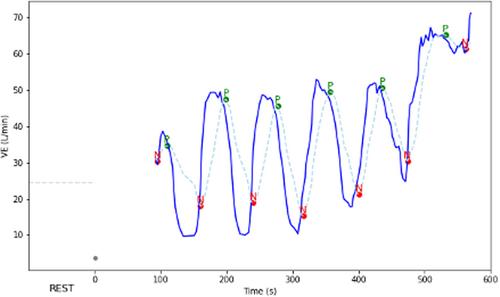
Exercise Oscillatory Ventilation (EOV) and a steep ventilatory efficiency (VE/VCO2) slope are features of ventilatory inefficiency on cardiopulmonary exercise testing (CPET), both associated with poor prognosis in patients with heart failure (HF). The prevalence in patients with co-existent atrial fibrillation (AF) and the impact of catheter ablation (CA) is unknown.
Objectives
To characterize ventilatory inefficiency in patients with persistent AF and Left Ventricular Systolic Dysfunction (LVSD) and assess the impact of CA.
Methods
Patients with persistent AF and Left Ventricular Ejection Fraction (LVEF) < 50% undergoing first-time CA were prospectively enrolled. Echocardiography and CPET were performed at baseline and 6 months post-CA. EOV was defined using the Kremser–Corrà criteria, and VE/VCO2 slope gradient > 30 was considered abnormal.
Results
A total of 53 participants were enrolled (mean LVEF of 34 ± 9%). A total of 10 (19.2%) exhibited EOV at baseline. These patients had larger indexed left atrial (41.6 ± 13.1 mL/m2 vs. 33.3 ± 9.3 mL/m2, p = 0.03) and ventricular volumes [65.7 mL/m2 (57.1, 89.0) vs. 46.7 mL/m2 (39.8, 61.4), p = 0.03]. The partial pressure of end-tidal carbon dioxide (PETCO2) at peak exercise increased (33.7 ± 6.1 mmHg to 41.2 ± 5.8 mmHg, p < 0.001) and correlated with improvement in HF symptoms (p = −0.003) and objective HF markers. A total of 25 (48.1%) had an abnormal VE/VCO2 gradient. The EOV pattern resolved in eight (80%) participants due to a reduction in EOV burden (71.1 ± 11.9% vs. 48.8 ± 14.8%, p = 0.006) and the component amplitude of minute ventilation cycles (2.6 L/min (2.5,3.2) vs 2.2 L/min (1.8,2.6), p = 0.028). Fewer patients had an abnormal VE/VCO2 gradient after CA [25 (48.1%) vs. 16 (34.0%), p = 0.004].
Conclusions
Ventilatory inefficiency is common in patients with AF and LVSD. CA improves both EOV and VE/VCO2 in AF-induced cardiomyopathy. Improvement in PETCO2 is also seen and correlates with HF symptom burden.
期刊介绍:
Journal of Cardiovascular Electrophysiology (JCE) keeps its readership well informed of the latest developments in the study and management of arrhythmic disorders. Edited by Bradley P. Knight, M.D., and a distinguished international editorial board, JCE is the leading journal devoted to the study of the electrophysiology of the heart.




 京公网安备 11010802042870号
京ICP备2023020795号-1
京公网安备 11010802042870号
京ICP备2023020795号-1

 分享
分享
 求助内容:
求助内容: 应助结果提醒方式:
 扫码关注我们
