{"title":"影响COVID-19疫苗接种意向的个人、家庭和社区因素的多水平分析:来自2021年韩国社区健康调查的证据","authors":"Ji-Seon Seong, Jong-Yeon Kim","doi":"10.24171/j.phrp.2024.0254","DOIUrl":null,"url":null,"abstract":"<p><strong>Background: </strong>This study aimed to investigate the combined effects of individual, household, and community-level factors on coronavirus disease 2019 (COVID-19) vaccination intention using a multilevel analysis.</p><p><strong>Methods: </strong>This cross-sectional study analyzed raw data from the 2021 Korea Community Health Survey and regional statistics from 255 health centers, with a final sample of 229,216 individuals. Multilevel analysis was conducted, focusing on individual, household, and community-level factors. Individual-level factors included demographics, health status, and COVID-19 concerns; household-level factors included income and marital status; and community-level factors included city type and vaccination rates.</p><p><strong>Results: </strong>At the individual level, significant differences were observed across all variables. At the household level, higher vaccination intention was associated with households of 4 or more members and a monthly income of 4 million Korean won or more. At the community level, higher flu vaccination rates, greater concern about COVID-19 infection, and higher COVID-19 vaccination rates were linked to increased vaccination intention.</p><p><strong>Conclusion: </strong>This study highlights that COVID-19 vaccination intention is influenced by factors at the individual, household, and community levels. Vaccination strategies that integrate household and community-level approaches may be more effective. Policymakers should consider both individual and social health factors when designing vaccination policies.</p>","PeriodicalId":38949,"journal":{"name":"Osong Public Health and Research Perspectives","volume":" ","pages":"169-180"},"PeriodicalIF":1.6000,"publicationDate":"2025-04-01","publicationTypes":"Journal Article","fieldsOfStudy":null,"isOpenAccess":false,"openAccessPdf":"https://www.ncbi.nlm.nih.gov/pmc/articles/PMC12066228/pdf/","citationCount":"0","resultStr":"{\"title\":\"Multilevel analysis of individual, household, and community factors influencing COVID-19 vaccination intention: evidence from the 2021 Korea Community Health Survey.\",\"authors\":\"Ji-Seon Seong, Jong-Yeon Kim\",\"doi\":\"10.24171/j.phrp.2024.0254\",\"DOIUrl\":null,\"url\":null,\"abstract\":\"<p><strong>Background: </strong>This study aimed to investigate the combined effects of individual, household, and community-level factors on coronavirus disease 2019 (COVID-19) vaccination intention using a multilevel analysis.</p><p><strong>Methods: </strong>This cross-sectional study analyzed raw data from the 2021 Korea Community Health Survey and regional statistics from 255 health centers, with a final sample of 229,216 individuals. Multilevel analysis was conducted, focusing on individual, household, and community-level factors. Individual-level factors included demographics, health status, and COVID-19 concerns; household-level factors included income and marital status; and community-level factors included city type and vaccination rates.</p><p><strong>Results: </strong>At the individual level, significant differences were observed across all variables. At the household level, higher vaccination intention was associated with households of 4 or more members and a monthly income of 4 million Korean won or more. At the community level, higher flu vaccination rates, greater concern about COVID-19 infection, and higher COVID-19 vaccination rates were linked to increased vaccination intention.</p><p><strong>Conclusion: </strong>This study highlights that COVID-19 vaccination intention is influenced by factors at the individual, household, and community levels. Vaccination strategies that integrate household and community-level approaches may be more effective. Policymakers should consider both individual and social health factors when designing vaccination policies.</p>\",\"PeriodicalId\":38949,\"journal\":{\"name\":\"Osong Public Health and Research Perspectives\",\"volume\":\" \",\"pages\":\"169-180\"},\"PeriodicalIF\":1.6000,\"publicationDate\":\"2025-04-01\",\"publicationTypes\":\"Journal Article\",\"fieldsOfStudy\":null,\"isOpenAccess\":false,\"openAccessPdf\":\"https://www.ncbi.nlm.nih.gov/pmc/articles/PMC12066228/pdf/\",\"citationCount\":\"0\",\"resultStr\":null,\"platform\":\"Semanticscholar\",\"paperid\":null,\"PeriodicalName\":\"Osong Public Health and Research Perspectives\",\"FirstCategoryId\":\"1085\",\"ListUrlMain\":\"https://doi.org/10.24171/j.phrp.2024.0254\",\"RegionNum\":0,\"RegionCategory\":null,\"ArticlePicture\":[],\"TitleCN\":null,\"AbstractTextCN\":null,\"PMCID\":null,\"EPubDate\":\"2025/2/21 0:00:00\",\"PubModel\":\"Epub\",\"JCR\":\"Q3\",\"JCRName\":\"PUBLIC, ENVIRONMENTAL & OCCUPATIONAL HEALTH\",\"Score\":null,\"Total\":0}","platform":"Semanticscholar","paperid":null,"PeriodicalName":"Osong Public Health and Research Perspectives","FirstCategoryId":"1085","ListUrlMain":"https://doi.org/10.24171/j.phrp.2024.0254","RegionNum":0,"RegionCategory":null,"ArticlePicture":[],"TitleCN":null,"AbstractTextCN":null,"PMCID":null,"EPubDate":"2025/2/21 0:00:00","PubModel":"Epub","JCR":"Q3","JCRName":"PUBLIC, ENVIRONMENTAL & OCCUPATIONAL HEALTH","Score":null,"Total":0}
Multilevel analysis of individual, household, and community factors influencing COVID-19 vaccination intention: evidence from the 2021 Korea Community Health Survey.
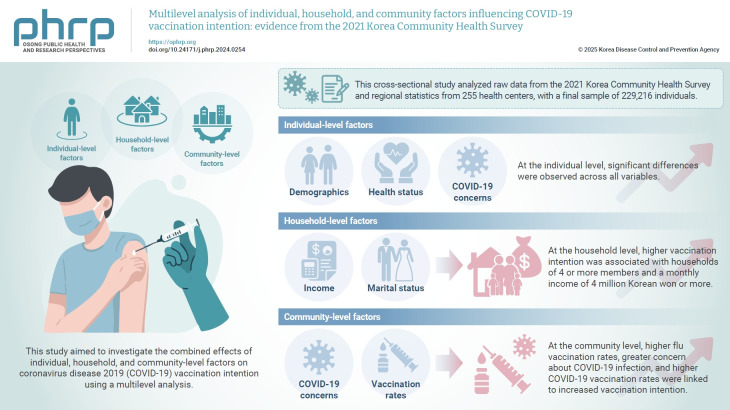
Background: This study aimed to investigate the combined effects of individual, household, and community-level factors on coronavirus disease 2019 (COVID-19) vaccination intention using a multilevel analysis.
Methods: This cross-sectional study analyzed raw data from the 2021 Korea Community Health Survey and regional statistics from 255 health centers, with a final sample of 229,216 individuals. Multilevel analysis was conducted, focusing on individual, household, and community-level factors. Individual-level factors included demographics, health status, and COVID-19 concerns; household-level factors included income and marital status; and community-level factors included city type and vaccination rates.
Results: At the individual level, significant differences were observed across all variables. At the household level, higher vaccination intention was associated with households of 4 or more members and a monthly income of 4 million Korean won or more. At the community level, higher flu vaccination rates, greater concern about COVID-19 infection, and higher COVID-19 vaccination rates were linked to increased vaccination intention.
Conclusion: This study highlights that COVID-19 vaccination intention is influenced by factors at the individual, household, and community levels. Vaccination strategies that integrate household and community-level approaches may be more effective. Policymakers should consider both individual and social health factors when designing vaccination policies.





 京公网安备 11010802042870号
京ICP备2023020795号-1
京公网安备 11010802042870号
京ICP备2023020795号-1

 分享
分享
 求助内容:
求助内容: 应助结果提醒方式:
 扫码关注我们
