Wei Wei, Song Li, Xingping Zhou, Haiyan Peng, Xiaolin Xie
{"title":"巯基烯光聚合增强全息聚合物纳米复合材料的液晶有序性和结构规整性:耦合DPD-FDTD模拟","authors":"Wei Wei, Song Li, Xingping Zhou, Haiyan Peng, Xiaolin Xie","doi":"10.1021/acs.macromol.4c02287","DOIUrl":null,"url":null,"abstract":"Holographic polymer nanocomposites comprising liquid crystals (LCs), which are basically formulated by periodic photopolymerization-induced phase separation under coherent lasers, exhibit significant application value in a myriad of high-tech fields such as augmented reality (AR)/virtual reality (VR), 3D displays, advanced anticounterfeiting, and holographic sensing. Herein, by coupling the dissipative particle dynamics (DPD) simulation in the mesoscale and finite-difference time-domain (FDTD) simulation in the macroscale, we disclose that the thiol–ene click polymerization can lead to greater LC ordering in holographic polymer nanocomposites. Besides, compared to the thiol–acrylate polymerization system, step-growth polymerization dominates in the thiol–ene click polymerization system, giving rise to more regular phase separation structures with higher polymer density and lower interfacial roughness. Due to the high LC ordering at the DPD temperature of <i>T</i>* = 0.40 <i>k</i><sub>B</sub><i>T</i>, a maximum LC ordering parameter is achieved, i.e., <i>S</i><sub>u</sub> = 0.51 ± 0.01. Consequently, significant polarization-dependent diffraction is observed, with a maximum diffraction efficiency of 92.5 ± 0.3% and 69.3 ± 5.4%, respectively, when probed by <i>s</i>- and <i>p</i>-polarized light. The cross-scale coupled DPD-FDTD simulation not only provides valuable insights into the fundamental structure–property relation of holographic polymer nanocomposites but also offers a viable tool to study structure-ordered materials.","PeriodicalId":51,"journal":{"name":"Macromolecules","volume":"23 1","pages":""},"PeriodicalIF":5.2000,"publicationDate":"2025-02-22","publicationTypes":"Journal Article","fieldsOfStudy":null,"isOpenAccess":false,"openAccessPdf":"","citationCount":"0","resultStr":"{\"title\":\"Thiol–Ene Photopolymerization Enhances Liquid Crystal Ordering and Structural Regularity in Holographic Polymer Nanocomposites: A Coupled DPD-FDTD Simulation\",\"authors\":\"Wei Wei, Song Li, Xingping Zhou, Haiyan Peng, Xiaolin Xie\",\"doi\":\"10.1021/acs.macromol.4c02287\",\"DOIUrl\":null,\"url\":null,\"abstract\":\"Holographic polymer nanocomposites comprising liquid crystals (LCs), which are basically formulated by periodic photopolymerization-induced phase separation under coherent lasers, exhibit significant application value in a myriad of high-tech fields such as augmented reality (AR)/virtual reality (VR), 3D displays, advanced anticounterfeiting, and holographic sensing. Herein, by coupling the dissipative particle dynamics (DPD) simulation in the mesoscale and finite-difference time-domain (FDTD) simulation in the macroscale, we disclose that the thiol–ene click polymerization can lead to greater LC ordering in holographic polymer nanocomposites. Besides, compared to the thiol–acrylate polymerization system, step-growth polymerization dominates in the thiol–ene click polymerization system, giving rise to more regular phase separation structures with higher polymer density and lower interfacial roughness. Due to the high LC ordering at the DPD temperature of <i>T</i>* = 0.40 <i>k</i><sub>B</sub><i>T</i>, a maximum LC ordering parameter is achieved, i.e., <i>S</i><sub>u</sub> = 0.51 ± 0.01. Consequently, significant polarization-dependent diffraction is observed, with a maximum diffraction efficiency of 92.5 ± 0.3% and 69.3 ± 5.4%, respectively, when probed by <i>s</i>- and <i>p</i>-polarized light. The cross-scale coupled DPD-FDTD simulation not only provides valuable insights into the fundamental structure–property relation of holographic polymer nanocomposites but also offers a viable tool to study structure-ordered materials.\",\"PeriodicalId\":51,\"journal\":{\"name\":\"Macromolecules\",\"volume\":\"23 1\",\"pages\":\"\"},\"PeriodicalIF\":5.2000,\"publicationDate\":\"2025-02-22\",\"publicationTypes\":\"Journal Article\",\"fieldsOfStudy\":null,\"isOpenAccess\":false,\"openAccessPdf\":\"\",\"citationCount\":\"0\",\"resultStr\":null,\"platform\":\"Semanticscholar\",\"paperid\":null,\"PeriodicalName\":\"Macromolecules\",\"FirstCategoryId\":\"92\",\"ListUrlMain\":\"https://doi.org/10.1021/acs.macromol.4c02287\",\"RegionNum\":1,\"RegionCategory\":\"化学\",\"ArticlePicture\":[],\"TitleCN\":null,\"AbstractTextCN\":null,\"PMCID\":null,\"EPubDate\":\"\",\"PubModel\":\"\",\"JCR\":\"Q1\",\"JCRName\":\"POLYMER SCIENCE\",\"Score\":null,\"Total\":0}","platform":"Semanticscholar","paperid":null,"PeriodicalName":"Macromolecules","FirstCategoryId":"92","ListUrlMain":"https://doi.org/10.1021/acs.macromol.4c02287","RegionNum":1,"RegionCategory":"化学","ArticlePicture":[],"TitleCN":null,"AbstractTextCN":null,"PMCID":null,"EPubDate":"","PubModel":"","JCR":"Q1","JCRName":"POLYMER SCIENCE","Score":null,"Total":0}
Thiol–Ene Photopolymerization Enhances Liquid Crystal Ordering and Structural Regularity in Holographic Polymer Nanocomposites: A Coupled DPD-FDTD Simulation
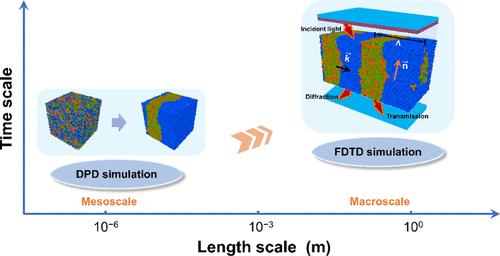
Holographic polymer nanocomposites comprising liquid crystals (LCs), which are basically formulated by periodic photopolymerization-induced phase separation under coherent lasers, exhibit significant application value in a myriad of high-tech fields such as augmented reality (AR)/virtual reality (VR), 3D displays, advanced anticounterfeiting, and holographic sensing. Herein, by coupling the dissipative particle dynamics (DPD) simulation in the mesoscale and finite-difference time-domain (FDTD) simulation in the macroscale, we disclose that the thiol–ene click polymerization can lead to greater LC ordering in holographic polymer nanocomposites. Besides, compared to the thiol–acrylate polymerization system, step-growth polymerization dominates in the thiol–ene click polymerization system, giving rise to more regular phase separation structures with higher polymer density and lower interfacial roughness. Due to the high LC ordering at the DPD temperature of T* = 0.40 kBT, a maximum LC ordering parameter is achieved, i.e., Su = 0.51 ± 0.01. Consequently, significant polarization-dependent diffraction is observed, with a maximum diffraction efficiency of 92.5 ± 0.3% and 69.3 ± 5.4%, respectively, when probed by s- and p-polarized light. The cross-scale coupled DPD-FDTD simulation not only provides valuable insights into the fundamental structure–property relation of holographic polymer nanocomposites but also offers a viable tool to study structure-ordered materials.
期刊介绍:
Macromolecules publishes original, fundamental, and impactful research on all aspects of polymer science. Topics of interest include synthesis (e.g., controlled polymerizations, polymerization catalysis, post polymerization modification, new monomer structures and polymer architectures, and polymerization mechanisms/kinetics analysis); phase behavior, thermodynamics, dynamic, and ordering/disordering phenomena (e.g., self-assembly, gelation, crystallization, solution/melt/solid-state characteristics); structure and properties (e.g., mechanical and rheological properties, surface/interfacial characteristics, electronic and transport properties); new state of the art characterization (e.g., spectroscopy, scattering, microscopy, rheology), simulation (e.g., Monte Carlo, molecular dynamics, multi-scale/coarse-grained modeling), and theoretical methods. Renewable/sustainable polymers, polymer networks, responsive polymers, electro-, magneto- and opto-active macromolecules, inorganic polymers, charge-transporting polymers (ion-containing, semiconducting, and conducting), nanostructured polymers, and polymer composites are also of interest. Typical papers published in Macromolecules showcase important and innovative concepts, experimental methods/observations, and theoretical/computational approaches that demonstrate a fundamental advance in the understanding of polymers.




 京公网安备 11010802042870号
京ICP备2023020795号-1
京公网安备 11010802042870号
京ICP备2023020795号-1

 分享
分享
 求助内容:
求助内容: 应助结果提醒方式:
 扫码关注我们
