基于集合模型的花椒温室西部花蓟马(Frankliniella occidentalis Pergande)种群周预报方法

IF 4.2 1区 农林科学 Q1 AGRONOMY Pest Management Science Pub Date : 2025-02-21 DOI:10.1002/ps.8713
Kin Ho Chan, Rob Moerkens, Nathalie Brenard, Marlies Huysmans, Herwig Leirs, Vincent Sluydts
{"title":"基于集合模型的花椒温室西部花蓟马(Frankliniella occidentalis Pergande)种群周预报方法","authors":"Kin Ho Chan,&nbsp;Rob Moerkens,&nbsp;Nathalie Brenard,&nbsp;Marlies Huysmans,&nbsp;Herwig Leirs,&nbsp;Vincent Sluydts","doi":"10.1002/ps.8713","DOIUrl":null,"url":null,"abstract":"<div>\n \n \n <section>\n \n <h3> BACKGROUND</h3>\n \n <p>Integrated pest management (IPM) in European glasshouses has substantially advanced in automated insect pest detection systems lately. However, transforming such an enormous data influx into optimal biological control strategies remains challenging. In addition, most biological control forecast studies relied on the single-best model approach, which is susceptible to overconfidence, and they lack validation over sufficient sampling repetitions where robustness remains questionable. Here we propose employing an unweighted ensemble model, by combining multiple forecasting models ranging from simple models (linear regressions and Lotka–Volterra model) to machine learning models (Gaussian process, Random Forest, XGBoost, Multi-Layer Perceptron), to predict 1-week-ahead population of western flower thrips (<i>Frankliniella occidentalis</i>), a notorious pest in glasshouses, under the influence of its biological control agent <i>Macrolophus pygmaeus</i> in pepper-growing glasshouses.</p>\n </section>\n \n <section>\n \n <h3> RESULTS</h3>\n \n <p>Models were trained with only 1 year of data, validated over 3 years of monitoring of multiple compartments to evaluate their robustness. The full ensemble model outperformed the Naïve Forecast in 10 out of 14 compartments for validation, with around 0.451 and 26.6% increase in coefficient of determination (<i>R</i><sup>2</sup>) and directional accuracy, respectively. It also extended 0.096 in <i>R</i><sup>2</sup> from the best single model, equivalent to a 27% increase in accuracy, while maintaining a 75% directional accuracy.</p>\n </section>\n \n <section>\n \n <h3> CONCLUSION</h3>\n \n <p>Our results demonstrated the benefits of the ensemble model over the traditional ‘single-best model’ approach, avoiding model structural biases and minimizing the risk of overconfidence. This showcased how an ensemble model with minimal training data can assist growers in fully utilizing the pest monitoring data and support their decision-making on IPM. © 2025 Society of Chemical Industry.</p>\n </section>\n </div>","PeriodicalId":218,"journal":{"name":"Pest Management Science","volume":"81 6","pages":"3378-3390"},"PeriodicalIF":4.2000,"publicationDate":"2025-02-21","publicationTypes":"Journal Article","fieldsOfStudy":null,"isOpenAccess":false,"openAccessPdf":"","citationCount":"0","resultStr":"{\"title\":\"Data-driven approach to weekly forecast of the western flower thrips (Frankliniella occidentalis Pergande) population in a pepper greenhouse with an ensemble model\",\"authors\":\"Kin Ho Chan,&nbsp;Rob Moerkens,&nbsp;Nathalie Brenard,&nbsp;Marlies Huysmans,&nbsp;Herwig Leirs,&nbsp;Vincent Sluydts\",\"doi\":\"10.1002/ps.8713\",\"DOIUrl\":null,\"url\":null,\"abstract\":\"<div>\\n \\n \\n <section>\\n \\n <h3> BACKGROUND</h3>\\n \\n <p>Integrated pest management (IPM) in European glasshouses has substantially advanced in automated insect pest detection systems lately. However, transforming such an enormous data influx into optimal biological control strategies remains challenging. In addition, most biological control forecast studies relied on the single-best model approach, which is susceptible to overconfidence, and they lack validation over sufficient sampling repetitions where robustness remains questionable. Here we propose employing an unweighted ensemble model, by combining multiple forecasting models ranging from simple models (linear regressions and Lotka–Volterra model) to machine learning models (Gaussian process, Random Forest, XGBoost, Multi-Layer Perceptron), to predict 1-week-ahead population of western flower thrips (<i>Frankliniella occidentalis</i>), a notorious pest in glasshouses, under the influence of its biological control agent <i>Macrolophus pygmaeus</i> in pepper-growing glasshouses.</p>\\n </section>\\n \\n <section>\\n \\n <h3> RESULTS</h3>\\n \\n <p>Models were trained with only 1 year of data, validated over 3 years of monitoring of multiple compartments to evaluate their robustness. The full ensemble model outperformed the Naïve Forecast in 10 out of 14 compartments for validation, with around 0.451 and 26.6% increase in coefficient of determination (<i>R</i><sup>2</sup>) and directional accuracy, respectively. It also extended 0.096 in <i>R</i><sup>2</sup> from the best single model, equivalent to a 27% increase in accuracy, while maintaining a 75% directional accuracy.</p>\\n </section>\\n \\n <section>\\n \\n <h3> CONCLUSION</h3>\\n \\n <p>Our results demonstrated the benefits of the ensemble model over the traditional ‘single-best model’ approach, avoiding model structural biases and minimizing the risk of overconfidence. This showcased how an ensemble model with minimal training data can assist growers in fully utilizing the pest monitoring data and support their decision-making on IPM. © 2025 Society of Chemical Industry.</p>\\n </section>\\n </div>\",\"PeriodicalId\":218,\"journal\":{\"name\":\"Pest Management Science\",\"volume\":\"81 6\",\"pages\":\"3378-3390\"},\"PeriodicalIF\":4.2000,\"publicationDate\":\"2025-02-21\",\"publicationTypes\":\"Journal Article\",\"fieldsOfStudy\":null,\"isOpenAccess\":false,\"openAccessPdf\":\"\",\"citationCount\":\"0\",\"resultStr\":null,\"platform\":\"Semanticscholar\",\"paperid\":null,\"PeriodicalName\":\"Pest Management Science\",\"FirstCategoryId\":\"97\",\"ListUrlMain\":\"https://scijournals.onlinelibrary.wiley.com/doi/10.1002/ps.8713\",\"RegionNum\":1,\"RegionCategory\":\"农林科学\",\"ArticlePicture\":[],\"TitleCN\":null,\"AbstractTextCN\":null,\"PMCID\":null,\"EPubDate\":\"\",\"PubModel\":\"\",\"JCR\":\"Q1\",\"JCRName\":\"AGRONOMY\",\"Score\":null,\"Total\":0}","platform":"Semanticscholar","paperid":null,"PeriodicalName":"Pest Management Science","FirstCategoryId":"97","ListUrlMain":"https://scijournals.onlinelibrary.wiley.com/doi/10.1002/ps.8713","RegionNum":1,"RegionCategory":"农林科学","ArticlePicture":[],"TitleCN":null,"AbstractTextCN":null,"PMCID":null,"EPubDate":"","PubModel":"","JCR":"Q1","JCRName":"AGRONOMY","Score":null,"Total":0}
引用次数: 0

摘要

近年来,欧洲温室害虫综合治理(IPM)在害虫自动检测系统方面取得了长足的进步。然而,将如此庞大的数据流转化为最佳的生物控制策略仍然具有挑战性。此外,大多数生物防治预测研究依赖于单一最佳模型方法,这种方法容易过度自信,并且在足够的采样重复中缺乏验证,其稳健性仍然值得怀疑。本文提出了一种非加权集成模型,通过结合简单模型(线性回归和Lotka-Volterra模型)和机器学习模型(高斯过程、随机森林、XGBoost、多层感知器)的多种预测模型,预测温室中恶名害虫西部花蓟马(Frankliniella occidentalis)在其生物防治剂pygmaeus的影响下,在种植辣椒的温室中1周内的种群数量。
本文章由计算机程序翻译,如有差异,请以英文原文为准。

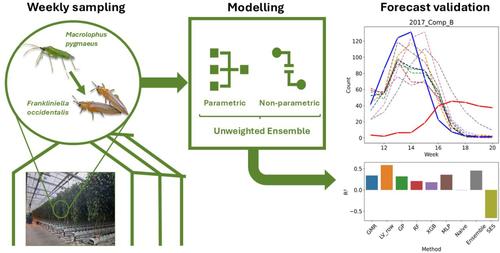
摘要图片

查看原文
分享 分享
微信好友 朋友圈 QQ好友 复制链接
本刊更多论文
Data-driven approach to weekly forecast of the western flower thrips (Frankliniella occidentalis Pergande) population in a pepper greenhouse with an ensemble model

BACKGROUND

Integrated pest management (IPM) in European glasshouses has substantially advanced in automated insect pest detection systems lately. However, transforming such an enormous data influx into optimal biological control strategies remains challenging. In addition, most biological control forecast studies relied on the single-best model approach, which is susceptible to overconfidence, and they lack validation over sufficient sampling repetitions where robustness remains questionable. Here we propose employing an unweighted ensemble model, by combining multiple forecasting models ranging from simple models (linear regressions and Lotka–Volterra model) to machine learning models (Gaussian process, Random Forest, XGBoost, Multi-Layer Perceptron), to predict 1-week-ahead population of western flower thrips (Frankliniella occidentalis), a notorious pest in glasshouses, under the influence of its biological control agent Macrolophus pygmaeus in pepper-growing glasshouses.

RESULTS

Models were trained with only 1 year of data, validated over 3 years of monitoring of multiple compartments to evaluate their robustness. The full ensemble model outperformed the Naïve Forecast in 10 out of 14 compartments for validation, with around 0.451 and 26.6% increase in coefficient of determination (R2) and directional accuracy, respectively. It also extended 0.096 in R2 from the best single model, equivalent to a 27% increase in accuracy, while maintaining a 75% directional accuracy.

CONCLUSION

Our results demonstrated the benefits of the ensemble model over the traditional ‘single-best model’ approach, avoiding model structural biases and minimizing the risk of overconfidence. This showcased how an ensemble model with minimal training data can assist growers in fully utilizing the pest monitoring data and support their decision-making on IPM. © 2025 Society of Chemical Industry.

求助全文
通过发布文献求助,成功后即可免费获取论文全文。 去求助
来源期刊
Pest Management Science
Pest Management Science 农林科学-昆虫学
CiteScore
7.90
自引率
9.80%
发文量
553
审稿时长
4.8 months
期刊介绍: Pest Management Science is the international journal of research and development in crop protection and pest control. Since its launch in 1970, the journal has become the premier forum for papers on the discovery, application, and impact on the environment of products and strategies designed for pest management. Published for SCI by John Wiley & Sons Ltd.
期刊最新文献
RETRACTED: Revealing pest patterns: A comparative spatial distribution analysis of insect threats in Kharif rice across the key agricultural regions in the Eastern India. Reduction of pesticide dosage and off-target drift with enhanced control efficacy in unmanned aerial vehicle-based application using lecithin adjuvants. Discovery of the microtubule-severing protein as the target of antifungal compound heat-stable antifungal factor in Fusarium graminearum and rational design of novel inhibitors. Leaf penetration by endophytic Metarhizium brunneum enables infection of Phthorimaea absoluta in tomato mines while inducing the crop defense system. Geographic structure and human-mediated gene flow in driving genetic diversity of Heterodera glycines: A mitochondrial COI-based cross-regional analysis.
×
引用
GB/T 7714-2015
复制
MLA
复制
APA
复制
导出至
BibTeX EndNote RefMan NoteFirst NoteExpress
×
×
提示
您的信息不完整,为了账户安全,请先补充。
现在去补充
×
提示
您因"违规操作"
具体请查看互助需知
我知道了
×
提示
现在去查看 取消
×
提示
确定
0
微信
客服QQ
Book学术公众号 扫码关注我们
反馈
×
意见反馈
请填写您的意见或建议
请填写您的手机或邮箱
已复制链接
已复制链接
快去分享给好友吧!
我知道了
×
扫码分享
扫码分享
Book学术官方微信
Book学术官方微信
Book学术文献互助
Book学术文献互助群
群 号:604180095
Book学术
文献互助 智能选刊 最新文献 互助须知 联系我们:info@booksci.cn
Book学术提供免费学术资源搜索服务,方便国内外学者检索中英文文献。致力于提供最便捷和优质的服务体验。
Copyright © 2023 Book学术 All rights reserved.
ghs 京公网安备 11010802042870号 京ICP备2023020795号-1