{"title":"通过点对点识别和活细胞中的诱导自组装对蛋白质三聚体进行程序化检测的 DNA 四面体质量标记探针组","authors":"Jiapu Li, Xiaoxu Li, Yunjing Wang, Jianhua Zhu, Yun Chen","doi":"10.1021/acs.analchem.4c05947","DOIUrl":null,"url":null,"abstract":"Multimeric proteins normally perform different biological functions from their monomer components. Thus, precise recognition and quantitative detection of multimeric proteins can benefit a better understanding of complex biological processes and their roles in disease diagnosis and treatment. The challenge herein is to distinguish the multimeric proteins containing identical monomer components and recognize all the monomers in a multimeric protein on spatial scales. This situation is likely to become more significant for homomultimeric proteins. In this study, a DNA polyhedron mass-tagged probe set strategy was developed for the programmed detection of multimeric proteins in living cells. The probe set comprised recognition and displacement probes, a DNA polyhedron probe, and a mass-tagged probe. After point-to-point recognition of each monomer in the target protein complex by recognition and displacement probes, the DNA polyhedron probe could integrate the information on all the protein monomers by carrying out induced self-assembly via a cascaded toehold-mediated strand-displacement (TMSD) reaction. Afterward, the mass-tagged probe collected the integrated information, and the mass tag in the probe was released by ultraviolet (UV) irradiation and detected by mass spectrometry (MS). Using the tmTNF-α homotrimer as an example, its expression levels in different breast cancer cell lines were ultimately determined using this probe set containing a DNA tetrahedron probe. This study is among the first to quantitatively detect multimeric proteins in living cells. Using a similar strategy, more DNA polyhedron mass-tagged probe sets can be developed for the detection of higher-order multimeric proteins.","PeriodicalId":27,"journal":{"name":"Analytical Chemistry","volume":"30 1","pages":""},"PeriodicalIF":7.3000,"publicationDate":"2025-02-22","publicationTypes":"Journal Article","fieldsOfStudy":null,"isOpenAccess":false,"openAccessPdf":"","citationCount":"0","resultStr":"{\"title\":\"DNA Tetrahedron Mass-Tagged Probe Set for the Programmed Detection of Protein Trimers by Point-to-Point Recognition and Induced Self-Assembly in Living Cells\",\"authors\":\"Jiapu Li, Xiaoxu Li, Yunjing Wang, Jianhua Zhu, Yun Chen\",\"doi\":\"10.1021/acs.analchem.4c05947\",\"DOIUrl\":null,\"url\":null,\"abstract\":\"Multimeric proteins normally perform different biological functions from their monomer components. Thus, precise recognition and quantitative detection of multimeric proteins can benefit a better understanding of complex biological processes and their roles in disease diagnosis and treatment. The challenge herein is to distinguish the multimeric proteins containing identical monomer components and recognize all the monomers in a multimeric protein on spatial scales. This situation is likely to become more significant for homomultimeric proteins. In this study, a DNA polyhedron mass-tagged probe set strategy was developed for the programmed detection of multimeric proteins in living cells. The probe set comprised recognition and displacement probes, a DNA polyhedron probe, and a mass-tagged probe. After point-to-point recognition of each monomer in the target protein complex by recognition and displacement probes, the DNA polyhedron probe could integrate the information on all the protein monomers by carrying out induced self-assembly via a cascaded toehold-mediated strand-displacement (TMSD) reaction. Afterward, the mass-tagged probe collected the integrated information, and the mass tag in the probe was released by ultraviolet (UV) irradiation and detected by mass spectrometry (MS). Using the tmTNF-α homotrimer as an example, its expression levels in different breast cancer cell lines were ultimately determined using this probe set containing a DNA tetrahedron probe. This study is among the first to quantitatively detect multimeric proteins in living cells. Using a similar strategy, more DNA polyhedron mass-tagged probe sets can be developed for the detection of higher-order multimeric proteins.\",\"PeriodicalId\":27,\"journal\":{\"name\":\"Analytical Chemistry\",\"volume\":\"30 1\",\"pages\":\"\"},\"PeriodicalIF\":7.3000,\"publicationDate\":\"2025-02-22\",\"publicationTypes\":\"Journal Article\",\"fieldsOfStudy\":null,\"isOpenAccess\":false,\"openAccessPdf\":\"\",\"citationCount\":\"0\",\"resultStr\":null,\"platform\":\"Semanticscholar\",\"paperid\":null,\"PeriodicalName\":\"Analytical Chemistry\",\"FirstCategoryId\":\"92\",\"ListUrlMain\":\"https://doi.org/10.1021/acs.analchem.4c05947\",\"RegionNum\":1,\"RegionCategory\":\"化学\",\"ArticlePicture\":[],\"TitleCN\":null,\"AbstractTextCN\":null,\"PMCID\":null,\"EPubDate\":\"\",\"PubModel\":\"\",\"JCR\":\"Q1\",\"JCRName\":\"CHEMISTRY, ANALYTICAL\",\"Score\":null,\"Total\":0}","platform":"Semanticscholar","paperid":null,"PeriodicalName":"Analytical Chemistry","FirstCategoryId":"92","ListUrlMain":"https://doi.org/10.1021/acs.analchem.4c05947","RegionNum":1,"RegionCategory":"化学","ArticlePicture":[],"TitleCN":null,"AbstractTextCN":null,"PMCID":null,"EPubDate":"","PubModel":"","JCR":"Q1","JCRName":"CHEMISTRY, ANALYTICAL","Score":null,"Total":0}
DNA Tetrahedron Mass-Tagged Probe Set for the Programmed Detection of Protein Trimers by Point-to-Point Recognition and Induced Self-Assembly in Living Cells
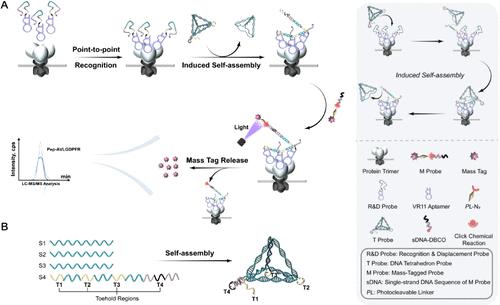
Multimeric proteins normally perform different biological functions from their monomer components. Thus, precise recognition and quantitative detection of multimeric proteins can benefit a better understanding of complex biological processes and their roles in disease diagnosis and treatment. The challenge herein is to distinguish the multimeric proteins containing identical monomer components and recognize all the monomers in a multimeric protein on spatial scales. This situation is likely to become more significant for homomultimeric proteins. In this study, a DNA polyhedron mass-tagged probe set strategy was developed for the programmed detection of multimeric proteins in living cells. The probe set comprised recognition and displacement probes, a DNA polyhedron probe, and a mass-tagged probe. After point-to-point recognition of each monomer in the target protein complex by recognition and displacement probes, the DNA polyhedron probe could integrate the information on all the protein monomers by carrying out induced self-assembly via a cascaded toehold-mediated strand-displacement (TMSD) reaction. Afterward, the mass-tagged probe collected the integrated information, and the mass tag in the probe was released by ultraviolet (UV) irradiation and detected by mass spectrometry (MS). Using the tmTNF-α homotrimer as an example, its expression levels in different breast cancer cell lines were ultimately determined using this probe set containing a DNA tetrahedron probe. This study is among the first to quantitatively detect multimeric proteins in living cells. Using a similar strategy, more DNA polyhedron mass-tagged probe sets can be developed for the detection of higher-order multimeric proteins.
期刊介绍:
Analytical Chemistry, a peer-reviewed research journal, focuses on disseminating new and original knowledge across all branches of analytical chemistry. Fundamental articles may explore general principles of chemical measurement science and need not directly address existing or potential analytical methodology. They can be entirely theoretical or report experimental results. Contributions may cover various phases of analytical operations, including sampling, bioanalysis, electrochemistry, mass spectrometry, microscale and nanoscale systems, environmental analysis, separations, spectroscopy, chemical reactions and selectivity, instrumentation, imaging, surface analysis, and data processing. Papers discussing known analytical methods should present a significant, original application of the method, a notable improvement, or results on an important analyte.





 京公网安备 11010802042870号
京ICP备2023020795号-1
京公网安备 11010802042870号
京ICP备2023020795号-1

 分享
分享
 求助内容:
求助内容: 应助结果提醒方式:
 扫码关注我们
