Wenchi Xie, Landie Ji, Dan Luo, Lili Ye, Qian Li, Landan Kang, Qingquan He, Jie Mei
{"title":"妊娠期间肝内胆汁淤积症预测早产的nomogram建立和验证:一项回顾性研究。","authors":"Wenchi Xie, Landie Ji, Dan Luo, Lili Ye, Qian Li, Landan Kang, Qingquan He, Jie Mei","doi":"10.1186/s12884-025-07320-w","DOIUrl":null,"url":null,"abstract":"<p><strong>Objective: </strong>This study aimed to develop and evaluate a nomogram for predicting preterm birth in patients with intrahepatic cholestasis of pregnancy (ICP), with a view to assisting clinical management and intervention.</p><p><strong>Methods: </strong>This retrospective observational study included 257 pregnant women with ICP from Sichuan Provincial People's Hospital between January 1, 2022 and July 30, 2024. The routine clinical and laboratory information of these patients were also collected. We used the least absolute shrinkage and selection operator (LASSO) and multivariable logistic regression analysis to investigate the association between clinical and laboratory data and preterm birth in ICP patients. A nomogram was developed to predict the likelihood of preterm birth in ICP patients. The prediction accuracy of the model was evaluated by consistency index (C-index), receiver operating characteristic (ROC) curve, area under the curve (AUC), and calibration curve. Decision curve analysis (DCA) was used to evaluate its applicability in clinical practice.</p><p><strong>Results: </strong>Among the 257 ICP patients, 56 (21.79%) were diagnosed with preterm birth. Cases were randomly divided into a training set (154 cases) and a test set (103 cases). A nomogram was developed to predict preterm birth in ICP patients based on height, twin pregnancy (TP), gestational age at diagnosis (GA at diagnosis), and total bile acid level (TBA) at diagnosis. The calibration curve of the training set was close to the diagonal (C-index = 0.864), and the calibration curve of the test set was also close to the diagonal (C-index = 0.835). These results indicate that the model has a good consistency. The AUC of the training group and the test group were 0.864 and 0.836, respectively, indicating the good accuracy of the model. The DCA reveals that this nomogram could be applied to clinical practice.</p><p><strong>Conclusion: </strong>The combination of TBA level, TP, height and GA at diagnosis is an effective model for identifying preterm birth in ICP patients. These results will help guide the clinical management and treatment of patients with ICP, thereby reducing maternal and infant safety issues caused by preterm birth.</p>","PeriodicalId":9033,"journal":{"name":"BMC Pregnancy and Childbirth","volume":"25 1","pages":"194"},"PeriodicalIF":3.1000,"publicationDate":"2025-02-21","publicationTypes":"Journal Article","fieldsOfStudy":null,"isOpenAccess":false,"openAccessPdf":"https://www.ncbi.nlm.nih.gov/pmc/articles/PMC11846180/pdf/","citationCount":"0","resultStr":"{\"title\":\"Establishment and validation of a nomogram for predicting preterm birth in intrahepatic cholestasis during pregnancy: a retrospective study.\",\"authors\":\"Wenchi Xie, Landie Ji, Dan Luo, Lili Ye, Qian Li, Landan Kang, Qingquan He, Jie Mei\",\"doi\":\"10.1186/s12884-025-07320-w\",\"DOIUrl\":null,\"url\":null,\"abstract\":\"<p><strong>Objective: </strong>This study aimed to develop and evaluate a nomogram for predicting preterm birth in patients with intrahepatic cholestasis of pregnancy (ICP), with a view to assisting clinical management and intervention.</p><p><strong>Methods: </strong>This retrospective observational study included 257 pregnant women with ICP from Sichuan Provincial People's Hospital between January 1, 2022 and July 30, 2024. The routine clinical and laboratory information of these patients were also collected. We used the least absolute shrinkage and selection operator (LASSO) and multivariable logistic regression analysis to investigate the association between clinical and laboratory data and preterm birth in ICP patients. A nomogram was developed to predict the likelihood of preterm birth in ICP patients. The prediction accuracy of the model was evaluated by consistency index (C-index), receiver operating characteristic (ROC) curve, area under the curve (AUC), and calibration curve. Decision curve analysis (DCA) was used to evaluate its applicability in clinical practice.</p><p><strong>Results: </strong>Among the 257 ICP patients, 56 (21.79%) were diagnosed with preterm birth. Cases were randomly divided into a training set (154 cases) and a test set (103 cases). A nomogram was developed to predict preterm birth in ICP patients based on height, twin pregnancy (TP), gestational age at diagnosis (GA at diagnosis), and total bile acid level (TBA) at diagnosis. The calibration curve of the training set was close to the diagonal (C-index = 0.864), and the calibration curve of the test set was also close to the diagonal (C-index = 0.835). These results indicate that the model has a good consistency. The AUC of the training group and the test group were 0.864 and 0.836, respectively, indicating the good accuracy of the model. The DCA reveals that this nomogram could be applied to clinical practice.</p><p><strong>Conclusion: </strong>The combination of TBA level, TP, height and GA at diagnosis is an effective model for identifying preterm birth in ICP patients. These results will help guide the clinical management and treatment of patients with ICP, thereby reducing maternal and infant safety issues caused by preterm birth.</p>\",\"PeriodicalId\":9033,\"journal\":{\"name\":\"BMC Pregnancy and Childbirth\",\"volume\":\"25 1\",\"pages\":\"194\"},\"PeriodicalIF\":3.1000,\"publicationDate\":\"2025-02-21\",\"publicationTypes\":\"Journal Article\",\"fieldsOfStudy\":null,\"isOpenAccess\":false,\"openAccessPdf\":\"https://www.ncbi.nlm.nih.gov/pmc/articles/PMC11846180/pdf/\",\"citationCount\":\"0\",\"resultStr\":null,\"platform\":\"Semanticscholar\",\"paperid\":null,\"PeriodicalName\":\"BMC Pregnancy and Childbirth\",\"FirstCategoryId\":\"3\",\"ListUrlMain\":\"https://doi.org/10.1186/s12884-025-07320-w\",\"RegionNum\":2,\"RegionCategory\":\"医学\",\"ArticlePicture\":[],\"TitleCN\":null,\"AbstractTextCN\":null,\"PMCID\":null,\"EPubDate\":\"\",\"PubModel\":\"\",\"JCR\":\"Q1\",\"JCRName\":\"OBSTETRICS & GYNECOLOGY\",\"Score\":null,\"Total\":0}","platform":"Semanticscholar","paperid":null,"PeriodicalName":"BMC Pregnancy and Childbirth","FirstCategoryId":"3","ListUrlMain":"https://doi.org/10.1186/s12884-025-07320-w","RegionNum":2,"RegionCategory":"医学","ArticlePicture":[],"TitleCN":null,"AbstractTextCN":null,"PMCID":null,"EPubDate":"","PubModel":"","JCR":"Q1","JCRName":"OBSTETRICS & GYNECOLOGY","Score":null,"Total":0}
Establishment and validation of a nomogram for predicting preterm birth in intrahepatic cholestasis during pregnancy: a retrospective study.
Objective: This study aimed to develop and evaluate a nomogram for predicting preterm birth in patients with intrahepatic cholestasis of pregnancy (ICP), with a view to assisting clinical management and intervention.
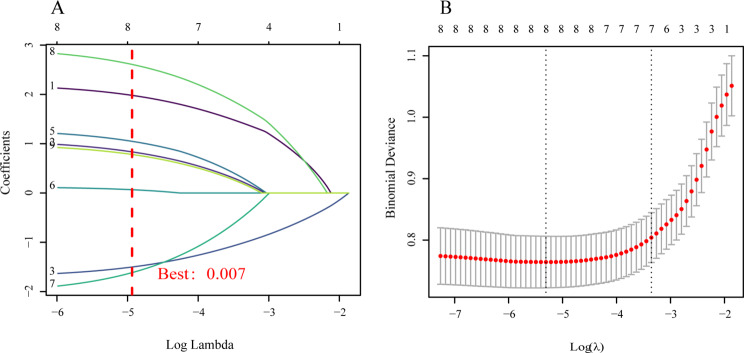
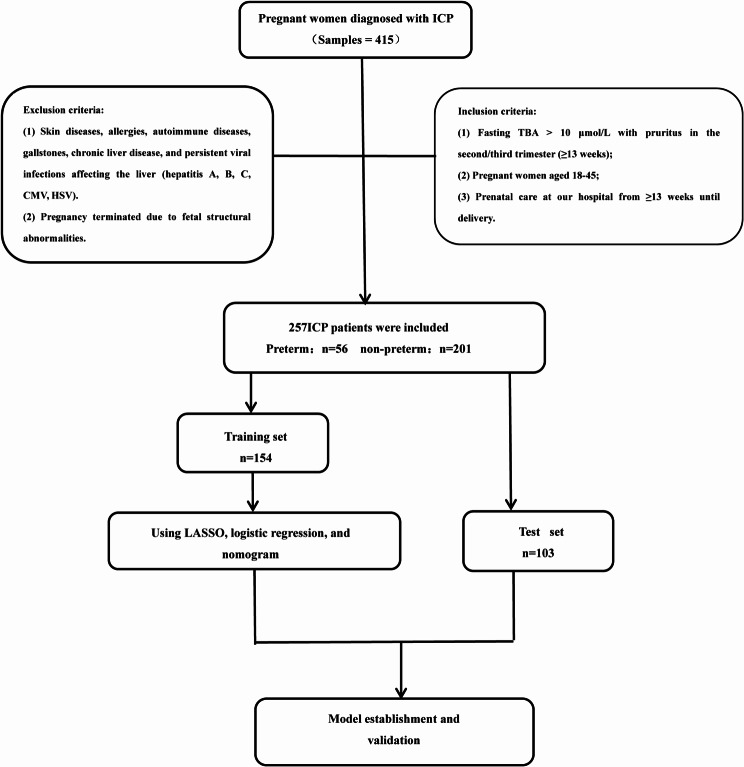
Methods: This retrospective observational study included 257 pregnant women with ICP from Sichuan Provincial People's Hospital between January 1, 2022 and July 30, 2024. The routine clinical and laboratory information of these patients were also collected. We used the least absolute shrinkage and selection operator (LASSO) and multivariable logistic regression analysis to investigate the association between clinical and laboratory data and preterm birth in ICP patients. A nomogram was developed to predict the likelihood of preterm birth in ICP patients. The prediction accuracy of the model was evaluated by consistency index (C-index), receiver operating characteristic (ROC) curve, area under the curve (AUC), and calibration curve. Decision curve analysis (DCA) was used to evaluate its applicability in clinical practice.
Results: Among the 257 ICP patients, 56 (21.79%) were diagnosed with preterm birth. Cases were randomly divided into a training set (154 cases) and a test set (103 cases). A nomogram was developed to predict preterm birth in ICP patients based on height, twin pregnancy (TP), gestational age at diagnosis (GA at diagnosis), and total bile acid level (TBA) at diagnosis. The calibration curve of the training set was close to the diagonal (C-index = 0.864), and the calibration curve of the test set was also close to the diagonal (C-index = 0.835). These results indicate that the model has a good consistency. The AUC of the training group and the test group were 0.864 and 0.836, respectively, indicating the good accuracy of the model. The DCA reveals that this nomogram could be applied to clinical practice.
Conclusion: The combination of TBA level, TP, height and GA at diagnosis is an effective model for identifying preterm birth in ICP patients. These results will help guide the clinical management and treatment of patients with ICP, thereby reducing maternal and infant safety issues caused by preterm birth.
期刊介绍:
BMC Pregnancy & Childbirth is an open access, peer-reviewed journal that considers articles on all aspects of pregnancy and childbirth. The journal welcomes submissions on the biomedical aspects of pregnancy, breastfeeding, labor, maternal health, maternity care, trends and sociological aspects of pregnancy and childbirth.





 京公网安备 11010802042870号
京ICP备2023020795号-1
京公网安备 11010802042870号
京ICP备2023020795号-1

 分享
分享
 求助内容:
求助内容: 应助结果提醒方式:
 扫码关注我们
