Tao Bao, Yuanlin Deng, Liang Chen, Weijie Sun, Mingjian Ge, Xiaolong Zhao, Xu Chen, Liang Zhang, Yingjian Wang, Xiandong He, Xiangshu Pu, Yan He, Jun Yu, Wei Guo
{"title":"手术中意外发现胸膜播散的非小细胞肺癌患者的原发肿瘤切除:一项双中心回顾性队列研究。","authors":"Tao Bao, Yuanlin Deng, Liang Chen, Weijie Sun, Mingjian Ge, Xiaolong Zhao, Xu Chen, Liang Zhang, Yingjian Wang, Xiandong He, Xiangshu Pu, Yan He, Jun Yu, Wei Guo","doi":"10.1186/s12885-025-13747-3","DOIUrl":null,"url":null,"abstract":"<p><strong>Background: </strong>There is no consensus regarding whether primary tumour resection (PTR) should be performed in non-small cell lung cancer (NSCLC) patients with unexpected pleural dissemination (PD) discovered at thoracotomy.</p><p><strong>Materials and methods: </strong>Consecutive NSCLC patients with surgically confirmed PD were retrospectively enrolled from two high-volume centres between January 2016 and December 2023. Patients were divided into the primary tumour resection (PTR) and exploratory thoracotomy (ET) group. PTR included wedge resection, segmentectomy and lobectomy. Patients in the ET group received biopsy only. Propensity score matching (PSM) was used to reduce selection bias from confounding factors. Disease-specific survival (DSS) and progression-free survival (PFS) were analysed using the Kaplan‒Meier method, and comparisons were made using the log-rank test. Multivariate Cox regression analyses were performed to identify the independent prognostic factors.</p><p><strong>Results: </strong>A total of 223 patients were identified: 167 (74.9%) in the PTR group and 56 (25.1%) in the ET group. The median follow-up time and median survival time (MST) were 39.0 months and 49.0 months, respectively. The MST for the ET and PTR groups were 44.0 and 60.0 months, respectively (HR 0.80, 95% CI 0.51-1.24; p = 0.3097). After PSM, there were no significant differences in terms of median disease-specific survival (DSS: 60.0 vs. 61.0 months, p = 0.3419) or progression-free survival (PFS: 30.0 vs. 47.0 months, p = 0.5471) between the two groups. Multivariate analysis revealed that smoking history and a tumour size ≥ 3 cm were independent risk factors for DSS and PFS, whereas targeted therapy was an independent protective factor.</p><p><strong>Conclusion: </strong>Our results suggest that primary tumour resection does not improve long-term survival in NSCLC patients with unexpected PD discovered at thoracotomy. It is high time to re-evaluate the value of surgery for NSCLC patients with PD and avoid overtreatment, especially in the era of targeted therapy and immunotherapy.</p><p><strong>Trial registration: </strong>ClinicalTrials.gov NCT06232967 (approval date: January 31, 2024).</p>","PeriodicalId":9131,"journal":{"name":"BMC Cancer","volume":"25 1","pages":"316"},"PeriodicalIF":3.4000,"publicationDate":"2025-02-21","publicationTypes":"Journal Article","fieldsOfStudy":null,"isOpenAccess":false,"openAccessPdf":"https://www.ncbi.nlm.nih.gov/pmc/articles/PMC11844075/pdf/","citationCount":"0","resultStr":"{\"title\":\"Primary tumour resection in non-small cell lung cancer patients with pleural dissemination unexpectedly detected during operation: a two-centre retrospective cohort study.\",\"authors\":\"Tao Bao, Yuanlin Deng, Liang Chen, Weijie Sun, Mingjian Ge, Xiaolong Zhao, Xu Chen, Liang Zhang, Yingjian Wang, Xiandong He, Xiangshu Pu, Yan He, Jun Yu, Wei Guo\",\"doi\":\"10.1186/s12885-025-13747-3\",\"DOIUrl\":null,\"url\":null,\"abstract\":\"<p><strong>Background: </strong>There is no consensus regarding whether primary tumour resection (PTR) should be performed in non-small cell lung cancer (NSCLC) patients with unexpected pleural dissemination (PD) discovered at thoracotomy.</p><p><strong>Materials and methods: </strong>Consecutive NSCLC patients with surgically confirmed PD were retrospectively enrolled from two high-volume centres between January 2016 and December 2023. Patients were divided into the primary tumour resection (PTR) and exploratory thoracotomy (ET) group. PTR included wedge resection, segmentectomy and lobectomy. Patients in the ET group received biopsy only. Propensity score matching (PSM) was used to reduce selection bias from confounding factors. Disease-specific survival (DSS) and progression-free survival (PFS) were analysed using the Kaplan‒Meier method, and comparisons were made using the log-rank test. Multivariate Cox regression analyses were performed to identify the independent prognostic factors.</p><p><strong>Results: </strong>A total of 223 patients were identified: 167 (74.9%) in the PTR group and 56 (25.1%) in the ET group. The median follow-up time and median survival time (MST) were 39.0 months and 49.0 months, respectively. The MST for the ET and PTR groups were 44.0 and 60.0 months, respectively (HR 0.80, 95% CI 0.51-1.24; p = 0.3097). After PSM, there were no significant differences in terms of median disease-specific survival (DSS: 60.0 vs. 61.0 months, p = 0.3419) or progression-free survival (PFS: 30.0 vs. 47.0 months, p = 0.5471) between the two groups. Multivariate analysis revealed that smoking history and a tumour size ≥ 3 cm were independent risk factors for DSS and PFS, whereas targeted therapy was an independent protective factor.</p><p><strong>Conclusion: </strong>Our results suggest that primary tumour resection does not improve long-term survival in NSCLC patients with unexpected PD discovered at thoracotomy. It is high time to re-evaluate the value of surgery for NSCLC patients with PD and avoid overtreatment, especially in the era of targeted therapy and immunotherapy.</p><p><strong>Trial registration: </strong>ClinicalTrials.gov NCT06232967 (approval date: January 31, 2024).</p>\",\"PeriodicalId\":9131,\"journal\":{\"name\":\"BMC Cancer\",\"volume\":\"25 1\",\"pages\":\"316\"},\"PeriodicalIF\":3.4000,\"publicationDate\":\"2025-02-21\",\"publicationTypes\":\"Journal Article\",\"fieldsOfStudy\":null,\"isOpenAccess\":false,\"openAccessPdf\":\"https://www.ncbi.nlm.nih.gov/pmc/articles/PMC11844075/pdf/\",\"citationCount\":\"0\",\"resultStr\":null,\"platform\":\"Semanticscholar\",\"paperid\":null,\"PeriodicalName\":\"BMC Cancer\",\"FirstCategoryId\":\"3\",\"ListUrlMain\":\"https://doi.org/10.1186/s12885-025-13747-3\",\"RegionNum\":2,\"RegionCategory\":\"医学\",\"ArticlePicture\":[],\"TitleCN\":null,\"AbstractTextCN\":null,\"PMCID\":null,\"EPubDate\":\"\",\"PubModel\":\"\",\"JCR\":\"Q2\",\"JCRName\":\"ONCOLOGY\",\"Score\":null,\"Total\":0}","platform":"Semanticscholar","paperid":null,"PeriodicalName":"BMC Cancer","FirstCategoryId":"3","ListUrlMain":"https://doi.org/10.1186/s12885-025-13747-3","RegionNum":2,"RegionCategory":"医学","ArticlePicture":[],"TitleCN":null,"AbstractTextCN":null,"PMCID":null,"EPubDate":"","PubModel":"","JCR":"Q2","JCRName":"ONCOLOGY","Score":null,"Total":0}
引用次数: 0
摘要
背景:对于在开胸手术中发现意外胸膜播散(PD)的非小细胞肺癌(NSCLC)患者是否应进行原发肿瘤切除术(PTR)尚无共识。材料和方法:回顾性纳入2016年1月至2023年12月两个高容量中心的连续非小细胞肺癌手术确诊PD患者。患者分为原发性肿瘤切除术(PTR)组和探索性开胸术(ET)组。PTR包括楔形切除术、节段切除术和肺叶切除术。ET组患者仅接受活检。倾向得分匹配(PSM)用于减少混杂因素的选择偏差。采用Kaplan-Meier法分析疾病特异性生存期(DSS)和无进展生存期(PFS),并采用log-rank检验进行比较。多因素Cox回归分析确定独立预后因素。结果:共发现223例患者:PTR组167例(74.9%),ET组56例(25.1%)。中位随访时间和中位生存时间(MST)分别为39.0个月和49.0个月。ET组和PTR组的MST分别为44.0和60.0个月(HR 0.80, 95% CI 0.51-1.24;p = 0.3097)。PSM后,两组在中位疾病特异性生存期(DSS: 60.0 vs. 61.0个月,p = 0.3419)或无进展生存期(PFS: 30.0 vs. 47.0个月,p = 0.5471)方面无显著差异。多因素分析显示,吸烟史和肿瘤大小≥3cm是DSS和PFS的独立危险因素,而靶向治疗是独立的保护因素。结论:我们的研究结果表明,原发性肿瘤切除并不能提高在开胸手术中发现意外PD的非小细胞肺癌患者的长期生存率。在靶向治疗和免疫治疗的时代,重新评估非小细胞肺癌伴PD患者手术治疗的价值,避免过度治疗是迫切需要的。试验注册:ClinicalTrials.gov NCT06232967(批准日期:2024年1月31日)。
Primary tumour resection in non-small cell lung cancer patients with pleural dissemination unexpectedly detected during operation: a two-centre retrospective cohort study.
Background: There is no consensus regarding whether primary tumour resection (PTR) should be performed in non-small cell lung cancer (NSCLC) patients with unexpected pleural dissemination (PD) discovered at thoracotomy.
Materials and methods: Consecutive NSCLC patients with surgically confirmed PD were retrospectively enrolled from two high-volume centres between January 2016 and December 2023. Patients were divided into the primary tumour resection (PTR) and exploratory thoracotomy (ET) group. PTR included wedge resection, segmentectomy and lobectomy. Patients in the ET group received biopsy only. Propensity score matching (PSM) was used to reduce selection bias from confounding factors. Disease-specific survival (DSS) and progression-free survival (PFS) were analysed using the Kaplan‒Meier method, and comparisons were made using the log-rank test. Multivariate Cox regression analyses were performed to identify the independent prognostic factors.
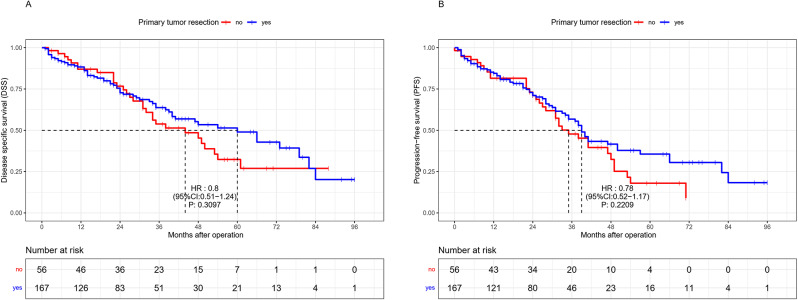
Results: A total of 223 patients were identified: 167 (74.9%) in the PTR group and 56 (25.1%) in the ET group. The median follow-up time and median survival time (MST) were 39.0 months and 49.0 months, respectively. The MST for the ET and PTR groups were 44.0 and 60.0 months, respectively (HR 0.80, 95% CI 0.51-1.24; p = 0.3097). After PSM, there were no significant differences in terms of median disease-specific survival (DSS: 60.0 vs. 61.0 months, p = 0.3419) or progression-free survival (PFS: 30.0 vs. 47.0 months, p = 0.5471) between the two groups. Multivariate analysis revealed that smoking history and a tumour size ≥ 3 cm were independent risk factors for DSS and PFS, whereas targeted therapy was an independent protective factor.
Conclusion: Our results suggest that primary tumour resection does not improve long-term survival in NSCLC patients with unexpected PD discovered at thoracotomy. It is high time to re-evaluate the value of surgery for NSCLC patients with PD and avoid overtreatment, especially in the era of targeted therapy and immunotherapy.
Trial registration: ClinicalTrials.gov NCT06232967 (approval date: January 31, 2024).
期刊介绍:
BMC Cancer is an open access, peer-reviewed journal that considers articles on all aspects of cancer research, including the pathophysiology, prevention, diagnosis and treatment of cancers. The journal welcomes submissions concerning molecular and cellular biology, genetics, epidemiology, and clinical trials.






 京公网安备 11010802042870号
京ICP备2023020795号-1
京公网安备 11010802042870号
京ICP备2023020795号-1

 分享
分享
 求助内容:
求助内容: 应助结果提醒方式:
 扫码关注我们
