{"title":"malabaricum Bedd的植物化学分析、细胞毒性评价和代谢物的硅筛选。","authors":"Nivedita Bhardwaj, Nancy Tripathi, Rimjhim Trivedi, Dinesh Kumar, Gudasalamani Ravikanth, Shreyans K. Jain","doi":"10.1002/cbdv.202403419","DOIUrl":null,"url":null,"abstract":"<div>\n \n <p><i>Dysoxylum malabaricum</i> is well-known as a folklore herb. It is extensively utilized in traditional medicine to address various ailments. The study investigated the phytochemicals of <i>D.malabaricum</i>, focusing on its fruit, which was found to contain various terpenoids. Through extensive spectral analysis, six triterpenoids and one limonoid were identified and reported for the first time. The cytotoxicity of the compound was evaluated through in-vitro and in-silico studies followed by molecular dynamics simulations. Extracts were prepared and chromatographic techniques were applied to isolate compounds from the extract, which underwent phytochemical screening via liquid chromatography-high resolution mass spectrometry (LC-HRMS). Functional groups were assessed using nuclear magnetic resonance confirming the presence of bioactive compounds. LC-HRMS analysis identified seven phytoconstituents, with Binectarilactone and Dihydrobinectarilactone being potentially bioactive characterized. Our findings confirm known molecules, highlighting the potential of Binectarilactone and Dihydrobinectarilactone as significant cytotoxic agents having half-maximal inhibitory concentrations of 29 and 14 µM, respectively, against MCF-7 cell lines. The molecular docking and dynamic simulation analysis showed the anti-cancer properties of the compound with epidermal growth factor receptor (EGFR) enzymes. Binectarilactone and Dihydrobinectarilactone displayed the highest binding energy for all the proteins, for example, EGFR, fibroblast growth factor receptor (FGFR), human epidermal growth factor receptor 2 (HER-2), and insulin-like growth factor I overexpressed on MCF-7, MDA-MB-231, Hs578t, ZR-75-30, and BT549 cell lines. Both showed conformational stability of protein-ligand complex with EGFR, FGFR, and HER-2.</p>\n </div>","PeriodicalId":9878,"journal":{"name":"Chemistry & Biodiversity","volume":"22 7","pages":""},"PeriodicalIF":2.9000,"publicationDate":"2025-02-21","publicationTypes":"Journal Article","fieldsOfStudy":null,"isOpenAccess":false,"openAccessPdf":"","citationCount":"0","resultStr":"{\"title\":\"Phytochemical Analysis, Cytotoxic Evaluation, and In Silico Screening of Metabolites From Dysoxylum malabaricum Bedd\",\"authors\":\"Nivedita Bhardwaj, Nancy Tripathi, Rimjhim Trivedi, Dinesh Kumar, Gudasalamani Ravikanth, Shreyans K. Jain\",\"doi\":\"10.1002/cbdv.202403419\",\"DOIUrl\":null,\"url\":null,\"abstract\":\"<div>\\n \\n <p><i>Dysoxylum malabaricum</i> is well-known as a folklore herb. It is extensively utilized in traditional medicine to address various ailments. The study investigated the phytochemicals of <i>D.malabaricum</i>, focusing on its fruit, which was found to contain various terpenoids. Through extensive spectral analysis, six triterpenoids and one limonoid were identified and reported for the first time. The cytotoxicity of the compound was evaluated through in-vitro and in-silico studies followed by molecular dynamics simulations. Extracts were prepared and chromatographic techniques were applied to isolate compounds from the extract, which underwent phytochemical screening via liquid chromatography-high resolution mass spectrometry (LC-HRMS). Functional groups were assessed using nuclear magnetic resonance confirming the presence of bioactive compounds. LC-HRMS analysis identified seven phytoconstituents, with Binectarilactone and Dihydrobinectarilactone being potentially bioactive characterized. Our findings confirm known molecules, highlighting the potential of Binectarilactone and Dihydrobinectarilactone as significant cytotoxic agents having half-maximal inhibitory concentrations of 29 and 14 µM, respectively, against MCF-7 cell lines. The molecular docking and dynamic simulation analysis showed the anti-cancer properties of the compound with epidermal growth factor receptor (EGFR) enzymes. Binectarilactone and Dihydrobinectarilactone displayed the highest binding energy for all the proteins, for example, EGFR, fibroblast growth factor receptor (FGFR), human epidermal growth factor receptor 2 (HER-2), and insulin-like growth factor I overexpressed on MCF-7, MDA-MB-231, Hs578t, ZR-75-30, and BT549 cell lines. Both showed conformational stability of protein-ligand complex with EGFR, FGFR, and HER-2.</p>\\n </div>\",\"PeriodicalId\":9878,\"journal\":{\"name\":\"Chemistry & Biodiversity\",\"volume\":\"22 7\",\"pages\":\"\"},\"PeriodicalIF\":2.9000,\"publicationDate\":\"2025-02-21\",\"publicationTypes\":\"Journal Article\",\"fieldsOfStudy\":null,\"isOpenAccess\":false,\"openAccessPdf\":\"\",\"citationCount\":\"0\",\"resultStr\":null,\"platform\":\"Semanticscholar\",\"paperid\":null,\"PeriodicalName\":\"Chemistry & Biodiversity\",\"FirstCategoryId\":\"92\",\"ListUrlMain\":\"https://onlinelibrary.wiley.com/doi/10.1002/cbdv.202403419\",\"RegionNum\":3,\"RegionCategory\":\"化学\",\"ArticlePicture\":[],\"TitleCN\":null,\"AbstractTextCN\":null,\"PMCID\":null,\"EPubDate\":\"\",\"PubModel\":\"\",\"JCR\":\"Q3\",\"JCRName\":\"BIOCHEMISTRY & MOLECULAR BIOLOGY\",\"Score\":null,\"Total\":0}","platform":"Semanticscholar","paperid":null,"PeriodicalName":"Chemistry & Biodiversity","FirstCategoryId":"92","ListUrlMain":"https://onlinelibrary.wiley.com/doi/10.1002/cbdv.202403419","RegionNum":3,"RegionCategory":"化学","ArticlePicture":[],"TitleCN":null,"AbstractTextCN":null,"PMCID":null,"EPubDate":"","PubModel":"","JCR":"Q3","JCRName":"BIOCHEMISTRY & MOLECULAR BIOLOGY","Score":null,"Total":0}
Phytochemical Analysis, Cytotoxic Evaluation, and In Silico Screening of Metabolites From Dysoxylum malabaricum Bedd
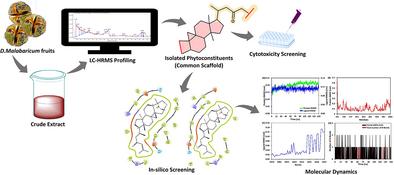
Dysoxylum malabaricum is well-known as a folklore herb. It is extensively utilized in traditional medicine to address various ailments. The study investigated the phytochemicals of D.malabaricum, focusing on its fruit, which was found to contain various terpenoids. Through extensive spectral analysis, six triterpenoids and one limonoid were identified and reported for the first time. The cytotoxicity of the compound was evaluated through in-vitro and in-silico studies followed by molecular dynamics simulations. Extracts were prepared and chromatographic techniques were applied to isolate compounds from the extract, which underwent phytochemical screening via liquid chromatography-high resolution mass spectrometry (LC-HRMS). Functional groups were assessed using nuclear magnetic resonance confirming the presence of bioactive compounds. LC-HRMS analysis identified seven phytoconstituents, with Binectarilactone and Dihydrobinectarilactone being potentially bioactive characterized. Our findings confirm known molecules, highlighting the potential of Binectarilactone and Dihydrobinectarilactone as significant cytotoxic agents having half-maximal inhibitory concentrations of 29 and 14 µM, respectively, against MCF-7 cell lines. The molecular docking and dynamic simulation analysis showed the anti-cancer properties of the compound with epidermal growth factor receptor (EGFR) enzymes. Binectarilactone and Dihydrobinectarilactone displayed the highest binding energy for all the proteins, for example, EGFR, fibroblast growth factor receptor (FGFR), human epidermal growth factor receptor 2 (HER-2), and insulin-like growth factor I overexpressed on MCF-7, MDA-MB-231, Hs578t, ZR-75-30, and BT549 cell lines. Both showed conformational stability of protein-ligand complex with EGFR, FGFR, and HER-2.
期刊介绍:
Chemistry & Biodiversity serves as a high-quality publishing forum covering a wide range of biorelevant topics for a truly international audience. This journal publishes both field-specific and interdisciplinary contributions on all aspects of biologically relevant chemistry research in the form of full-length original papers, short communications, invited reviews, and commentaries. It covers all research fields straddling the border between the chemical and biological sciences, with the ultimate goal of broadening our understanding of how nature works at a molecular level.
Since 2017, Chemistry & Biodiversity is published in an online-only format.




 京公网安备 11010802042870号
京ICP备2023020795号-1
京公网安备 11010802042870号
京ICP备2023020795号-1

 分享
分享
 求助内容:
求助内容: 应助结果提醒方式:
 扫码关注我们
