Japhet Kabalu Tshiongo, Flory Luzolo Khote, Melissa Kabena, Hypolite Muhindo Mavoko, Thierry Kalonji-Mukendi, Landrine Luzolo, Henk D F H Schallig, Kassoum Kayentao, Petra F Mens, Pascal Lutumba, Halidou Tinto, Vivi Maketa
{"title":"在刚果民主共和国金沙萨,使用超灵敏疟疾快速诊断试验进行间歇性筛查,并将吡咯嘧啶-青蒿琥酯治疗与磺胺多辛-乙胺嘧啶标准预防性治疗进行比较,以预防孕妇疟疾。","authors":"Japhet Kabalu Tshiongo, Flory Luzolo Khote, Melissa Kabena, Hypolite Muhindo Mavoko, Thierry Kalonji-Mukendi, Landrine Luzolo, Henk D F H Schallig, Kassoum Kayentao, Petra F Mens, Pascal Lutumba, Halidou Tinto, Vivi Maketa","doi":"10.1186/s12936-025-05260-6","DOIUrl":null,"url":null,"abstract":"<p><strong>Background: </strong>The declining effectiveness of Intermittent Preventive Treatment in pregnancy with sulfadoxine-pyrimethamine (IPTp-SP) due to the emergence of Plasmodium falciparum resistance highlights the need for alternative malaria prevention strategies in pregnant women. A novel approach was proposed: screening with an ultra-sensitive rapid diagnostic test and treating positive with pyronaridine-artesunate (ISTp-uRDT-PA). This trial compared the impact of both strategies on maternal malaria and anaemia, abortion, intrauterine death, birth weight, preterm delivery.</p><p><strong>Methods: </strong>This non-inferiority trial, conducted in Kinshasa, enrolled pregnant women in their second and third trimesters. Participants in the IPTp-SP arm (n = 124) received SP at monthly antenatal visit as per guidelines, while those in the ISTp-uRDT-PA arm (n = 126) were screened monthly with an uRDT and treated with PA if positive. Primary outcomes included asymptomatic parasitaemia (uRDT positive without fever) or symptomatic parasitaemia (uRDT positive with fever or history of fever, and parasite density by microscopy during pregnancy.</p><p><strong>Results: </strong>Asymptomatic parasitaemia by uRDT during pregnancy was similar in both arms (20.8% in IPTp-SP vs 21.0% in ISTp-uRDT-PA). At delivery, asymptomatic parasitaemia was 51% higher in ISTp-uRDT-PA arm compared to IPTp-SP (cRR = 1.51 [95% CI 0.76-3.00], p = 0.24). Symptomatic parasitaemia by uRDT at delivery showed no significant difference. Malaria by microscopy at enrolment was detected in 34.4% of women. Malaria by microscopy during pregnancy was 9.6% in IPTp-SP and 10.1%. ISTp-uRDT-PA (p = 0.19), decreasing to 3.2% and 0.9%, respectively, at delivery (p = 0.24). Mean haemoglobin concentration at enrolment was 10.1 g/dl in the IPTp-SP and 9.8 g/dl in the ISTp-uRDT-PA with no significant difference in maternal anaemia at delivery (7%; cRR = 1.07 [95% CI 0.87-1.31], p = 0.52). No significant differences were found for spontaneous abortions and in utero death in both arms. The risk of a premature newborn declined by 14% in ISTp-uRDT-PA compared to the IPTp-SP arm (cRR = 0.86 [95% CI 0.29-2.85], p = 0.79) while low-birth-weight was not significantly higher (cRR = 1.74 [95% CI 0.86-3.53], p = 0.12).</p><p><strong>Conclusion: </strong>ISTp-uRDT-PA was non inferior to IPTp-SP and can be considered as a future alternative for IPTp-SP in case this intervention can no longer be used due to high SP resistance.</p><p><strong>Clinical trials registration: </strong>NCT04783051.</p>","PeriodicalId":18317,"journal":{"name":"Malaria Journal","volume":"24 1","pages":"58"},"PeriodicalIF":3.0000,"publicationDate":"2025-02-21","publicationTypes":"Journal Article","fieldsOfStudy":null,"isOpenAccess":false,"openAccessPdf":"https://www.ncbi.nlm.nih.gov/pmc/articles/PMC11846385/pdf/","citationCount":"0","resultStr":"{\"title\":\"Intermittent screening using ultra-sensitive malaria rapid diagnostic test and treatment with pyronaridine-artesunate compared to standard preventive treatment with sulfadoxine-pyrimethamine for malaria prevention in pregnant women in Kinshasa, DRC.\",\"authors\":\"Japhet Kabalu Tshiongo, Flory Luzolo Khote, Melissa Kabena, Hypolite Muhindo Mavoko, Thierry Kalonji-Mukendi, Landrine Luzolo, Henk D F H Schallig, Kassoum Kayentao, Petra F Mens, Pascal Lutumba, Halidou Tinto, Vivi Maketa\",\"doi\":\"10.1186/s12936-025-05260-6\",\"DOIUrl\":null,\"url\":null,\"abstract\":\"<p><strong>Background: </strong>The declining effectiveness of Intermittent Preventive Treatment in pregnancy with sulfadoxine-pyrimethamine (IPTp-SP) due to the emergence of Plasmodium falciparum resistance highlights the need for alternative malaria prevention strategies in pregnant women. A novel approach was proposed: screening with an ultra-sensitive rapid diagnostic test and treating positive with pyronaridine-artesunate (ISTp-uRDT-PA). This trial compared the impact of both strategies on maternal malaria and anaemia, abortion, intrauterine death, birth weight, preterm delivery.</p><p><strong>Methods: </strong>This non-inferiority trial, conducted in Kinshasa, enrolled pregnant women in their second and third trimesters. Participants in the IPTp-SP arm (n = 124) received SP at monthly antenatal visit as per guidelines, while those in the ISTp-uRDT-PA arm (n = 126) were screened monthly with an uRDT and treated with PA if positive. Primary outcomes included asymptomatic parasitaemia (uRDT positive without fever) or symptomatic parasitaemia (uRDT positive with fever or history of fever, and parasite density by microscopy during pregnancy.</p><p><strong>Results: </strong>Asymptomatic parasitaemia by uRDT during pregnancy was similar in both arms (20.8% in IPTp-SP vs 21.0% in ISTp-uRDT-PA). At delivery, asymptomatic parasitaemia was 51% higher in ISTp-uRDT-PA arm compared to IPTp-SP (cRR = 1.51 [95% CI 0.76-3.00], p = 0.24). Symptomatic parasitaemia by uRDT at delivery showed no significant difference. Malaria by microscopy at enrolment was detected in 34.4% of women. Malaria by microscopy during pregnancy was 9.6% in IPTp-SP and 10.1%. ISTp-uRDT-PA (p = 0.19), decreasing to 3.2% and 0.9%, respectively, at delivery (p = 0.24). Mean haemoglobin concentration at enrolment was 10.1 g/dl in the IPTp-SP and 9.8 g/dl in the ISTp-uRDT-PA with no significant difference in maternal anaemia at delivery (7%; cRR = 1.07 [95% CI 0.87-1.31], p = 0.52). No significant differences were found for spontaneous abortions and in utero death in both arms. The risk of a premature newborn declined by 14% in ISTp-uRDT-PA compared to the IPTp-SP arm (cRR = 0.86 [95% CI 0.29-2.85], p = 0.79) while low-birth-weight was not significantly higher (cRR = 1.74 [95% CI 0.86-3.53], p = 0.12).</p><p><strong>Conclusion: </strong>ISTp-uRDT-PA was non inferior to IPTp-SP and can be considered as a future alternative for IPTp-SP in case this intervention can no longer be used due to high SP resistance.</p><p><strong>Clinical trials registration: </strong>NCT04783051.</p>\",\"PeriodicalId\":18317,\"journal\":{\"name\":\"Malaria Journal\",\"volume\":\"24 1\",\"pages\":\"58\"},\"PeriodicalIF\":3.0000,\"publicationDate\":\"2025-02-21\",\"publicationTypes\":\"Journal Article\",\"fieldsOfStudy\":null,\"isOpenAccess\":false,\"openAccessPdf\":\"https://www.ncbi.nlm.nih.gov/pmc/articles/PMC11846385/pdf/\",\"citationCount\":\"0\",\"resultStr\":null,\"platform\":\"Semanticscholar\",\"paperid\":null,\"PeriodicalName\":\"Malaria Journal\",\"FirstCategoryId\":\"3\",\"ListUrlMain\":\"https://doi.org/10.1186/s12936-025-05260-6\",\"RegionNum\":3,\"RegionCategory\":\"医学\",\"ArticlePicture\":[],\"TitleCN\":null,\"AbstractTextCN\":null,\"PMCID\":null,\"EPubDate\":\"\",\"PubModel\":\"\",\"JCR\":\"Q3\",\"JCRName\":\"INFECTIOUS DISEASES\",\"Score\":null,\"Total\":0}","platform":"Semanticscholar","paperid":null,"PeriodicalName":"Malaria Journal","FirstCategoryId":"3","ListUrlMain":"https://doi.org/10.1186/s12936-025-05260-6","RegionNum":3,"RegionCategory":"医学","ArticlePicture":[],"TitleCN":null,"AbstractTextCN":null,"PMCID":null,"EPubDate":"","PubModel":"","JCR":"Q3","JCRName":"INFECTIOUS DISEASES","Score":null,"Total":0}
引用次数: 0
摘要
背景:由于恶性疟原虫耐药性的出现,妊娠期磺胺多辛-乙胺嘧啶间歇预防治疗(IPTp-SP)的有效性下降,这突出表明需要在孕妇中采取替代疟疾预防策略。提出了一种新的方法:用超灵敏快速诊断试验进行筛选,阳性患者用吡咯吡啶-青蒿琥酯(ISTp-uRDT-PA)治疗。该试验比较了两种策略对孕产妇疟疾和贫血、流产、宫内死亡、出生体重、早产的影响。方法:这项在金沙萨进行的非劣效性试验招募了妊娠中期和晚期的孕妇。IPTp-SP组的参与者(n = 124)按照指南每月产前检查接受SP,而ISTp-uRDT-PA组的参与者(n = 126)每月接受uRDT筛查,如果阳性则接受PA治疗。主要结局包括无症状寄生虫血症(uRDT阳性,无发热)或有症状寄生虫血症(uRDT阳性,有发热或发热史),以及妊娠期间显微镜下的寄生虫密度。结果:两组妊娠期由uRDT引起的无症状寄生虫病发生率相似(IPTp-SP组为20.8%,ISTp-uRDT-PA组为21.0%)。分娩时,ISTp-uRDT-PA组无症状寄生虫血症比IPTp-SP组高51% (cRR = 1.51 [95% CI 0.76-3.00], p = 0.24)。分娩时uRDT引起的症状性寄生虫血症无显著性差异。入组时通过显微镜检查发现34.4%的妇女患有疟疾。妊娠期镜检疟疾IPTp-SP为9.6%,10.1%。ISTp-uRDT-PA (p = 0.19),分娩时分别降至3.2%和0.9% (p = 0.24)。入组时,IPTp-SP的平均血红蛋白浓度为10.1 g/dl, ISTp-uRDT-PA的平均血红蛋白浓度为9.8 g/dl,分娩时产妇贫血无显著差异(7%;cRR = 1.07 [95% CI 0.87-1.31], p = 0.52)。两组自然流产和子宫内死亡发生率无显著差异。与IPTp-SP组相比,ISTp-uRDT-PA组早产的风险降低了14% (cRR = 0.86 [95% CI 0.29-2.85], p = 0.79),而低出生体重组没有显著升高(cRR = 1.74 [95% CI 0.86-3.53], p = 0.12)。结论:ISTp-uRDT-PA不逊于IPTp-SP,在IPTp-SP因高SP抗性而不能继续使用的情况下,可以考虑作为IPTp-SP的未来替代方案。临床试验注册:NCT04783051。
Intermittent screening using ultra-sensitive malaria rapid diagnostic test and treatment with pyronaridine-artesunate compared to standard preventive treatment with sulfadoxine-pyrimethamine for malaria prevention in pregnant women in Kinshasa, DRC.
Background: The declining effectiveness of Intermittent Preventive Treatment in pregnancy with sulfadoxine-pyrimethamine (IPTp-SP) due to the emergence of Plasmodium falciparum resistance highlights the need for alternative malaria prevention strategies in pregnant women. A novel approach was proposed: screening with an ultra-sensitive rapid diagnostic test and treating positive with pyronaridine-artesunate (ISTp-uRDT-PA). This trial compared the impact of both strategies on maternal malaria and anaemia, abortion, intrauterine death, birth weight, preterm delivery.
Methods: This non-inferiority trial, conducted in Kinshasa, enrolled pregnant women in their second and third trimesters. Participants in the IPTp-SP arm (n = 124) received SP at monthly antenatal visit as per guidelines, while those in the ISTp-uRDT-PA arm (n = 126) were screened monthly with an uRDT and treated with PA if positive. Primary outcomes included asymptomatic parasitaemia (uRDT positive without fever) or symptomatic parasitaemia (uRDT positive with fever or history of fever, and parasite density by microscopy during pregnancy.
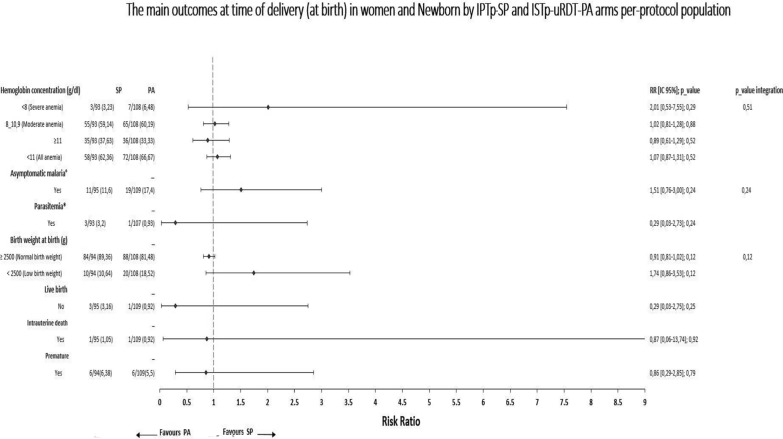
Results: Asymptomatic parasitaemia by uRDT during pregnancy was similar in both arms (20.8% in IPTp-SP vs 21.0% in ISTp-uRDT-PA). At delivery, asymptomatic parasitaemia was 51% higher in ISTp-uRDT-PA arm compared to IPTp-SP (cRR = 1.51 [95% CI 0.76-3.00], p = 0.24). Symptomatic parasitaemia by uRDT at delivery showed no significant difference. Malaria by microscopy at enrolment was detected in 34.4% of women. Malaria by microscopy during pregnancy was 9.6% in IPTp-SP and 10.1%. ISTp-uRDT-PA (p = 0.19), decreasing to 3.2% and 0.9%, respectively, at delivery (p = 0.24). Mean haemoglobin concentration at enrolment was 10.1 g/dl in the IPTp-SP and 9.8 g/dl in the ISTp-uRDT-PA with no significant difference in maternal anaemia at delivery (7%; cRR = 1.07 [95% CI 0.87-1.31], p = 0.52). No significant differences were found for spontaneous abortions and in utero death in both arms. The risk of a premature newborn declined by 14% in ISTp-uRDT-PA compared to the IPTp-SP arm (cRR = 0.86 [95% CI 0.29-2.85], p = 0.79) while low-birth-weight was not significantly higher (cRR = 1.74 [95% CI 0.86-3.53], p = 0.12).
Conclusion: ISTp-uRDT-PA was non inferior to IPTp-SP and can be considered as a future alternative for IPTp-SP in case this intervention can no longer be used due to high SP resistance.
期刊介绍:
Malaria Journal is aimed at the scientific community interested in malaria in its broadest sense. It is the only journal that publishes exclusively articles on malaria and, as such, it aims to bring together knowledge from the different specialities involved in this very broad discipline, from the bench to the bedside and to the field.





 京公网安备 11010802042870号
京ICP备2023020795号-1
京公网安备 11010802042870号
京ICP备2023020795号-1

 分享
分享
 求助内容:
求助内容: 应助结果提醒方式:
 扫码关注我们
