{"title":"立体图像重定向质量评价的视觉舒适度和深度感知测量","authors":"Zhenhua Tang, Yin Zhang, Xuejun Zhang","doi":"10.1016/j.cag.2025.104179","DOIUrl":null,"url":null,"abstract":"<div><div>Most stereoscopic image retargeting quality assessment (SIRQA) algorithms ignore the binocular difference between the left and right views on visually important content and the relative depth difference between the original and resized images, lowering the performance of the SIRQA algorithms. To address these issues, we propose a metric to measure the visual comfort of stereoscopic retargeted images, which assesses the binocular inconsistency caused by the difference between the left and right views in terms of the matched pixel pairs and information loss in salient regions. We also present a metric to evaluate the depth perception distortion of stereoscopic retargeted images, which calculates the relative depth between the background and the foreground objects in the original and the retargeted image respectively, and measures the relative depth difference between the original and the resized photos. Furthermore, we adopt the two proposed metrics to a SIRQA framework based on image classification to perform the quality evaluation of the stereoscopic resized images with other metrics. Experimental results demonstrate that the performance of the proposed SIRQA method outperforms the state-of-the-art algorithms. Moreover, ablation studies indicate that the proposed metrics can effectively improve the consistency between subjective and objective evaluations.</div></div>","PeriodicalId":50628,"journal":{"name":"Computers & Graphics-Uk","volume":"127 ","pages":"Article 104179"},"PeriodicalIF":2.8000,"publicationDate":"2025-04-01","publicationTypes":"Journal Article","fieldsOfStudy":null,"isOpenAccess":false,"openAccessPdf":"","citationCount":"0","resultStr":"{\"title\":\"Visual comfort and depth perception measurement for stereoscopic image retargeting quality assessment\",\"authors\":\"Zhenhua Tang, Yin Zhang, Xuejun Zhang\",\"doi\":\"10.1016/j.cag.2025.104179\",\"DOIUrl\":null,\"url\":null,\"abstract\":\"<div><div>Most stereoscopic image retargeting quality assessment (SIRQA) algorithms ignore the binocular difference between the left and right views on visually important content and the relative depth difference between the original and resized images, lowering the performance of the SIRQA algorithms. To address these issues, we propose a metric to measure the visual comfort of stereoscopic retargeted images, which assesses the binocular inconsistency caused by the difference between the left and right views in terms of the matched pixel pairs and information loss in salient regions. We also present a metric to evaluate the depth perception distortion of stereoscopic retargeted images, which calculates the relative depth between the background and the foreground objects in the original and the retargeted image respectively, and measures the relative depth difference between the original and the resized photos. Furthermore, we adopt the two proposed metrics to a SIRQA framework based on image classification to perform the quality evaluation of the stereoscopic resized images with other metrics. Experimental results demonstrate that the performance of the proposed SIRQA method outperforms the state-of-the-art algorithms. Moreover, ablation studies indicate that the proposed metrics can effectively improve the consistency between subjective and objective evaluations.</div></div>\",\"PeriodicalId\":50628,\"journal\":{\"name\":\"Computers & Graphics-Uk\",\"volume\":\"127 \",\"pages\":\"Article 104179\"},\"PeriodicalIF\":2.8000,\"publicationDate\":\"2025-04-01\",\"publicationTypes\":\"Journal Article\",\"fieldsOfStudy\":null,\"isOpenAccess\":false,\"openAccessPdf\":\"\",\"citationCount\":\"0\",\"resultStr\":null,\"platform\":\"Semanticscholar\",\"paperid\":null,\"PeriodicalName\":\"Computers & Graphics-Uk\",\"FirstCategoryId\":\"94\",\"ListUrlMain\":\"https://www.sciencedirect.com/science/article/pii/S0097849325000184\",\"RegionNum\":4,\"RegionCategory\":\"计算机科学\",\"ArticlePicture\":[],\"TitleCN\":null,\"AbstractTextCN\":null,\"PMCID\":null,\"EPubDate\":\"2025/2/20 0:00:00\",\"PubModel\":\"Epub\",\"JCR\":\"Q2\",\"JCRName\":\"COMPUTER SCIENCE, SOFTWARE ENGINEERING\",\"Score\":null,\"Total\":0}","platform":"Semanticscholar","paperid":null,"PeriodicalName":"Computers & Graphics-Uk","FirstCategoryId":"94","ListUrlMain":"https://www.sciencedirect.com/science/article/pii/S0097849325000184","RegionNum":4,"RegionCategory":"计算机科学","ArticlePicture":[],"TitleCN":null,"AbstractTextCN":null,"PMCID":null,"EPubDate":"2025/2/20 0:00:00","PubModel":"Epub","JCR":"Q2","JCRName":"COMPUTER SCIENCE, SOFTWARE ENGINEERING","Score":null,"Total":0}
Visual comfort and depth perception measurement for stereoscopic image retargeting quality assessment
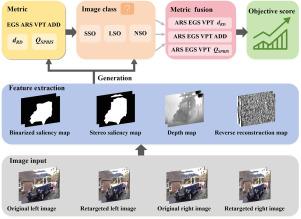
Most stereoscopic image retargeting quality assessment (SIRQA) algorithms ignore the binocular difference between the left and right views on visually important content and the relative depth difference between the original and resized images, lowering the performance of the SIRQA algorithms. To address these issues, we propose a metric to measure the visual comfort of stereoscopic retargeted images, which assesses the binocular inconsistency caused by the difference between the left and right views in terms of the matched pixel pairs and information loss in salient regions. We also present a metric to evaluate the depth perception distortion of stereoscopic retargeted images, which calculates the relative depth between the background and the foreground objects in the original and the retargeted image respectively, and measures the relative depth difference between the original and the resized photos. Furthermore, we adopt the two proposed metrics to a SIRQA framework based on image classification to perform the quality evaluation of the stereoscopic resized images with other metrics. Experimental results demonstrate that the performance of the proposed SIRQA method outperforms the state-of-the-art algorithms. Moreover, ablation studies indicate that the proposed metrics can effectively improve the consistency between subjective and objective evaluations.
期刊介绍:
Computers & Graphics is dedicated to disseminate information on research and applications of computer graphics (CG) techniques. The journal encourages articles on:
1. Research and applications of interactive computer graphics. We are particularly interested in novel interaction techniques and applications of CG to problem domains.
2. State-of-the-art papers on late-breaking, cutting-edge research on CG.
3. Information on innovative uses of graphics principles and technologies.
4. Tutorial papers on both teaching CG principles and innovative uses of CG in education.



 京公网安备 11010802042870号
京ICP备2023020795号-1
京公网安备 11010802042870号
京ICP备2023020795号-1

 分享
分享
 求助内容:
求助内容: 应助结果提醒方式:
 扫码关注我们
