Giada Diana , Andrea Milanesi , Alessandro Candiani , Alessandro Sodano , Paolo Rassè , Andrea Foglio Bonda , Laura Alessandroni , Lorella Giovannelli , Lorena Segale , Jean Daniel Coïsson
{"title":"含有维生素D3的水包油乳液的喷雾干燥:配方和工艺条件之间的协同作用,以获得微粒。","authors":"Giada Diana , Andrea Milanesi , Alessandro Candiani , Alessandro Sodano , Paolo Rassè , Andrea Foglio Bonda , Laura Alessandroni , Lorella Giovannelli , Lorena Segale , Jean Daniel Coïsson","doi":"10.1016/j.ijpharm.2025.125384","DOIUrl":null,"url":null,"abstract":"<div><div>Spray drying is a practical solution to convert oil-in-water emulsion into solid microparticles. In this work, a formulation study was conducted to identify the best composition of vitamin D3-loaded oil-in-water emulsion to process via a lab-scale spray dryer. The emulsion was composed of vitamin D3 oily solution (7 % w/w) and maltodextrin (21 % w/w), arabic gum (9 % w/w) and pea protein hydrolysate (1 % w/w) aqueous solution and was characterized by optimal stability (> 24 h). The spray drying process (T<sub>in</sub>: 160 °C; T<sub>out</sub>: 94 °C; Gas atomization: 1.75 bar; Feeding rate: 8.75 g/min) was successful: the process yield was good, and the obtained powder had an acceptable residual humidity. The average diameter of microparticles was 23 µm with a quite wide particle size distribution. The oil and vitamin D3 recovered from the powder were 85.69 ± 3.91 % and 80.10 ± 9.94 % of the expected, respectively. The accelerated stability and photostability study results showed that the percentage of vitamin D3 present in the powder after storage was twice compared to vitamin D3 in oil solution stored at the same conditions. Moreover, the scale-up of the process from lab- to pilot-scale spray dryer was encouraging. Regardless of the top or bottom spray set-up, the pilot scale treatments increased the production rate and improved drying efficiency. The top spray configuration and a low inlet temperature guaranteed a yield of over 86 %, about 3 % residual humidity in the powder, and preserved the oil quality, maintaining a peroxide value comparable to the initial one.</div></div>","PeriodicalId":14187,"journal":{"name":"International Journal of Pharmaceutics","volume":"673 ","pages":"Article 125384"},"PeriodicalIF":6.0000,"publicationDate":"2025-03-30","publicationTypes":"Journal Article","fieldsOfStudy":null,"isOpenAccess":false,"openAccessPdf":"","citationCount":"0","resultStr":"{\"title\":\"Spray drying of an oil-in-water emulsion containing vitamin D3: a synergy between formulation and process conditions to obtain microparticles\",\"authors\":\"Giada Diana , Andrea Milanesi , Alessandro Candiani , Alessandro Sodano , Paolo Rassè , Andrea Foglio Bonda , Laura Alessandroni , Lorella Giovannelli , Lorena Segale , Jean Daniel Coïsson\",\"doi\":\"10.1016/j.ijpharm.2025.125384\",\"DOIUrl\":null,\"url\":null,\"abstract\":\"<div><div>Spray drying is a practical solution to convert oil-in-water emulsion into solid microparticles. In this work, a formulation study was conducted to identify the best composition of vitamin D3-loaded oil-in-water emulsion to process via a lab-scale spray dryer. The emulsion was composed of vitamin D3 oily solution (7 % w/w) and maltodextrin (21 % w/w), arabic gum (9 % w/w) and pea protein hydrolysate (1 % w/w) aqueous solution and was characterized by optimal stability (> 24 h). The spray drying process (T<sub>in</sub>: 160 °C; T<sub>out</sub>: 94 °C; Gas atomization: 1.75 bar; Feeding rate: 8.75 g/min) was successful: the process yield was good, and the obtained powder had an acceptable residual humidity. The average diameter of microparticles was 23 µm with a quite wide particle size distribution. The oil and vitamin D3 recovered from the powder were 85.69 ± 3.91 % and 80.10 ± 9.94 % of the expected, respectively. The accelerated stability and photostability study results showed that the percentage of vitamin D3 present in the powder after storage was twice compared to vitamin D3 in oil solution stored at the same conditions. Moreover, the scale-up of the process from lab- to pilot-scale spray dryer was encouraging. Regardless of the top or bottom spray set-up, the pilot scale treatments increased the production rate and improved drying efficiency. The top spray configuration and a low inlet temperature guaranteed a yield of over 86 %, about 3 % residual humidity in the powder, and preserved the oil quality, maintaining a peroxide value comparable to the initial one.</div></div>\",\"PeriodicalId\":14187,\"journal\":{\"name\":\"International Journal of Pharmaceutics\",\"volume\":\"673 \",\"pages\":\"Article 125384\"},\"PeriodicalIF\":6.0000,\"publicationDate\":\"2025-03-30\",\"publicationTypes\":\"Journal Article\",\"fieldsOfStudy\":null,\"isOpenAccess\":false,\"openAccessPdf\":\"\",\"citationCount\":\"0\",\"resultStr\":null,\"platform\":\"Semanticscholar\",\"paperid\":null,\"PeriodicalName\":\"International Journal of Pharmaceutics\",\"FirstCategoryId\":\"3\",\"ListUrlMain\":\"https://www.sciencedirect.com/science/article/pii/S0378517325002200\",\"RegionNum\":2,\"RegionCategory\":\"医学\",\"ArticlePicture\":[],\"TitleCN\":null,\"AbstractTextCN\":null,\"PMCID\":null,\"EPubDate\":\"2025/2/20 0:00:00\",\"PubModel\":\"Epub\",\"JCR\":\"Q1\",\"JCRName\":\"PHARMACOLOGY & PHARMACY\",\"Score\":null,\"Total\":0}","platform":"Semanticscholar","paperid":null,"PeriodicalName":"International Journal of Pharmaceutics","FirstCategoryId":"3","ListUrlMain":"https://www.sciencedirect.com/science/article/pii/S0378517325002200","RegionNum":2,"RegionCategory":"医学","ArticlePicture":[],"TitleCN":null,"AbstractTextCN":null,"PMCID":null,"EPubDate":"2025/2/20 0:00:00","PubModel":"Epub","JCR":"Q1","JCRName":"PHARMACOLOGY & PHARMACY","Score":null,"Total":0}
Spray drying of an oil-in-water emulsion containing vitamin D3: a synergy between formulation and process conditions to obtain microparticles
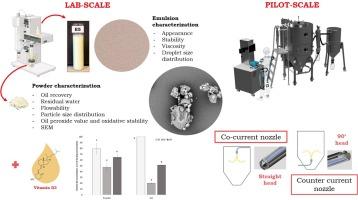
Spray drying is a practical solution to convert oil-in-water emulsion into solid microparticles. In this work, a formulation study was conducted to identify the best composition of vitamin D3-loaded oil-in-water emulsion to process via a lab-scale spray dryer. The emulsion was composed of vitamin D3 oily solution (7 % w/w) and maltodextrin (21 % w/w), arabic gum (9 % w/w) and pea protein hydrolysate (1 % w/w) aqueous solution and was characterized by optimal stability (> 24 h). The spray drying process (Tin: 160 °C; Tout: 94 °C; Gas atomization: 1.75 bar; Feeding rate: 8.75 g/min) was successful: the process yield was good, and the obtained powder had an acceptable residual humidity. The average diameter of microparticles was 23 µm with a quite wide particle size distribution. The oil and vitamin D3 recovered from the powder were 85.69 ± 3.91 % and 80.10 ± 9.94 % of the expected, respectively. The accelerated stability and photostability study results showed that the percentage of vitamin D3 present in the powder after storage was twice compared to vitamin D3 in oil solution stored at the same conditions. Moreover, the scale-up of the process from lab- to pilot-scale spray dryer was encouraging. Regardless of the top or bottom spray set-up, the pilot scale treatments increased the production rate and improved drying efficiency. The top spray configuration and a low inlet temperature guaranteed a yield of over 86 %, about 3 % residual humidity in the powder, and preserved the oil quality, maintaining a peroxide value comparable to the initial one.
期刊介绍:
The International Journal of Pharmaceutics is the third most cited journal in the "Pharmacy & Pharmacology" category out of 366 journals, being the true home for pharmaceutical scientists concerned with the physical, chemical and biological properties of devices and delivery systems for drugs, vaccines and biologicals, including their design, manufacture and evaluation. This includes evaluation of the properties of drugs, excipients such as surfactants and polymers and novel materials. The journal has special sections on pharmaceutical nanotechnology and personalized medicines, and publishes research papers, reviews, commentaries and letters to the editor as well as special issues.




 京公网安备 11010802042870号
京ICP备2023020795号-1
京公网安备 11010802042870号
京ICP备2023020795号-1

 分享
分享
 求助内容:
求助内容: 应助结果提醒方式:
 扫码关注我们
