Danial Zangeneh*, Bibash Sapkota, Ritesh Uppuluri and Robert F. Klie,
{"title":"MgCr1.5Mn0.5O4中光束诱导相变的原子尺度跟踪","authors":"Danial Zangeneh*, Bibash Sapkota, Ritesh Uppuluri and Robert F. Klie, ","doi":"10.1021/acs.chemmater.4c02880","DOIUrl":null,"url":null,"abstract":"<p >Transition metal (TM) oxides, particularly manganese oxide spinels, are promising cathode materials for next-generation rechargeable batteries, offering reversible intercalation of multivalent ions, such as Mg<sup>2+</sup>, at high voltages and energy storage capacities potentially higher than conventional Li-ion cathodes. However, repeated electrochemical cycling of these oxide cathodes with Mg<sup>2+</sup> can lead to irreversible structural changes, causing capacity fade and voltage losses. In this study, we utilize <i>in situ</i> transmission electron microscopy (TEM), including aberration-corrected scanning transmission electron microscopy (STEM) imaging and electron energy-loss spectroscopy (EELS), to examine the electronic and structural changes in MgCr<sub>1.5</sub>Mn<sub>0.5</sub>O<sub>4</sub> under electron beam exposure. We find that electron beam irradiation induces Mn migration in both the bulk and surface regions of the nanocrystals, leading to the formation of a MnO phase on the crystal surface, with the dynamics of this formation captured at the atomic scale. These results demonstrate the potential for <i>in situ</i> TEM to capture the atomic-scale dynamics of cation migration during the structural changes previously observed in battery cathodes throughout electrochemical cycling. Our study identifies the causes of unwanted secondary phase formation in multivalent spinel oxide cathodes, attributing it to phase separation and TM-ion diffusion.</p>","PeriodicalId":33,"journal":{"name":"Chemistry of Materials","volume":"37 4","pages":"1491–1499 1491–1499"},"PeriodicalIF":7.1000,"publicationDate":"2025-02-10","publicationTypes":"Journal Article","fieldsOfStudy":null,"isOpenAccess":false,"openAccessPdf":"","citationCount":"0","resultStr":"{\"title\":\"Atomic-Scale Tracking of Beam-Induced Phase Transitions in MgCr1.5Mn0.5O4\",\"authors\":\"Danial Zangeneh*, Bibash Sapkota, Ritesh Uppuluri and Robert F. Klie, \",\"doi\":\"10.1021/acs.chemmater.4c02880\",\"DOIUrl\":null,\"url\":null,\"abstract\":\"<p >Transition metal (TM) oxides, particularly manganese oxide spinels, are promising cathode materials for next-generation rechargeable batteries, offering reversible intercalation of multivalent ions, such as Mg<sup>2+</sup>, at high voltages and energy storage capacities potentially higher than conventional Li-ion cathodes. However, repeated electrochemical cycling of these oxide cathodes with Mg<sup>2+</sup> can lead to irreversible structural changes, causing capacity fade and voltage losses. In this study, we utilize <i>in situ</i> transmission electron microscopy (TEM), including aberration-corrected scanning transmission electron microscopy (STEM) imaging and electron energy-loss spectroscopy (EELS), to examine the electronic and structural changes in MgCr<sub>1.5</sub>Mn<sub>0.5</sub>O<sub>4</sub> under electron beam exposure. We find that electron beam irradiation induces Mn migration in both the bulk and surface regions of the nanocrystals, leading to the formation of a MnO phase on the crystal surface, with the dynamics of this formation captured at the atomic scale. These results demonstrate the potential for <i>in situ</i> TEM to capture the atomic-scale dynamics of cation migration during the structural changes previously observed in battery cathodes throughout electrochemical cycling. Our study identifies the causes of unwanted secondary phase formation in multivalent spinel oxide cathodes, attributing it to phase separation and TM-ion diffusion.</p>\",\"PeriodicalId\":33,\"journal\":{\"name\":\"Chemistry of Materials\",\"volume\":\"37 4\",\"pages\":\"1491–1499 1491–1499\"},\"PeriodicalIF\":7.1000,\"publicationDate\":\"2025-02-10\",\"publicationTypes\":\"Journal Article\",\"fieldsOfStudy\":null,\"isOpenAccess\":false,\"openAccessPdf\":\"\",\"citationCount\":\"0\",\"resultStr\":null,\"platform\":\"Semanticscholar\",\"paperid\":null,\"PeriodicalName\":\"Chemistry of Materials\",\"FirstCategoryId\":\"88\",\"ListUrlMain\":\"https://pubs.acs.org/doi/10.1021/acs.chemmater.4c02880\",\"RegionNum\":2,\"RegionCategory\":\"材料科学\",\"ArticlePicture\":[],\"TitleCN\":null,\"AbstractTextCN\":null,\"PMCID\":null,\"EPubDate\":\"\",\"PubModel\":\"\",\"JCR\":\"Q2\",\"JCRName\":\"CHEMISTRY, PHYSICAL\",\"Score\":null,\"Total\":0}","platform":"Semanticscholar","paperid":null,"PeriodicalName":"Chemistry of Materials","FirstCategoryId":"88","ListUrlMain":"https://pubs.acs.org/doi/10.1021/acs.chemmater.4c02880","RegionNum":2,"RegionCategory":"材料科学","ArticlePicture":[],"TitleCN":null,"AbstractTextCN":null,"PMCID":null,"EPubDate":"","PubModel":"","JCR":"Q2","JCRName":"CHEMISTRY, PHYSICAL","Score":null,"Total":0}
Atomic-Scale Tracking of Beam-Induced Phase Transitions in MgCr1.5Mn0.5O4
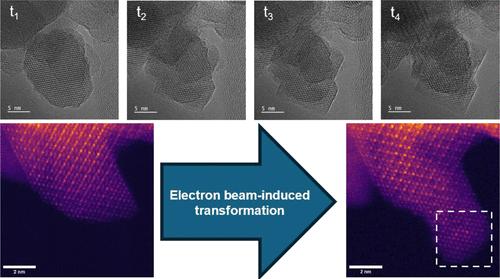
Transition metal (TM) oxides, particularly manganese oxide spinels, are promising cathode materials for next-generation rechargeable batteries, offering reversible intercalation of multivalent ions, such as Mg2+, at high voltages and energy storage capacities potentially higher than conventional Li-ion cathodes. However, repeated electrochemical cycling of these oxide cathodes with Mg2+ can lead to irreversible structural changes, causing capacity fade and voltage losses. In this study, we utilize in situ transmission electron microscopy (TEM), including aberration-corrected scanning transmission electron microscopy (STEM) imaging and electron energy-loss spectroscopy (EELS), to examine the electronic and structural changes in MgCr1.5Mn0.5O4 under electron beam exposure. We find that electron beam irradiation induces Mn migration in both the bulk and surface regions of the nanocrystals, leading to the formation of a MnO phase on the crystal surface, with the dynamics of this formation captured at the atomic scale. These results demonstrate the potential for in situ TEM to capture the atomic-scale dynamics of cation migration during the structural changes previously observed in battery cathodes throughout electrochemical cycling. Our study identifies the causes of unwanted secondary phase formation in multivalent spinel oxide cathodes, attributing it to phase separation and TM-ion diffusion.
期刊介绍:
The journal Chemistry of Materials focuses on publishing original research at the intersection of materials science and chemistry. The studies published in the journal involve chemistry as a prominent component and explore topics such as the design, synthesis, characterization, processing, understanding, and application of functional or potentially functional materials. The journal covers various areas of interest, including inorganic and organic solid-state chemistry, nanomaterials, biomaterials, thin films and polymers, and composite/hybrid materials. The journal particularly seeks papers that highlight the creation or development of innovative materials with novel optical, electrical, magnetic, catalytic, or mechanical properties. It is essential that manuscripts on these topics have a primary focus on the chemistry of materials and represent a significant advancement compared to prior research. Before external reviews are sought, submitted manuscripts undergo a review process by a minimum of two editors to ensure their appropriateness for the journal and the presence of sufficient evidence of a significant advance that will be of broad interest to the materials chemistry community.




 京公网安备 11010802042870号
京ICP备2023020795号-1
京公网安备 11010802042870号
京ICP备2023020795号-1

 分享
分享
 求助内容:
求助内容: 应助结果提醒方式:
 扫码关注我们
