Guillermo Iglesias , Hector Menendez , Edgar Talavera
{"title":"结合变分自编码器和对抗性机器学习改进医学x射线诊断的解释","authors":"Guillermo Iglesias , Hector Menendez , Edgar Talavera","doi":"10.1016/j.compbiomed.2025.109857","DOIUrl":null,"url":null,"abstract":"<div><div>Explainability in Medical Computer Vision is one of the most sensible implementations of Artificial Intelligence nowadays in healthcare. In this work, we propose a novel Deep Learning architecture for eXplainable Artificial Intelligence, specially designed for medical diagnostic. The proposed approach leverages Variational Autoencoders properties to produce linear modifications of images in a lower-dimensional embedded space, and then reconstructs these modifications into non-linear explanations in the original image space. The proposed approach is based on global and local regularisation of the latent space, which stores visual and semantic information about images. Specifically, a multi-objective genetic algorithm is designed for searching explanations, finding individuals that can misclassify the classification output of the network while producing the minimum number of changes in the image descriptor. The genetic algorithm is able to search for explanations without defining any hyperparameters, and uses only one individual to provide a complete explanation of the whole image. Furthermore, the explanations found by the proposed approach are compared with state-of-the-art eXplainable Artificial Intelligence systems and the results show an improvement in the precision of the explanation between 56.39 and 7.23 percentage points.</div></div>","PeriodicalId":10578,"journal":{"name":"Computers in biology and medicine","volume":"188 ","pages":"Article 109857"},"PeriodicalIF":6.3000,"publicationDate":"2025-04-01","publicationTypes":"Journal Article","fieldsOfStudy":null,"isOpenAccess":false,"openAccessPdf":"","citationCount":"0","resultStr":"{\"title\":\"Improving explanations for medical X-ray diagnosis combining variational autoencoders and adversarial machine learning\",\"authors\":\"Guillermo Iglesias , Hector Menendez , Edgar Talavera\",\"doi\":\"10.1016/j.compbiomed.2025.109857\",\"DOIUrl\":null,\"url\":null,\"abstract\":\"<div><div>Explainability in Medical Computer Vision is one of the most sensible implementations of Artificial Intelligence nowadays in healthcare. In this work, we propose a novel Deep Learning architecture for eXplainable Artificial Intelligence, specially designed for medical diagnostic. The proposed approach leverages Variational Autoencoders properties to produce linear modifications of images in a lower-dimensional embedded space, and then reconstructs these modifications into non-linear explanations in the original image space. The proposed approach is based on global and local regularisation of the latent space, which stores visual and semantic information about images. Specifically, a multi-objective genetic algorithm is designed for searching explanations, finding individuals that can misclassify the classification output of the network while producing the minimum number of changes in the image descriptor. The genetic algorithm is able to search for explanations without defining any hyperparameters, and uses only one individual to provide a complete explanation of the whole image. Furthermore, the explanations found by the proposed approach are compared with state-of-the-art eXplainable Artificial Intelligence systems and the results show an improvement in the precision of the explanation between 56.39 and 7.23 percentage points.</div></div>\",\"PeriodicalId\":10578,\"journal\":{\"name\":\"Computers in biology and medicine\",\"volume\":\"188 \",\"pages\":\"Article 109857\"},\"PeriodicalIF\":6.3000,\"publicationDate\":\"2025-04-01\",\"publicationTypes\":\"Journal Article\",\"fieldsOfStudy\":null,\"isOpenAccess\":false,\"openAccessPdf\":\"\",\"citationCount\":\"0\",\"resultStr\":null,\"platform\":\"Semanticscholar\",\"paperid\":null,\"PeriodicalName\":\"Computers in biology and medicine\",\"FirstCategoryId\":\"5\",\"ListUrlMain\":\"https://www.sciencedirect.com/science/article/pii/S0010482525002070\",\"RegionNum\":2,\"RegionCategory\":\"医学\",\"ArticlePicture\":[],\"TitleCN\":null,\"AbstractTextCN\":null,\"PMCID\":null,\"EPubDate\":\"2025/2/24 0:00:00\",\"PubModel\":\"Epub\",\"JCR\":\"Q1\",\"JCRName\":\"BIOLOGY\",\"Score\":null,\"Total\":0}","platform":"Semanticscholar","paperid":null,"PeriodicalName":"Computers in biology and medicine","FirstCategoryId":"5","ListUrlMain":"https://www.sciencedirect.com/science/article/pii/S0010482525002070","RegionNum":2,"RegionCategory":"医学","ArticlePicture":[],"TitleCN":null,"AbstractTextCN":null,"PMCID":null,"EPubDate":"2025/2/24 0:00:00","PubModel":"Epub","JCR":"Q1","JCRName":"BIOLOGY","Score":null,"Total":0}
Improving explanations for medical X-ray diagnosis combining variational autoencoders and adversarial machine learning
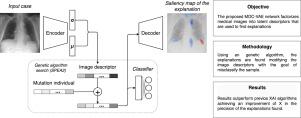
Explainability in Medical Computer Vision is one of the most sensible implementations of Artificial Intelligence nowadays in healthcare. In this work, we propose a novel Deep Learning architecture for eXplainable Artificial Intelligence, specially designed for medical diagnostic. The proposed approach leverages Variational Autoencoders properties to produce linear modifications of images in a lower-dimensional embedded space, and then reconstructs these modifications into non-linear explanations in the original image space. The proposed approach is based on global and local regularisation of the latent space, which stores visual and semantic information about images. Specifically, a multi-objective genetic algorithm is designed for searching explanations, finding individuals that can misclassify the classification output of the network while producing the minimum number of changes in the image descriptor. The genetic algorithm is able to search for explanations without defining any hyperparameters, and uses only one individual to provide a complete explanation of the whole image. Furthermore, the explanations found by the proposed approach are compared with state-of-the-art eXplainable Artificial Intelligence systems and the results show an improvement in the precision of the explanation between 56.39 and 7.23 percentage points.
期刊介绍:
Computers in Biology and Medicine is an international forum for sharing groundbreaking advancements in the use of computers in bioscience and medicine. This journal serves as a medium for communicating essential research, instruction, ideas, and information regarding the rapidly evolving field of computer applications in these domains. By encouraging the exchange of knowledge, we aim to facilitate progress and innovation in the utilization of computers in biology and medicine.




 京公网安备 11010802042870号
京ICP备2023020795号-1
京公网安备 11010802042870号
京ICP备2023020795号-1

 分享
分享
 求助内容:
求助内容: 应助结果提醒方式:
 扫码关注我们
