Jose Victor Zambrana, Ian A Mellis, Abigail Shotwell, Hannah E Maier, Yara Saborio, Carlos Barillas, Roger Lopez, Gerald Vasquez, Miguel Plazaola, Nery Sanchez, Sergio Ojeda, Isabel Gilbertson, Guillermina Kuan, Qian Wang, Lihong Liu, Angel Balmaseda, David D Ho, Aubree Gordon
{"title":"变异特异性抗体与SARS-CoV-2 Omicron症状性和整体感染的保护相关。","authors":"Jose Victor Zambrana, Ian A Mellis, Abigail Shotwell, Hannah E Maier, Yara Saborio, Carlos Barillas, Roger Lopez, Gerald Vasquez, Miguel Plazaola, Nery Sanchez, Sergio Ojeda, Isabel Gilbertson, Guillermina Kuan, Qian Wang, Lihong Liu, Angel Balmaseda, David D Ho, Aubree Gordon","doi":"10.1101/2025.02.11.25322066","DOIUrl":null,"url":null,"abstract":"<p><strong>Background: </strong>Vaccination prior infection elicit neutralizing antibodies targeting SARS-CoV-2, yet the quantitative relationship between serum antibodies infection risk against viral variants remains uncertain, particularly in underrepresented regions.</p><p><strong>Methods: </strong>We investigated the protective correlation of pre-exposure serum neutralizing antibody levels, employing a panel of SARS-CoV-2 pseudoviruses (Omicron BA.1, Omicron BA.2, ancestral D614G), Spike-binding antibody levels, with symptomatic BA.1 or BA.2 SARS-CoV-2 infections overall infection, in 345 household contacts from a SARS-CoV-2 household cohort study.</p><p><strong>Results: </strong>A four-fold increase in homotypic-neutralizing (e.g., BA.1-neutralizing vs. BA.1 exposure) titers was correlated with protection from symptomatic infections (BA.1 protection: 28% [95%CI 12-42%]; BA.2 protection: 43% [20-62%]), ancestral-neutralizing titers were also correlated with protection from either variant, but only at higher average levels than homotypic. Mediation analyses revealed that homotypic D614G-neutralizing antibodies mediated protection from infection symptomatic infection both from prior infection vaccination.</p><p><strong>Conclusions: </strong>These findings underscore the importance of monitoring variant-specific antibody responses highlight that antibodies targeting circulating strains may be more predictive of protection from infection. Nevertheless, ancestral-strain-neutralizing antibodies remain relevant as a correlate of protection. Our study emphasizes the need for continued efforts to assess antibody correlates of protection.</p><p><strong>Funding: </strong>We acknowledge funding from the U.S. N.I.H., the Open Philanthropy Project, the Bill Melinda Gates Foundation.</p>","PeriodicalId":94281,"journal":{"name":"medRxiv : the preprint server for health sciences","volume":" ","pages":""},"PeriodicalIF":0.0000,"publicationDate":"2025-02-13","publicationTypes":"Journal Article","fieldsOfStudy":null,"isOpenAccess":false,"openAccessPdf":"https://www.ncbi.nlm.nih.gov/pmc/articles/PMC11844606/pdf/","citationCount":"0","resultStr":"{\"title\":\"Variant-specific antibody correlates of protection against SARS-CoV-2 Omicron symptomatic overall infections.\",\"authors\":\"Jose Victor Zambrana, Ian A Mellis, Abigail Shotwell, Hannah E Maier, Yara Saborio, Carlos Barillas, Roger Lopez, Gerald Vasquez, Miguel Plazaola, Nery Sanchez, Sergio Ojeda, Isabel Gilbertson, Guillermina Kuan, Qian Wang, Lihong Liu, Angel Balmaseda, David D Ho, Aubree Gordon\",\"doi\":\"10.1101/2025.02.11.25322066\",\"DOIUrl\":null,\"url\":null,\"abstract\":\"<p><strong>Background: </strong>Vaccination prior infection elicit neutralizing antibodies targeting SARS-CoV-2, yet the quantitative relationship between serum antibodies infection risk against viral variants remains uncertain, particularly in underrepresented regions.</p><p><strong>Methods: </strong>We investigated the protective correlation of pre-exposure serum neutralizing antibody levels, employing a panel of SARS-CoV-2 pseudoviruses (Omicron BA.1, Omicron BA.2, ancestral D614G), Spike-binding antibody levels, with symptomatic BA.1 or BA.2 SARS-CoV-2 infections overall infection, in 345 household contacts from a SARS-CoV-2 household cohort study.</p><p><strong>Results: </strong>A four-fold increase in homotypic-neutralizing (e.g., BA.1-neutralizing vs. BA.1 exposure) titers was correlated with protection from symptomatic infections (BA.1 protection: 28% [95%CI 12-42%]; BA.2 protection: 43% [20-62%]), ancestral-neutralizing titers were also correlated with protection from either variant, but only at higher average levels than homotypic. Mediation analyses revealed that homotypic D614G-neutralizing antibodies mediated protection from infection symptomatic infection both from prior infection vaccination.</p><p><strong>Conclusions: </strong>These findings underscore the importance of monitoring variant-specific antibody responses highlight that antibodies targeting circulating strains may be more predictive of protection from infection. Nevertheless, ancestral-strain-neutralizing antibodies remain relevant as a correlate of protection. Our study emphasizes the need for continued efforts to assess antibody correlates of protection.</p><p><strong>Funding: </strong>We acknowledge funding from the U.S. N.I.H., the Open Philanthropy Project, the Bill Melinda Gates Foundation.</p>\",\"PeriodicalId\":94281,\"journal\":{\"name\":\"medRxiv : the preprint server for health sciences\",\"volume\":\" \",\"pages\":\"\"},\"PeriodicalIF\":0.0000,\"publicationDate\":\"2025-02-13\",\"publicationTypes\":\"Journal Article\",\"fieldsOfStudy\":null,\"isOpenAccess\":false,\"openAccessPdf\":\"https://www.ncbi.nlm.nih.gov/pmc/articles/PMC11844606/pdf/\",\"citationCount\":\"0\",\"resultStr\":null,\"platform\":\"Semanticscholar\",\"paperid\":null,\"PeriodicalName\":\"medRxiv : the preprint server for health sciences\",\"FirstCategoryId\":\"1085\",\"ListUrlMain\":\"https://doi.org/10.1101/2025.02.11.25322066\",\"RegionNum\":0,\"RegionCategory\":null,\"ArticlePicture\":[],\"TitleCN\":null,\"AbstractTextCN\":null,\"PMCID\":null,\"EPubDate\":\"\",\"PubModel\":\"\",\"JCR\":\"\",\"JCRName\":\"\",\"Score\":null,\"Total\":0}","platform":"Semanticscholar","paperid":null,"PeriodicalName":"medRxiv : the preprint server for health sciences","FirstCategoryId":"1085","ListUrlMain":"https://doi.org/10.1101/2025.02.11.25322066","RegionNum":0,"RegionCategory":null,"ArticlePicture":[],"TitleCN":null,"AbstractTextCN":null,"PMCID":null,"EPubDate":"","PubModel":"","JCR":"","JCRName":"","Score":null,"Total":0}
Variant-specific antibody correlates of protection against SARS-CoV-2 Omicron symptomatic overall infections.
Background: Vaccination prior infection elicit neutralizing antibodies targeting SARS-CoV-2, yet the quantitative relationship between serum antibodies infection risk against viral variants remains uncertain, particularly in underrepresented regions.
Methods: We investigated the protective correlation of pre-exposure serum neutralizing antibody levels, employing a panel of SARS-CoV-2 pseudoviruses (Omicron BA.1, Omicron BA.2, ancestral D614G), Spike-binding antibody levels, with symptomatic BA.1 or BA.2 SARS-CoV-2 infections overall infection, in 345 household contacts from a SARS-CoV-2 household cohort study.
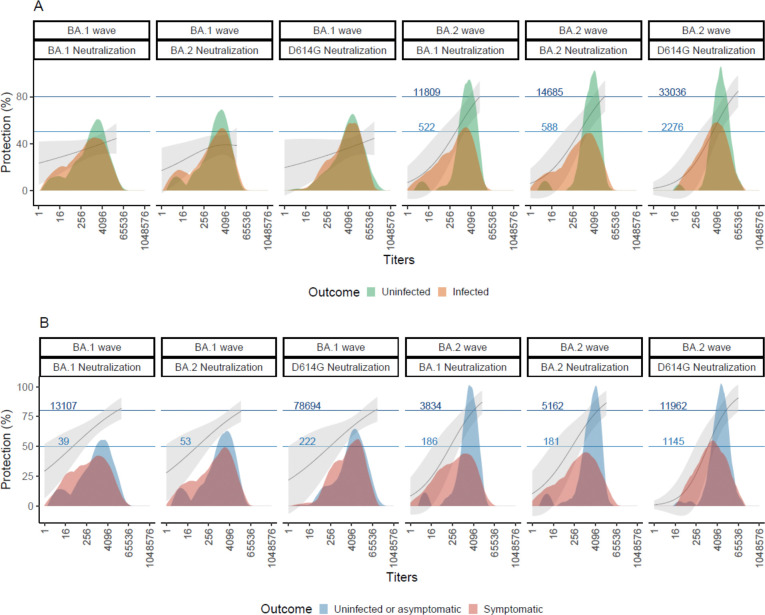
Results: A four-fold increase in homotypic-neutralizing (e.g., BA.1-neutralizing vs. BA.1 exposure) titers was correlated with protection from symptomatic infections (BA.1 protection: 28% [95%CI 12-42%]; BA.2 protection: 43% [20-62%]), ancestral-neutralizing titers were also correlated with protection from either variant, but only at higher average levels than homotypic. Mediation analyses revealed that homotypic D614G-neutralizing antibodies mediated protection from infection symptomatic infection both from prior infection vaccination.
Conclusions: These findings underscore the importance of monitoring variant-specific antibody responses highlight that antibodies targeting circulating strains may be more predictive of protection from infection. Nevertheless, ancestral-strain-neutralizing antibodies remain relevant as a correlate of protection. Our study emphasizes the need for continued efforts to assess antibody correlates of protection.
Funding: We acknowledge funding from the U.S. N.I.H., the Open Philanthropy Project, the Bill Melinda Gates Foundation.




 京公网安备 11010802042870号
京ICP备2023020795号-1
京公网安备 11010802042870号
京ICP备2023020795号-1

 分享
分享

 求助内容:
求助内容: 应助结果提醒方式:
 扫码关注我们
