{"title":"纳米胶囊诱导聚电解质的原位接枝和聚酰胺层的结构重排","authors":"Yunhuan Chen, Weier Wang, Xinyue Liu, Xiaoxiao Duan, Yongsheng Ren","doi":"10.1016/j.ces.2025.121437","DOIUrl":null,"url":null,"abstract":"<div><div>Highly permselective and antifouling nanofiltration (NF) membranes are desirable materials for ion sieving. Integrating favorable properties through interfacial polymerization (IP) is challenging. Herein, nano-encapsulation of polyethyleneimine (PEI) is performed using a functional group pre-protection approach. By precisely controlling the release process of the nanocapsules during IP reaction to achieve in situ deep cross-linking of PEI. Nanocapsule-modulated IP (NMIP) strategy affects the morphology of polyamide network in several ways, with the Turing structure endowing the membrane with higher water permeance (15.1 L m<sup>-2</sup>h<sup>−1</sup> bar<sup>−1</sup>) and a narrowed pore size that enhances the ion-sieving properties (Cl<sup>-</sup>/SO<sub>4</sub><sup>2-</sup> selectivity of 68.5). The nearly electroneutral separation layer shows low fouling rates and flux recoveries of up to 97.1 % in the treatment of charged organics and high stability under long-term high-loaded contamination conditions. This study unlocks new avenues for the precise, low-cost fabrication of high-performance ion-sieving materials.</div></div>","PeriodicalId":271,"journal":{"name":"Chemical Engineering Science","volume":"308 ","pages":"Article 121437"},"PeriodicalIF":5.1000,"publicationDate":"2025-04-01","publicationTypes":"Journal Article","fieldsOfStudy":null,"isOpenAccess":false,"openAccessPdf":"","citationCount":"0","resultStr":"{\"title\":\"Nanocapsules induce in situ grafting of polyelectrolytes and structural rearrangement of polyamide layers\",\"authors\":\"Yunhuan Chen, Weier Wang, Xinyue Liu, Xiaoxiao Duan, Yongsheng Ren\",\"doi\":\"10.1016/j.ces.2025.121437\",\"DOIUrl\":null,\"url\":null,\"abstract\":\"<div><div>Highly permselective and antifouling nanofiltration (NF) membranes are desirable materials for ion sieving. Integrating favorable properties through interfacial polymerization (IP) is challenging. Herein, nano-encapsulation of polyethyleneimine (PEI) is performed using a functional group pre-protection approach. By precisely controlling the release process of the nanocapsules during IP reaction to achieve in situ deep cross-linking of PEI. Nanocapsule-modulated IP (NMIP) strategy affects the morphology of polyamide network in several ways, with the Turing structure endowing the membrane with higher water permeance (15.1 L m<sup>-2</sup>h<sup>−1</sup> bar<sup>−1</sup>) and a narrowed pore size that enhances the ion-sieving properties (Cl<sup>-</sup>/SO<sub>4</sub><sup>2-</sup> selectivity of 68.5). The nearly electroneutral separation layer shows low fouling rates and flux recoveries of up to 97.1 % in the treatment of charged organics and high stability under long-term high-loaded contamination conditions. This study unlocks new avenues for the precise, low-cost fabrication of high-performance ion-sieving materials.</div></div>\",\"PeriodicalId\":271,\"journal\":{\"name\":\"Chemical Engineering Science\",\"volume\":\"308 \",\"pages\":\"Article 121437\"},\"PeriodicalIF\":5.1000,\"publicationDate\":\"2025-04-01\",\"publicationTypes\":\"Journal Article\",\"fieldsOfStudy\":null,\"isOpenAccess\":false,\"openAccessPdf\":\"\",\"citationCount\":\"0\",\"resultStr\":null,\"platform\":\"Semanticscholar\",\"paperid\":null,\"PeriodicalName\":\"Chemical Engineering Science\",\"FirstCategoryId\":\"5\",\"ListUrlMain\":\"https://www.sciencedirect.com/science/article/pii/S000925092500260X\",\"RegionNum\":2,\"RegionCategory\":\"工程技术\",\"ArticlePicture\":[],\"TitleCN\":null,\"AbstractTextCN\":null,\"PMCID\":null,\"EPubDate\":\"2025/2/25 0:00:00\",\"PubModel\":\"Epub\",\"JCR\":\"Q2\",\"JCRName\":\"ENGINEERING, CHEMICAL\",\"Score\":null,\"Total\":0}","platform":"Semanticscholar","paperid":null,"PeriodicalName":"Chemical Engineering Science","FirstCategoryId":"5","ListUrlMain":"https://www.sciencedirect.com/science/article/pii/S000925092500260X","RegionNum":2,"RegionCategory":"工程技术","ArticlePicture":[],"TitleCN":null,"AbstractTextCN":null,"PMCID":null,"EPubDate":"2025/2/25 0:00:00","PubModel":"Epub","JCR":"Q2","JCRName":"ENGINEERING, CHEMICAL","Score":null,"Total":0}
引用次数: 0
摘要
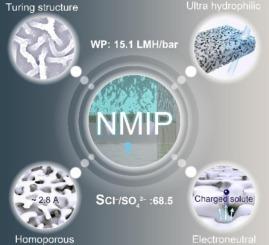
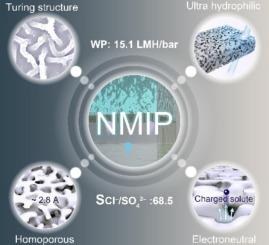
高透选择性和防污纳滤膜是离子筛分的理想材料。通过界面聚合(IP)整合良好的性能是具有挑战性的。在这里,聚乙烯亚胺(PEI)的纳米封装是使用官能团预保护方法进行的。通过精确控制IP反应过程中纳米胶囊的释放过程,实现PEI的原位深度交联。纳米胶囊调制IP (NMIP)策略通过多种方式影响聚酰胺网络的形态,图灵结构赋予膜更高的透水性(15.1 L m-2h−1 bar−1),缩小的孔径增强了离子筛分性能(Cl-/SO42-选择性为68.5)。近电中性分离层在处理带电有机物时显示出低污染率和高达97.1 %的通量回收率,并且在长期高负荷污染条件下具有很高的稳定性。这项研究为精确、低成本制造高性能离子筛分材料开辟了新的途径。
Nanocapsules induce in situ grafting of polyelectrolytes and structural rearrangement of polyamide layers
Highly permselective and antifouling nanofiltration (NF) membranes are desirable materials for ion sieving. Integrating favorable properties through interfacial polymerization (IP) is challenging. Herein, nano-encapsulation of polyethyleneimine (PEI) is performed using a functional group pre-protection approach. By precisely controlling the release process of the nanocapsules during IP reaction to achieve in situ deep cross-linking of PEI. Nanocapsule-modulated IP (NMIP) strategy affects the morphology of polyamide network in several ways, with the Turing structure endowing the membrane with higher water permeance (15.1 L m-2h−1 bar−1) and a narrowed pore size that enhances the ion-sieving properties (Cl-/SO42- selectivity of 68.5). The nearly electroneutral separation layer shows low fouling rates and flux recoveries of up to 97.1 % in the treatment of charged organics and high stability under long-term high-loaded contamination conditions. This study unlocks new avenues for the precise, low-cost fabrication of high-performance ion-sieving materials.
期刊介绍:
Chemical engineering enables the transformation of natural resources and energy into useful products for society. It draws on and applies natural sciences, mathematics and economics, and has developed fundamental engineering science that underpins the discipline.
Chemical Engineering Science (CES) has been publishing papers on the fundamentals of chemical engineering since 1951. CES is the platform where the most significant advances in the discipline have ever since been published. Chemical Engineering Science has accompanied and sustained chemical engineering through its development into the vibrant and broad scientific discipline it is today.




 京公网安备 11010802042870号
京ICP备2023020795号-1
京公网安备 11010802042870号
京ICP备2023020795号-1

 分享
分享
 求助内容:
求助内容: 应助结果提醒方式:
 扫码关注我们
