Synthesis, antibacterial evaluation and preliminary mechanism study of novel isoquinoline-3-carboxylic acid derivatives containing an acylhydrazone disulfone moiety
BACKGROUND
Limitations in the use and availability of copper-based fungicides and antibiotics has led to a scarcity of bactericidal agents. It is urgent to develop green bactericides with new modes-of-action and effective chemotypes.
RESULTS
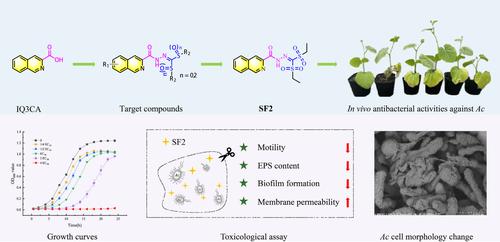
A bioactive substructure splicing approach was applied to optimize the structure of the natural product isoquinolin-3-carboxylic acid (IQ3CA). The structure–activity relationship analysis showed that the increase of sulfur atomic oxidation state and small groups on the sulfone will be beneficial for antibacterial activities. The difulone compound SF2 showed the most potent activity against Xanthomonas oryzae pv. oryzae (Xoo), Ralstonia solanacearum (Rs) and Acidovorax citrulli (Ac), with median lethal effective concentration values of 2.52, 2.62 and 1.12 μg mL−1, respectively, which were superior to those of IQ3CA and kasugamycin. The protective and curative effects of compound SF2 against Ac were 69.31% and 55.64%, respectively, which were better than those of thiodiazole copper (58.37% and 43.08%). Furthermore, preliminary mechanistic investigations indicated that compound SF2 could increase membrane permeability, reduce exopolysaccharide content, and inhibit both bacterial motility and biofilm formation.
期刊介绍:
Pest Management Science is the international journal of research and development in crop protection and pest control. Since its launch in 1970, the journal has become the premier forum for papers on the discovery, application, and impact on the environment of products and strategies designed for pest management.
Published for SCI by John Wiley & Sons Ltd.




 京公网安备 11010802042870号
京ICP备2023020795号-1
京公网安备 11010802042870号
京ICP备2023020795号-1

 分享
分享
 求助内容:
求助内容: 应助结果提醒方式:
 扫码关注我们
