{"title":"Ru-Py二元增敏还原剂光氧化还原催化中增敏引发的电子传递机理","authors":"Yaxiong Wei, Tingting Fu, Bowen Song, Zhongfa Sun, Zhou Lu, Yongjia Shang, Xinsheng Xu","doi":"10.1021/acs.jpcc.4c05888","DOIUrl":null,"url":null,"abstract":"The sensitization-initiated electron transfer (SenI-ET) mechanism is a well-established concept in photoredox catalysis, yet its kinetic intricacies remain to be fully elucidated. In this study, we have successfully designed and synthesized a dyad, Ru(bpy)<sub>3</sub><sup>2+</sup>–pyrene (Ru-Py), which functions dually as a sensitizer and a reductant. By the use of the rapid intramolecular triplet and singlet energy transfer of Ru-Py, the complex decay pathway of the SenI-ET process was effectively simplified. Notably, we have demonstrated that direct electron transfer from <sup>3</sup>Ru*-Py to diisopropyl ethylamine generates Ru(I)-Py, which further drives the catalytic process, rather than the catalytic reaction being driven by the formation of a Ru-Py<sup>•-</sup> through electron transfer from Ru-<sup>3</sup>Py* to diisopropyl ethylamine. Furthermore, we employed Ru-Py as a catalyst for the C–H oxidation of an activated aryl bromide, demonstrating superior catalytic efficiency compared to that of the conventional Ru(bpy)<sub>3</sub><sup>2+</sup>/pyrene system.","PeriodicalId":61,"journal":{"name":"The Journal of Physical Chemistry C","volume":"31 1","pages":""},"PeriodicalIF":3.2000,"publicationDate":"2025-02-24","publicationTypes":"Journal Article","fieldsOfStudy":null,"isOpenAccess":false,"openAccessPdf":"","citationCount":"0","resultStr":"{\"title\":\"Sensitization-Initiated Electron Transfer Mechanism in Photoredox Catalysis Using a Ru-Py Dyad as a Dual Sensitizer and Reductant\",\"authors\":\"Yaxiong Wei, Tingting Fu, Bowen Song, Zhongfa Sun, Zhou Lu, Yongjia Shang, Xinsheng Xu\",\"doi\":\"10.1021/acs.jpcc.4c05888\",\"DOIUrl\":null,\"url\":null,\"abstract\":\"The sensitization-initiated electron transfer (SenI-ET) mechanism is a well-established concept in photoredox catalysis, yet its kinetic intricacies remain to be fully elucidated. In this study, we have successfully designed and synthesized a dyad, Ru(bpy)<sub>3</sub><sup>2+</sup>–pyrene (Ru-Py), which functions dually as a sensitizer and a reductant. By the use of the rapid intramolecular triplet and singlet energy transfer of Ru-Py, the complex decay pathway of the SenI-ET process was effectively simplified. Notably, we have demonstrated that direct electron transfer from <sup>3</sup>Ru*-Py to diisopropyl ethylamine generates Ru(I)-Py, which further drives the catalytic process, rather than the catalytic reaction being driven by the formation of a Ru-Py<sup>•-</sup> through electron transfer from Ru-<sup>3</sup>Py* to diisopropyl ethylamine. Furthermore, we employed Ru-Py as a catalyst for the C–H oxidation of an activated aryl bromide, demonstrating superior catalytic efficiency compared to that of the conventional Ru(bpy)<sub>3</sub><sup>2+</sup>/pyrene system.\",\"PeriodicalId\":61,\"journal\":{\"name\":\"The Journal of Physical Chemistry C\",\"volume\":\"31 1\",\"pages\":\"\"},\"PeriodicalIF\":3.2000,\"publicationDate\":\"2025-02-24\",\"publicationTypes\":\"Journal Article\",\"fieldsOfStudy\":null,\"isOpenAccess\":false,\"openAccessPdf\":\"\",\"citationCount\":\"0\",\"resultStr\":null,\"platform\":\"Semanticscholar\",\"paperid\":null,\"PeriodicalName\":\"The Journal of Physical Chemistry C\",\"FirstCategoryId\":\"1\",\"ListUrlMain\":\"https://doi.org/10.1021/acs.jpcc.4c05888\",\"RegionNum\":3,\"RegionCategory\":\"化学\",\"ArticlePicture\":[],\"TitleCN\":null,\"AbstractTextCN\":null,\"PMCID\":null,\"EPubDate\":\"\",\"PubModel\":\"\",\"JCR\":\"Q2\",\"JCRName\":\"CHEMISTRY, PHYSICAL\",\"Score\":null,\"Total\":0}","platform":"Semanticscholar","paperid":null,"PeriodicalName":"The Journal of Physical Chemistry C","FirstCategoryId":"1","ListUrlMain":"https://doi.org/10.1021/acs.jpcc.4c05888","RegionNum":3,"RegionCategory":"化学","ArticlePicture":[],"TitleCN":null,"AbstractTextCN":null,"PMCID":null,"EPubDate":"","PubModel":"","JCR":"Q2","JCRName":"CHEMISTRY, PHYSICAL","Score":null,"Total":0}
Sensitization-Initiated Electron Transfer Mechanism in Photoredox Catalysis Using a Ru-Py Dyad as a Dual Sensitizer and Reductant
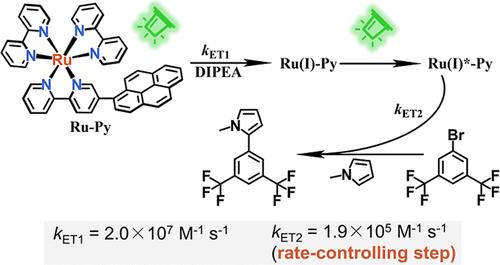
The sensitization-initiated electron transfer (SenI-ET) mechanism is a well-established concept in photoredox catalysis, yet its kinetic intricacies remain to be fully elucidated. In this study, we have successfully designed and synthesized a dyad, Ru(bpy)32+–pyrene (Ru-Py), which functions dually as a sensitizer and a reductant. By the use of the rapid intramolecular triplet and singlet energy transfer of Ru-Py, the complex decay pathway of the SenI-ET process was effectively simplified. Notably, we have demonstrated that direct electron transfer from 3Ru*-Py to diisopropyl ethylamine generates Ru(I)-Py, which further drives the catalytic process, rather than the catalytic reaction being driven by the formation of a Ru-Py•- through electron transfer from Ru-3Py* to diisopropyl ethylamine. Furthermore, we employed Ru-Py as a catalyst for the C–H oxidation of an activated aryl bromide, demonstrating superior catalytic efficiency compared to that of the conventional Ru(bpy)32+/pyrene system.
期刊介绍:
The Journal of Physical Chemistry A/B/C is devoted to reporting new and original experimental and theoretical basic research of interest to physical chemists, biophysical chemists, and chemical physicists.




 京公网安备 11010802042870号
京ICP备2023020795号-1
京公网安备 11010802042870号
京ICP备2023020795号-1

 分享
分享
 求助内容:
求助内容: 应助结果提醒方式:
 扫码关注我们
