{"title":"含2-硝基咪唑和苯磺酰胺基团的放射性碘标记低氧靶向药物的合成及体外评价","authors":"Weiqi Liu, Taiwei Chu","doi":"10.1016/j.ejmech.2025.117443","DOIUrl":null,"url":null,"abstract":"<div><div>Designing new radiolabeled hypoxia-targeted drugs is of great help in the diagnosis of tumors. Hypoxia-targeted drugs with dual bioactive groups can enhance hypoxia selectivity, strengthen the binding of drugs to targets, and improve diagnostic accuracy compared with traditional hypoxia-targeted drugs containing only one nitroimidazole group. In this study, a series of novel radioiodine labeled tyrosine derivatives containing 2-nitroimidazole and benzenesulfonamide groups were synthesized and <em>in vitro</em> evaluated. In the uptake experiments of S180 cells that didn't express carbonic anhydrase IX (CAIX), the compound [<sup>131</sup>I]-3-(3-iodo-4-(2-(2-methoxyethoxy)ethoxy)phenyl)-2-(2-(2-nitro-1<em>H</em>-imidazole-1-yl)acetamido)-<em>N</em>-(2-(2-nitro-1<em>H</em>-imidazole-1-yl)ethyl)propenamide (<sup><strong>131</strong></sup><strong>I-Tyr-05</strong>) containing two 2-nitroimidazole groups was modified from phenolic hydroxyl to methoxy to 2-(2-methoxyethoxy)ethoxy, gradually achieving improved membrane permeability and enhanced hydrophilicity. Compared with other compounds with similar structures but containing only one 2-nitroimidazole, it had higher hypoxic selectivity. In the uptake experiment of HeLa cells that expressed CAIX, [<sup>131</sup>I]-<em>N</em>-(3-(3-iodo-4-(2-(2-methoxyethoxy)ethoxy)phenyl)-1-((2-(2-nitro-1<em>H</em>-imidazole-1-yl)ethyl)amino)-1-oxopropan-2-yl)-4-sulfamoylbenzamide (<sup><strong>131</strong></sup><strong>I-Tyr-06</strong>), which contained both 2-nitroimidazole and benzenesulfonamide group, achieved enhanced hypoxic uptake and selectivity through the combination of two targeting groups. The S180 cell blocking experiments of <sup><strong>131</strong></sup><strong>I-Tyr-05</strong> and <sup><strong>131</strong></sup><strong>I-Tyr-06</strong> showed that the benzenesulfonamide group of the compounds didn't inhibit cellular uptake, and inhibition of cytochrome P450 (CYP450) enzyme had no effect on cellular uptake. <em>In silico</em> ADMET evaluation showed that <strong>I-Tyr-05</strong> and <strong>I-Tyr-06</strong> possessed acceptable physicochemical and ADMET properties. In conclusion, this work demonstrated the advantages of hypoxia-targeted drugs containing dual bioactive groups compared to a single group, and also found it was a feasible approach to design new dual-targeted drugs by combining 2-nitroimidazole and benzenesulfonamide groups.</div></div>","PeriodicalId":314,"journal":{"name":"European Journal of Medicinal Chemistry","volume":"289 ","pages":"Article 117443"},"PeriodicalIF":5.9000,"publicationDate":"2025-05-05","publicationTypes":"Journal Article","fieldsOfStudy":null,"isOpenAccess":false,"openAccessPdf":"","citationCount":"0","resultStr":"{\"title\":\"Synthesis and in vitro evaluation of radioiodine labeled hypoxia-targeted drugs containing 2-nitroimidazole and benzenesulfonamide groups\",\"authors\":\"Weiqi Liu, Taiwei Chu\",\"doi\":\"10.1016/j.ejmech.2025.117443\",\"DOIUrl\":null,\"url\":null,\"abstract\":\"<div><div>Designing new radiolabeled hypoxia-targeted drugs is of great help in the diagnosis of tumors. Hypoxia-targeted drugs with dual bioactive groups can enhance hypoxia selectivity, strengthen the binding of drugs to targets, and improve diagnostic accuracy compared with traditional hypoxia-targeted drugs containing only one nitroimidazole group. In this study, a series of novel radioiodine labeled tyrosine derivatives containing 2-nitroimidazole and benzenesulfonamide groups were synthesized and <em>in vitro</em> evaluated. In the uptake experiments of S180 cells that didn't express carbonic anhydrase IX (CAIX), the compound [<sup>131</sup>I]-3-(3-iodo-4-(2-(2-methoxyethoxy)ethoxy)phenyl)-2-(2-(2-nitro-1<em>H</em>-imidazole-1-yl)acetamido)-<em>N</em>-(2-(2-nitro-1<em>H</em>-imidazole-1-yl)ethyl)propenamide (<sup><strong>131</strong></sup><strong>I-Tyr-05</strong>) containing two 2-nitroimidazole groups was modified from phenolic hydroxyl to methoxy to 2-(2-methoxyethoxy)ethoxy, gradually achieving improved membrane permeability and enhanced hydrophilicity. Compared with other compounds with similar structures but containing only one 2-nitroimidazole, it had higher hypoxic selectivity. In the uptake experiment of HeLa cells that expressed CAIX, [<sup>131</sup>I]-<em>N</em>-(3-(3-iodo-4-(2-(2-methoxyethoxy)ethoxy)phenyl)-1-((2-(2-nitro-1<em>H</em>-imidazole-1-yl)ethyl)amino)-1-oxopropan-2-yl)-4-sulfamoylbenzamide (<sup><strong>131</strong></sup><strong>I-Tyr-06</strong>), which contained both 2-nitroimidazole and benzenesulfonamide group, achieved enhanced hypoxic uptake and selectivity through the combination of two targeting groups. The S180 cell blocking experiments of <sup><strong>131</strong></sup><strong>I-Tyr-05</strong> and <sup><strong>131</strong></sup><strong>I-Tyr-06</strong> showed that the benzenesulfonamide group of the compounds didn't inhibit cellular uptake, and inhibition of cytochrome P450 (CYP450) enzyme had no effect on cellular uptake. <em>In silico</em> ADMET evaluation showed that <strong>I-Tyr-05</strong> and <strong>I-Tyr-06</strong> possessed acceptable physicochemical and ADMET properties. In conclusion, this work demonstrated the advantages of hypoxia-targeted drugs containing dual bioactive groups compared to a single group, and also found it was a feasible approach to design new dual-targeted drugs by combining 2-nitroimidazole and benzenesulfonamide groups.</div></div>\",\"PeriodicalId\":314,\"journal\":{\"name\":\"European Journal of Medicinal Chemistry\",\"volume\":\"289 \",\"pages\":\"Article 117443\"},\"PeriodicalIF\":5.9000,\"publicationDate\":\"2025-05-05\",\"publicationTypes\":\"Journal Article\",\"fieldsOfStudy\":null,\"isOpenAccess\":false,\"openAccessPdf\":\"\",\"citationCount\":\"0\",\"resultStr\":null,\"platform\":\"Semanticscholar\",\"paperid\":null,\"PeriodicalName\":\"European Journal of Medicinal Chemistry\",\"FirstCategoryId\":\"3\",\"ListUrlMain\":\"https://www.sciencedirect.com/science/article/pii/S0223523425002089\",\"RegionNum\":2,\"RegionCategory\":\"医学\",\"ArticlePicture\":[],\"TitleCN\":null,\"AbstractTextCN\":null,\"PMCID\":null,\"EPubDate\":\"2025/2/25 0:00:00\",\"PubModel\":\"Epub\",\"JCR\":\"Q1\",\"JCRName\":\"CHEMISTRY, MEDICINAL\",\"Score\":null,\"Total\":0}","platform":"Semanticscholar","paperid":null,"PeriodicalName":"European Journal of Medicinal Chemistry","FirstCategoryId":"3","ListUrlMain":"https://www.sciencedirect.com/science/article/pii/S0223523425002089","RegionNum":2,"RegionCategory":"医学","ArticlePicture":[],"TitleCN":null,"AbstractTextCN":null,"PMCID":null,"EPubDate":"2025/2/25 0:00:00","PubModel":"Epub","JCR":"Q1","JCRName":"CHEMISTRY, MEDICINAL","Score":null,"Total":0}
引用次数: 0
摘要
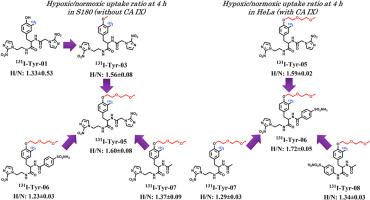
设计新的放射性低氧靶向药物对肿瘤的诊断有很大的帮助。具有双生物活性基团的低氧靶向药物与仅含有一个硝基咪唑基团的传统低氧靶向药物相比,可增强低氧选择性,加强药物与靶标的结合,提高诊断准确性。本研究合成了一系列含有2-硝基咪唑和苯磺酰胺基团的新型放射性碘标记酪氨酸衍生物,并进行了体外评价。在不表达碳酸酐酶IX (CAIX)的S180细胞的摄取实验中,将含有两个2-硝基咪唑基团的化合物[131I]-3-(3-碘-4-(2-(2-甲氧基乙氧基)苯基)-2-(2-(2-硝基- 1h -咪唑-1-基)乙酰氨基)- n -(2-(2-硝基- 1h -咪唑-1-基)乙基)丙烯酰胺(131I- tir -05)由酚羟基修饰为甲氧基再修饰为2-(2-(2-甲氧基乙氧基)乙氧基,逐渐达到改善膜透性和增强亲水性的目的。与其他结构相似但只含一个2-硝基咪唑的化合物相比,它具有更高的缺氧选择性。在表达CAIX的HeLa细胞摄取实验中,[131I]- n-(3-(3-碘-4-(2-(2-甲氧基乙氧基)乙氧基)苯基)-1-((2-(2-硝基- 1h -咪唑-1-酰基)乙基)氨基)-1-氧丙基-2-酰基)-4-磺胺基苯酰胺(131I- tyr -06)同时含有2-硝基咪唑和苯磺酰胺基团,通过两个靶向基团的结合,实现了增强的缺氧摄取和选择性。131I-Tyr-05和131I-Tyr-06的S180细胞阻断实验表明,化合物的苯磺酰胺基团不抑制细胞摄取,抑制细胞色素P450 (CYP450)酶对细胞摄取无影响。计算机ADMET评价表明,I-Tyr-05和I-Tyr-06具有良好的理化性能和ADMET性能。综上所述,本工作证明了含双活性基团的低氧靶向药物相对于单活性基团的优势,同时也发现将2-硝基咪唑和苯磺酰胺基团结合设计新的双靶向药物是一种可行的方法。
Synthesis and in vitro evaluation of radioiodine labeled hypoxia-targeted drugs containing 2-nitroimidazole and benzenesulfonamide groups
Designing new radiolabeled hypoxia-targeted drugs is of great help in the diagnosis of tumors. Hypoxia-targeted drugs with dual bioactive groups can enhance hypoxia selectivity, strengthen the binding of drugs to targets, and improve diagnostic accuracy compared with traditional hypoxia-targeted drugs containing only one nitroimidazole group. In this study, a series of novel radioiodine labeled tyrosine derivatives containing 2-nitroimidazole and benzenesulfonamide groups were synthesized and in vitro evaluated. In the uptake experiments of S180 cells that didn't express carbonic anhydrase IX (CAIX), the compound [131I]-3-(3-iodo-4-(2-(2-methoxyethoxy)ethoxy)phenyl)-2-(2-(2-nitro-1H-imidazole-1-yl)acetamido)-N-(2-(2-nitro-1H-imidazole-1-yl)ethyl)propenamide (131I-Tyr-05) containing two 2-nitroimidazole groups was modified from phenolic hydroxyl to methoxy to 2-(2-methoxyethoxy)ethoxy, gradually achieving improved membrane permeability and enhanced hydrophilicity. Compared with other compounds with similar structures but containing only one 2-nitroimidazole, it had higher hypoxic selectivity. In the uptake experiment of HeLa cells that expressed CAIX, [131I]-N-(3-(3-iodo-4-(2-(2-methoxyethoxy)ethoxy)phenyl)-1-((2-(2-nitro-1H-imidazole-1-yl)ethyl)amino)-1-oxopropan-2-yl)-4-sulfamoylbenzamide (131I-Tyr-06), which contained both 2-nitroimidazole and benzenesulfonamide group, achieved enhanced hypoxic uptake and selectivity through the combination of two targeting groups. The S180 cell blocking experiments of 131I-Tyr-05 and 131I-Tyr-06 showed that the benzenesulfonamide group of the compounds didn't inhibit cellular uptake, and inhibition of cytochrome P450 (CYP450) enzyme had no effect on cellular uptake. In silico ADMET evaluation showed that I-Tyr-05 and I-Tyr-06 possessed acceptable physicochemical and ADMET properties. In conclusion, this work demonstrated the advantages of hypoxia-targeted drugs containing dual bioactive groups compared to a single group, and also found it was a feasible approach to design new dual-targeted drugs by combining 2-nitroimidazole and benzenesulfonamide groups.
期刊介绍:
The European Journal of Medicinal Chemistry is a global journal that publishes studies on all aspects of medicinal chemistry. It provides a medium for publication of original papers and also welcomes critical review papers.
A typical paper would report on the organic synthesis, characterization and pharmacological evaluation of compounds. Other topics of interest are drug design, QSAR, molecular modeling, drug-receptor interactions, molecular aspects of drug metabolism, prodrug synthesis and drug targeting. The journal expects manuscripts to present the rational for a study, provide insight into the design of compounds or understanding of mechanism, or clarify the targets.





 京公网安备 11010802042870号
京ICP备2023020795号-1
京公网安备 11010802042870号
京ICP备2023020795号-1

 分享
分享
 求助内容:
求助内容: 应助结果提醒方式:
 扫码关注我们
