Ruisheng Zhao , Chaomin Hao , Dan Liu , Zizhong Liu , Yongsheng Bao
{"title":"Cu/DMAP共催化和DMAP催化C-N脱羧交叉偶联反应机理","authors":"Ruisheng Zhao , Chaomin Hao , Dan Liu , Zizhong Liu , Yongsheng Bao","doi":"10.1039/d4qo02352h","DOIUrl":null,"url":null,"abstract":"<div><div>A general and practical type of Cu/DMAP-cocatalyzed and DMAP-catalyzed C–N decarboxylative cross-coupling (DCC) reaction of carboxylic acids (or carboxylates) and azidoformates, which can construct both C(sp<sup>2</sup>)–N and C(sp<sup>3</sup>)–N bonds, was thoroughly investigated by density functional theory calculations. The Curtius rearrangements, <em>i.e.</em>, extrusions of N<sub>2</sub>, were found to be the rate-limiting steps for both Cu/DMAP-cocatalyzed and DMAP-catalyzed C–N DCC reactions. DMAP can facilitate the N<sub>3</sub><sup>−</sup> transfer from the initial azidoformate species to the ensuing generated acyl azide intermediates. Then, the acyl azide intermediates undergo the Curtius rearrangements, overcoming a relatively low energy barrier. If DMAP was absent, the Curtius rearrangements would have to occur on the initial azidoformate species with energy barriers over 40.0 kcal mol<sup>−1</sup>, which is not feasible at room temperature. Cu catalysts can further slightly facilitate the C–N DCC reactions.</div></div>","PeriodicalId":94379,"journal":{"name":"Organic chemistry frontiers : an international journal of organic chemistry","volume":"12 8","pages":"Pages 2568-2579"},"PeriodicalIF":0.0000,"publicationDate":"2025-02-12","publicationTypes":"Journal Article","fieldsOfStudy":null,"isOpenAccess":false,"openAccessPdf":"","citationCount":"0","resultStr":"{\"title\":\"Mechanisms of Cu/DMAP-cocatalyzed and DMAP-catalyzed C–N decarboxylative cross-coupling reactions†\",\"authors\":\"Ruisheng Zhao , Chaomin Hao , Dan Liu , Zizhong Liu , Yongsheng Bao\",\"doi\":\"10.1039/d4qo02352h\",\"DOIUrl\":null,\"url\":null,\"abstract\":\"<div><div>A general and practical type of Cu/DMAP-cocatalyzed and DMAP-catalyzed C–N decarboxylative cross-coupling (DCC) reaction of carboxylic acids (or carboxylates) and azidoformates, which can construct both C(sp<sup>2</sup>)–N and C(sp<sup>3</sup>)–N bonds, was thoroughly investigated by density functional theory calculations. The Curtius rearrangements, <em>i.e.</em>, extrusions of N<sub>2</sub>, were found to be the rate-limiting steps for both Cu/DMAP-cocatalyzed and DMAP-catalyzed C–N DCC reactions. DMAP can facilitate the N<sub>3</sub><sup>−</sup> transfer from the initial azidoformate species to the ensuing generated acyl azide intermediates. Then, the acyl azide intermediates undergo the Curtius rearrangements, overcoming a relatively low energy barrier. If DMAP was absent, the Curtius rearrangements would have to occur on the initial azidoformate species with energy barriers over 40.0 kcal mol<sup>−1</sup>, which is not feasible at room temperature. Cu catalysts can further slightly facilitate the C–N DCC reactions.</div></div>\",\"PeriodicalId\":94379,\"journal\":{\"name\":\"Organic chemistry frontiers : an international journal of organic chemistry\",\"volume\":\"12 8\",\"pages\":\"Pages 2568-2579\"},\"PeriodicalIF\":0.0000,\"publicationDate\":\"2025-02-12\",\"publicationTypes\":\"Journal Article\",\"fieldsOfStudy\":null,\"isOpenAccess\":false,\"openAccessPdf\":\"\",\"citationCount\":\"0\",\"resultStr\":null,\"platform\":\"Semanticscholar\",\"paperid\":null,\"PeriodicalName\":\"Organic chemistry frontiers : an international journal of organic chemistry\",\"FirstCategoryId\":\"1085\",\"ListUrlMain\":\"https://www.sciencedirect.com/org/science/article/pii/S2052412925001196\",\"RegionNum\":0,\"RegionCategory\":null,\"ArticlePicture\":[],\"TitleCN\":null,\"AbstractTextCN\":null,\"PMCID\":null,\"EPubDate\":\"2025/2/25 0:00:00\",\"PubModel\":\"Epub\",\"JCR\":\"\",\"JCRName\":\"\",\"Score\":null,\"Total\":0}","platform":"Semanticscholar","paperid":null,"PeriodicalName":"Organic chemistry frontiers : an international journal of organic chemistry","FirstCategoryId":"1085","ListUrlMain":"https://www.sciencedirect.com/org/science/article/pii/S2052412925001196","RegionNum":0,"RegionCategory":null,"ArticlePicture":[],"TitleCN":null,"AbstractTextCN":null,"PMCID":null,"EPubDate":"2025/2/25 0:00:00","PubModel":"Epub","JCR":"","JCRName":"","Score":null,"Total":0}
Mechanisms of Cu/DMAP-cocatalyzed and DMAP-catalyzed C–N decarboxylative cross-coupling reactions†
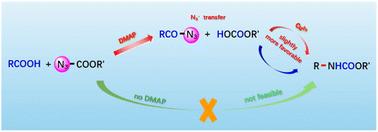
A general and practical type of Cu/DMAP-cocatalyzed and DMAP-catalyzed C–N decarboxylative cross-coupling (DCC) reaction of carboxylic acids (or carboxylates) and azidoformates, which can construct both C(sp2)–N and C(sp3)–N bonds, was thoroughly investigated by density functional theory calculations. The Curtius rearrangements, i.e., extrusions of N2, were found to be the rate-limiting steps for both Cu/DMAP-cocatalyzed and DMAP-catalyzed C–N DCC reactions. DMAP can facilitate the N3− transfer from the initial azidoformate species to the ensuing generated acyl azide intermediates. Then, the acyl azide intermediates undergo the Curtius rearrangements, overcoming a relatively low energy barrier. If DMAP was absent, the Curtius rearrangements would have to occur on the initial azidoformate species with energy barriers over 40.0 kcal mol−1, which is not feasible at room temperature. Cu catalysts can further slightly facilitate the C–N DCC reactions.




 京公网安备 11010802042870号
京ICP备2023020795号-1
京公网安备 11010802042870号
京ICP备2023020795号-1

 分享
分享

 求助内容:
求助内容: 应助结果提醒方式:
 扫码关注我们
