Changcheng Chen , Yuxi Du , Yaxin Xu , Zhengjun Wang , Yali Tuo , Zhao Han , Xiongfei Yun , Shaohang Shi , Jiangzhou Xie , Shuli Gao , Wen Chen , Chao Dong , Xiaoning Guan , Gang Liu , Pengfei Lu
{"title":"具有光电性质的非铅卤素Cs2NaB ' cl6 (B ' = In, Cr, Y, Tb)双卤化物钙钛矿的机器学习和第一性原理研究","authors":"Changcheng Chen , Yuxi Du , Yaxin Xu , Zhengjun Wang , Yali Tuo , Zhao Han , Xiongfei Yun , Shaohang Shi , Jiangzhou Xie , Shuli Gao , Wen Chen , Chao Dong , Xiaoning Guan , Gang Liu , Pengfei Lu","doi":"10.1016/j.mseb.2025.118135","DOIUrl":null,"url":null,"abstract":"<div><div>In the field of photovoltaic materials, wide-bandgap (Eg > 1.63 eV) perovskite solar cells have broad application prospects in the power generation of tandem solar cells and the integration of photovoltaics into buildings, with advantages such as a light absorption coefficient, long carrier lifetime, strong response to weak light, and a simple preparation process. In this paper, the relevant data obtained by machine learning are screened and combined with the development concept of high efficiency and environmental protection; the lead-free Cs<sub>2</sub>NaB’Cl<sub>6</sub> (B’ = In, Cr, Y, and Tb double-halide perovskite) is selected as the research object from the perspective of bandgap and energy. The structure and optoelectronic properties of the system are investigated using the first-principles density functional theory method. In terms of electrical performance, Cs<sub>2</sub>NaInCl<sub>6</sub> and Cs<sub>2</sub>NaCrCl<sub>6</sub> can be used for wide-bandgap perovskite batteries because of their bandgaps of 2.81 and 2.86 eV, while Cs<sub>2</sub>NaYCl<sub>6</sub> and Cs<sub>2</sub>NaTbCl<sub>6</sub> have bandgaps of 5.05 and 5.19 eV, which can be used for detectors. In terms of optical performance, the reflectivity of Cs<sub>2</sub>NaB’Cl<sub>6</sub> (B’ = In, Cr, Y, Tb)-halide perovskite is all less than 11 %, with low reflection loss and no metallic luster, so the material system has high transmittance and can be used for research and development of high-transmittance applications. CsNaCrCl<sub>6</sub> shows a significant absorption peak in the visible light range, and the three materials show a significant absorption peak in the ultraviolet region. It is found that Cs<sub>2</sub>NaCrCl<sub>6</sub> has broad application prospects in the field of tandem solar photovoltaic power generation and photovoltaic building integration because of its appropriate bandgap value, low reflectivity, and excellent light absorption performance. Cs<sub>2</sub>NaInCl<sub>6</sub>, Cs<sub>2</sub>NaYCl<sub>6</sub>, and Cs<sub>2</sub>NaTbCl<sub>6</sub> have low dielectric constants, high chemical stability, high exciton binding energy, and excellent electrical properties and can be used as wide-bandgap, direct-bandgap, halide double-perovskite semiconductor materials and have potential application value in optoelectronic devices and optical detectors.</div></div>","PeriodicalId":18233,"journal":{"name":"Materials Science and Engineering: B","volume":"316 ","pages":"Article 118135"},"PeriodicalIF":4.6000,"publicationDate":"2025-06-01","publicationTypes":"Journal Article","fieldsOfStudy":null,"isOpenAccess":false,"openAccessPdf":"","citationCount":"0","resultStr":"{\"title\":\"Machine learning and first-principles study of non-lead-halogen Cs2NaB’Cl6 (B’= In, Cr, Y, Tb) double halide perovskites with optoelectronic properties\",\"authors\":\"Changcheng Chen , Yuxi Du , Yaxin Xu , Zhengjun Wang , Yali Tuo , Zhao Han , Xiongfei Yun , Shaohang Shi , Jiangzhou Xie , Shuli Gao , Wen Chen , Chao Dong , Xiaoning Guan , Gang Liu , Pengfei Lu\",\"doi\":\"10.1016/j.mseb.2025.118135\",\"DOIUrl\":null,\"url\":null,\"abstract\":\"<div><div>In the field of photovoltaic materials, wide-bandgap (Eg > 1.63 eV) perovskite solar cells have broad application prospects in the power generation of tandem solar cells and the integration of photovoltaics into buildings, with advantages such as a light absorption coefficient, long carrier lifetime, strong response to weak light, and a simple preparation process. In this paper, the relevant data obtained by machine learning are screened and combined with the development concept of high efficiency and environmental protection; the lead-free Cs<sub>2</sub>NaB’Cl<sub>6</sub> (B’ = In, Cr, Y, and Tb double-halide perovskite) is selected as the research object from the perspective of bandgap and energy. The structure and optoelectronic properties of the system are investigated using the first-principles density functional theory method. In terms of electrical performance, Cs<sub>2</sub>NaInCl<sub>6</sub> and Cs<sub>2</sub>NaCrCl<sub>6</sub> can be used for wide-bandgap perovskite batteries because of their bandgaps of 2.81 and 2.86 eV, while Cs<sub>2</sub>NaYCl<sub>6</sub> and Cs<sub>2</sub>NaTbCl<sub>6</sub> have bandgaps of 5.05 and 5.19 eV, which can be used for detectors. In terms of optical performance, the reflectivity of Cs<sub>2</sub>NaB’Cl<sub>6</sub> (B’ = In, Cr, Y, Tb)-halide perovskite is all less than 11 %, with low reflection loss and no metallic luster, so the material system has high transmittance and can be used for research and development of high-transmittance applications. CsNaCrCl<sub>6</sub> shows a significant absorption peak in the visible light range, and the three materials show a significant absorption peak in the ultraviolet region. It is found that Cs<sub>2</sub>NaCrCl<sub>6</sub> has broad application prospects in the field of tandem solar photovoltaic power generation and photovoltaic building integration because of its appropriate bandgap value, low reflectivity, and excellent light absorption performance. Cs<sub>2</sub>NaInCl<sub>6</sub>, Cs<sub>2</sub>NaYCl<sub>6</sub>, and Cs<sub>2</sub>NaTbCl<sub>6</sub> have low dielectric constants, high chemical stability, high exciton binding energy, and excellent electrical properties and can be used as wide-bandgap, direct-bandgap, halide double-perovskite semiconductor materials and have potential application value in optoelectronic devices and optical detectors.</div></div>\",\"PeriodicalId\":18233,\"journal\":{\"name\":\"Materials Science and Engineering: B\",\"volume\":\"316 \",\"pages\":\"Article 118135\"},\"PeriodicalIF\":4.6000,\"publicationDate\":\"2025-06-01\",\"publicationTypes\":\"Journal Article\",\"fieldsOfStudy\":null,\"isOpenAccess\":false,\"openAccessPdf\":\"\",\"citationCount\":\"0\",\"resultStr\":null,\"platform\":\"Semanticscholar\",\"paperid\":null,\"PeriodicalName\":\"Materials Science and Engineering: B\",\"FirstCategoryId\":\"88\",\"ListUrlMain\":\"https://www.sciencedirect.com/science/article/pii/S0921510725001588\",\"RegionNum\":3,\"RegionCategory\":\"材料科学\",\"ArticlePicture\":[],\"TitleCN\":null,\"AbstractTextCN\":null,\"PMCID\":null,\"EPubDate\":\"2025/2/26 0:00:00\",\"PubModel\":\"Epub\",\"JCR\":\"Q2\",\"JCRName\":\"MATERIALS SCIENCE, MULTIDISCIPLINARY\",\"Score\":null,\"Total\":0}","platform":"Semanticscholar","paperid":null,"PeriodicalName":"Materials Science and Engineering: B","FirstCategoryId":"88","ListUrlMain":"https://www.sciencedirect.com/science/article/pii/S0921510725001588","RegionNum":3,"RegionCategory":"材料科学","ArticlePicture":[],"TitleCN":null,"AbstractTextCN":null,"PMCID":null,"EPubDate":"2025/2/26 0:00:00","PubModel":"Epub","JCR":"Q2","JCRName":"MATERIALS SCIENCE, MULTIDISCIPLINARY","Score":null,"Total":0}
引用次数: 0
摘要
在光伏材料领域,宽带隙(Eg >;1.63 eV)钙钛矿太阳能电池具有光吸收系数高、载流子寿命长、对弱光响应强、制备工艺简单等优点,在串联太阳能电池发电和光伏与建筑集成等方面具有广阔的应用前景。本文对机器学习获得的相关数据进行筛选,并结合高效环保的发展理念;从带隙和能量的角度选择无铅的Cs2NaB’cl6 (B’= In, Cr, Y, Tb双卤化物钙钛矿)作为研究对象。利用第一性原理密度泛函理论研究了该系统的结构和光电性能。电学性能方面,Cs2NaInCl6和Cs2NaCrCl6的带隙分别为2.81和2.86 eV,可用于宽带隙钙钛矿电池,而Cs2NaYCl6和Cs2NaTbCl6的带隙分别为5.05和5.19 eV,可用于探测器。在光学性能方面,Cs2NaB ' cl6 (B ' = In, Cr, Y, Tb)-卤化物钙钛矿的反射率均小于11%,反射损耗低,无金属光泽,因此该材料体系具有高透光率,可用于高透光率应用的研究与开发。CsNaCrCl6在可见光区表现出显著的吸收峰,三种材料在紫外区表现出显著的吸收峰。研究发现,Cs2NaCrCl6具有合适的带隙值、较低的反射率和优异的光吸收性能,在串联太阳能光伏发电和光伏建筑集成领域具有广阔的应用前景。Cs2NaInCl6、Cs2NaYCl6和Cs2NaTbCl6具有介电常数低、化学稳定性高、激子结合能高、电学性能优异等特点,可作为宽禁带、直接禁带、卤化物双钙钛矿半导体材料,在光电器件和光学探测器等方面具有潜在的应用价值。
Machine learning and first-principles study of non-lead-halogen Cs2NaB’Cl6 (B’= In, Cr, Y, Tb) double halide perovskites with optoelectronic properties
In the field of photovoltaic materials, wide-bandgap (Eg > 1.63 eV) perovskite solar cells have broad application prospects in the power generation of tandem solar cells and the integration of photovoltaics into buildings, with advantages such as a light absorption coefficient, long carrier lifetime, strong response to weak light, and a simple preparation process. In this paper, the relevant data obtained by machine learning are screened and combined with the development concept of high efficiency and environmental protection; the lead-free Cs2NaB’Cl6 (B’ = In, Cr, Y, and Tb double-halide perovskite) is selected as the research object from the perspective of bandgap and energy. The structure and optoelectronic properties of the system are investigated using the first-principles density functional theory method. In terms of electrical performance, Cs2NaInCl6 and Cs2NaCrCl6 can be used for wide-bandgap perovskite batteries because of their bandgaps of 2.81 and 2.86 eV, while Cs2NaYCl6 and Cs2NaTbCl6 have bandgaps of 5.05 and 5.19 eV, which can be used for detectors. In terms of optical performance, the reflectivity of Cs2NaB’Cl6 (B’ = In, Cr, Y, Tb)-halide perovskite is all less than 11 %, with low reflection loss and no metallic luster, so the material system has high transmittance and can be used for research and development of high-transmittance applications. CsNaCrCl6 shows a significant absorption peak in the visible light range, and the three materials show a significant absorption peak in the ultraviolet region. It is found that Cs2NaCrCl6 has broad application prospects in the field of tandem solar photovoltaic power generation and photovoltaic building integration because of its appropriate bandgap value, low reflectivity, and excellent light absorption performance. Cs2NaInCl6, Cs2NaYCl6, and Cs2NaTbCl6 have low dielectric constants, high chemical stability, high exciton binding energy, and excellent electrical properties and can be used as wide-bandgap, direct-bandgap, halide double-perovskite semiconductor materials and have potential application value in optoelectronic devices and optical detectors.
期刊介绍:
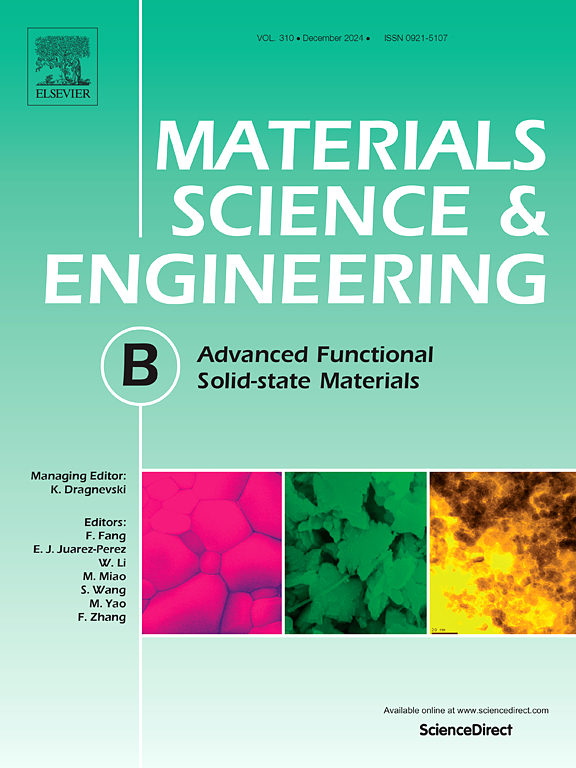
The journal provides an international medium for the publication of theoretical and experimental studies and reviews related to the electronic, electrochemical, ionic, magnetic, optical, and biosensing properties of solid state materials in bulk, thin film and particulate forms. Papers dealing with synthesis, processing, characterization, structure, physical properties and computational aspects of nano-crystalline, crystalline, amorphous and glassy forms of ceramics, semiconductors, layered insertion compounds, low-dimensional compounds and systems, fast-ion conductors, polymers and dielectrics are viewed as suitable for publication. Articles focused on nano-structured aspects of these advanced solid-state materials will also be considered suitable.





 京公网安备 11010802042870号
京ICP备2023020795号-1
京公网安备 11010802042870号
京ICP备2023020795号-1

 分享
分享
 求助内容:
求助内容: 应助结果提醒方式:
 扫码关注我们
